Celebrating the Life and Legacy of Jacques Kaplan in Kent
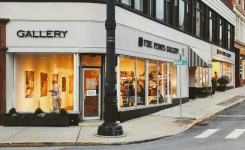
Jacques Kaplan, the pioneering art dealer in Kent, CT, was a larger than life figure. A one-time Fifth Avenue furrier, who collaborated on coats with artists such as Frank Stella in the go-go sixties, he ran his Paris-New York-Kent Gallery in a caboose by Kent’s old railroad station from 1984 to 2006. “When he died this summer, everyone asked us what kind of memorial there was going to be because he had such an impact on the town of Kent and on so many artists,“ says his longtime friend Darby Cardonsky, who owns the twenty-year-old Bachelier Cardonsky Gallery, in Kent, with Kaplan’s widow, Violaine Bachelier. “We decided we would celebrate his life in a joyful, creative way, which is how he lived his life.“
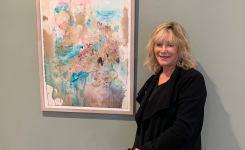
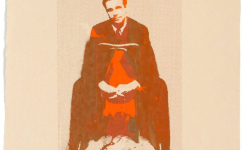
This Saturday, Bachelier Cardonsky will have an opening for A Memorial for Jacques with 100 Artists. “It’s actually 105,“ says Cardonsky. “We wanted to bring together as many artists as possible. Almost every artist in the show knew Jacques and either showed at his gallery or ours.“ One of the most sentimental pieces in the show is Dreams of Feat, 2008 [above] a multimedia piece by Cardonsky’s son, Nathaniel. “Jacques knew Nathaniel since the day he was born,“ says Cardonsky. “The photo of me and Jacques was taken years ago and the photo of Jacques and Violaine was taken the day he closed his gallery.“
A Memorial for Jacques with 100 Artists
Bachelier Cardonsky Gallery
North Main Street, Kent, CT; 860.927.3129
Public Opening: Saturday, November 22; 3 - 6 PM
The exhibition runs through December 21
Enjoy this post? Share it with others.
Posted by Dan Shaw on 11/19/08 at 01:43 PM • Permalink
A Major Sol LeWitt Retrospective at Mass MoCA
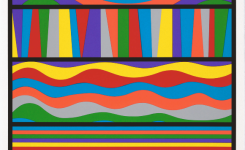
Sol LeWitt, one of the most influential artists of the last half century, so opposed the notion of artist-as-celebrity, it’s hard to imagine, had he lived, how he would have grappled with the opening this weekend at MASS MoCA. Never mind that the exhibition is a landmark retrospective of forty years of his “wall drawings,“ that it will be the sole occupant of a 3-story former mill on the Mass MoCA campus that was renovated expressly for this purpose, or that the museum has committed to keeping the exhibition up for a minimum of 25 years. Never mind that, before his death in 2007, LeWitt oversaw and approved every detail of this massive installation. Never mind. If operating true to form, LeWitt would have laid low this weekend, and discouraged media interest by refusing all photo ops and interviews.
Sol LeWitt, a leading exponent of conceptual and minimalist art, stressed the idea behind his work over its execution. To drive the point home, he or, as often, his assistants would draw and paint directly on the wall of the exhibition venue, thus rendering that particular expression of the piece temporary. Once a show was over, the work would be painted over with a roller. If a museum or private collector wished to acquire it, another would be made on site.
Jock Reynolds, of the Yale University Art Gallery, who conceived the MASS MoCA installation with LeWitt, explains, “Until now, large displays of Sol’s wall drawings have of necessity been on view for relatively brief periods of time in major museum survey exhibitions. To see multiple LeWitt wall drawings, one has had to travel far and wide and spend years pursuing them individually in situ. At MASS MoCA, visitors will be able to return again and again to see and enjoy one hundred of his wall drawings in one location.”
MASS MoCA’s decision to hold this Saturday’s members-only opening in the afternoon from 2 to 5, when daylight is still streaming into the galleries and the work looks its most radiant, rather than at the early-evening hour customary for openings, seems particularly LeWitt-like. What “celebrity” worthy of the name would deign to appear at such an hour?
MASS MoCA
87 Marshall Street, North Adams; 413.662.2111
Members’ reception: Saturday, November 15, 2 - 5
Public opening: Sunday, November 16, ceremony at noon.
Daily (closed Tuesdays), 11 - 5
Admission: $15 non-members, except Sundays/free; members/free (including November 15 reception).
Memberships: $50 and up
Enjoy this post? Share it with others.
Posted by Marilyn Bethany on 11/10/08 at 01:50 PM • Permalink
“Over the Top: American Posters from World War I” Opens at the Norman Rockwell Museum
As anyone who has spent time at the Norman Rockwell Museum knows, the quintessential American illustrator was a politically-minded man with a highly developed social conscience. Rockwell’s spirit lives on not only in the museum’s extraordinary permanent collection of his paintings, but also in the temporary exhibitions it mounts. On Saturday, November 8, the museum opens Over the Top: American Posters From World War I. These posters were the primary propaganda tool used to persuade citizens to purchase the war bonds which financed two-thirds of the cost of the war. What’s more, in light of the recent $700 billion bailout legislation, they seem to suggest that Karl Marx was right when he said: “History repeats itself, first as tragedy, second as farce. “
“With our new exhibition, Over the Top, the Norman Rockwell Museum is honoring our military personnel and their families who are on active duty on two war fronts,“ says museum director and CEO Laurie Norton Moffatt. “This stirring exhibition of rare World War I posters from a private collection is a striking visual reminder of the sacrifice of millions of Americans since our nation’s founding to serve and defend our freedoms. During the two World Wars, artists were employed to create morale boosting illustrations for recruitment to military service and to raise money to support the war effort. These powerful artworks speak to heroic service and common cause as we give thanks to all our veterans and active duty military personnel this upcoming Veterans Day.“

Over the Top: American Posters From World War I
November 8, 2008 - January 25, 2009
Norman Rockwell Museum
Stockbridge; 413.298.4100
Monday - Friday 10 AM - 4 PM; holidays and weekend 10 AM - 5 PM
Free Opening Reception for Members on November 8 from 6 to 8 PM; non-members $15
Veteran’s Day Gallery Talk by Rob Doane
“Norman Rockwell and the American Homefront, 1917 -1919,“ which will explore Rockwell’s stateside service in the Navy.
Tuesday, November 11 at 1:30 PM
Right: “Provide the Sinews of War,” Joseph Pennell, c. 1918
(2) CommentsEnjoy this post? Share it with others.
Posted by Dan Shaw on 11/03/08 at 08:18 PM • Permalink
“Forces of Nature” at Kent’s Ober Gallery
“Night Floaters,“ 40 x 60 inches, Katherine Bradford, 2008
“Some of my best clients are my former students,“ says Rob Ober, the former tennis pro at the Sharon Country Club who became an art dealer two years ago when he opened the Ober Gallery in Kent. “One day during a lesson, the man I was teaching was describing a painting he’d just bought by a young Russian artist. I said, ‘Is it Pavel Pepperstein?‘ He couldn’t believe that I would know that. He didn’t know that I was a serious collector of Soviet Nonconformist art.“
Ober, whose day job is teaching history at the private Kent School, first saw Non-conformist art (which daringly challenged Communist dogma) as a teenager when his diplomat father was stationed in the former Soviet Union. “I remember the artists’ courage most of all,“ he says. “They were putting their life on the line to express themselves.“ At the time, Ober was more interested in tennis than art, and he headed off to the Nick Bollettieri’s Tennis Academy in Florida from age 15 to 17, befriending Andre Agassi and bunking with Jim Courier. After graduating from Rollins College, Ober went to graduate school at Wesleyan for Russian Studies, and fell in love with Russain artists like Kazimir Malevich and Wassily Kandinsky. “As Stalin rose to power, many of them went underground and became teachers and eventually I fell in love with the work of their students—the Unconformists.“
As a single teacher and tennis pro in northwestern Connecticut in the 1990s (he is now married with two young children), Ober started collecting Russian art of the 1960s and 1970s. “Some paintings I can look at and say, That was 350 tennis lessons,“ he says, laughing. When the Guggenheim held its Russia!show in 2005, the value of his collection soared, which gave him the confidence to open his own art gallery. “By then I had fallen in love with American artists, too, especially painters who are students of Philip Guston and de Kooning.“
The group show he’s opening on Saturday—Forces of Nature—is a good representation of Ober’s point of view. “All of this work has an edge to it,“ he says. “But it’s not conceptual art which is so prevalent now in New York. I love painting. I have a love of the brustroke. I like it really loose or really tight. I don’t like it in between.“ He knows that many locals have more conservative taste so his roster of artists includes some traditional landscape painters like Lakeville’s Allen Blagden. “I don’t mind ‘barn art’ as long as it’s good barn art,“ says Ober.
But it is expressionist paintings that make him euphoric such as Paul Weingarten‘s brilliant canvas of lower Manhattan painted the year before 9/11 with its suggestion of turmoil brewing beneath the glorious surface, and the dreamy paintings of boats at sea by Katherine Bradford, which seem like metaphors for our time. He is also showing small, intricately painted works by David Ivie and elegiacal canvases by Alexey Krasnovsky, a Russian who lives in Ireland.
Ober doesn’t have enough wall space to show all the paintings he has on hand by these four artists, but he is known for pulling out his inventory to show anyone who is curious about an artist’s work. He said his clientele is a mix of weekenders and full-time residents: “For city people who come here on weekends and can’t do the New York galleries and for sophisticated locals who don’t want to go into New York to look at art, we’re the best of both worlds.“
Forces of Nature at Ober Gallery
14 Old Barn Road, Kent; 860.927.5030
Opening Reception: November 1, 3 - 6 PM
Hours:Thursday 1 - 4 PM; Friday - Sunday 12 - 5 PM
“Morning, New York,“ 56 x 76 inches, Paul Weingarten, 2000
Enjoy this post? Share it with others.
Posted by Dan Shaw on 10/30/08 at 03:44 PM • Permalink
The White Gallery Reopens in Lakeville
David Dunlop’s “Arrivals and Departures, Fast Track, Grand Central Station,“ 28 x 28 inches
Susan and Tino Galluzzo believe in second careers, second marriages and second acts. She’s a former lawyer and he’s a former investment banker, who became art dealers six years ago when they opened The White Gallery in Lakeville. Two years later, they became husband and wife (after previous marriages). Last spring, the unthinkable happened: their gallery was destroyed by fire (though the Lakeville Hose Company responded so quickly that only three pieces of art were completely ruined.) Instead of bemoaning their fate, the couple decided that rebuilding would give them a second chance to make the gallery, which is located in an antique New England house, more conducive to the contemporary art they like to show.
“We always knew there were flaws with the space and we’ve been able to address many of them in the renovation,“ says Tino (left), pointing to the new vaulted ceiling in the front parlor that will allow them to show tall pieces of sculpture indoors. (They always have a few pieces of traffic-stopping sculpture on their front lawn.) “We’ve learned a lot in six years and we’ve been able to improve our lighting and maximize our wall space to show more large-scale work, which we really love.“
For “The Art of the Figure,“ their first exhibition in their new old home, the Galluzzos are featuring both established and emerging artists. Gallery favorite David Dunlop, the star of the PBS series Landscapes Through Time with David Dunlop, will be showing a series of new paintings that capture the cosmopolitan freneticism of Grand Central Terminal in a fresh and affectionate manner. The Galuzzos are especially excited about Nikhil Bhandari, the first contemporary photographer they’ve ever shown. An artist from Mumbai, India, who works in both color and black-and-white, Bhandari layers images to create works that are mysteriously complex.
As Tino prepares to hang the first show, he points out how he’s added new down lighting in one alcove, enlarged a window in the front and covered another window to extend a wall.. There is one new feature, however, that has nothing to do with aesthetics. “Now,“ he says, “we have a state of the art fire system.“
The White Gallery
342 Main Street, Lakeville; 860.435.1029
“The Art of the Figure” Opening Artists Reception
October 25; 4 - 7 PM
(2) Comments
Enjoy this post? Share it with others.
Posted by Dan Shaw on 10/23/08 at 08:27 AM • Permalink
A Vassar Visionary: Jeanne Greenberg Rohatyn Brings Her Collection to her Alma Mater
Onyx bust by Barry X Ball, 2007-2008
Since 2002, Jeanne Greenberg Rohatyn (Vassar class of ‘89) has been exhibiting contemporary art at Salon 94, which is located downstairs from her home on New York’s Upper East Side. Now she is bringing pieces from her cutting-edge private collection to the Frances Lehman Loeb Art Center at Vassar College for an exhibit, Excerpt: Seclection from the Jeanne Greenberg Rohatyn Collection. An independent curator and art consultant, Rohatyn is lending the museum mostly 21st century works—by artists such as Marilyn Minter, Richard Prince and Laurie Simmons— that show “evidence of a diverse set of social, political, ethnic, and intergenerational interests,“ according to Mary-Kay Lombino, the curator who organized the exhibition and interviewed Rohatyn for the catalog.
Growing up in St. Louis, Rohatyn learned about art from her father who had a gallery that showed work by artists such as Roy Lichtenstein, Richard Serra and Donald Judd. She told Lombino about a party that her parents gave for Warhol at their home where the powder room’s walls were covered in Warhol’s purple Mao wallpaper. “During the opening evening’s celebrations, a shy wigged Warhol hung out in this bathroom, signing Campbell’s Soup cans nicked from our pantry by my parents’ friends,“ she recalled. “I stood below him—and when he had a break he would doodle bananas on a napkin for me. It was much later when I was at Vassar that I saw the Velvet Underground album cover that features Warhol’s banana drawings.“
The study of art has always been central to the Vassar curriculum; it was the first U.S. college founded with a permanent art collection and gallery when it opened in 1864. “The museum was always a great walk-through,“ Rohatyn told Lombino. “There, I discovered Florine Stettheimer’s 1927 Natatorium Undine. The painting became the inspiration for an exhibition I mounted years later in 1995 in the green room of the Gramercy Hotel at the Gramercy Contemporary Art Fair, entitled The Florine Stettheimer Collapsed Time Salon. . . . We recreated her salon in spirit—combining works by Warhol, Jeff Koons and a then emerging Elizabeth Peyton—and borrowed from Columbia University some of Stettheimer’s greatest paintings, including her self-portrait as the nude Olympia. Imitating her aesthetic, we covered the walls with cellophane, and Virgil Thomas was played on the piano.“
Rohatyn is known for keen instincts and supporting new talent. “As a patron of young artists, I often buy early on, yet I am priced out of their market soon thereafter,“ she says. “I have made a commitment to a handful of artists, whom I will continue to support. I will keep working to afford their work. Katy Grannan makes a portrait of our children every year that we use as our signature holiday card. We also collect her work in depth.“
Excerpt includes eight portraits by Grannan of the Rohatyn children, which were used as the family’s holiday cards from 2000 - 2007. The earliest work is a nude portrait of Jeanne Greenberg Rohatyn while she is pregnant with Alexander, her oldest child,“ says Lombino. “Never before shown publicly, these one-of-a-kind photographs ordinarily occupy the walls of the Rohatyn household. While these images possess the extraordinary intimacy, spontaneity, and authenticity typical of Grannan’s style, they stand apart from much of her other work in their buoyant mood and atmosphere of warm domestic familiarity. Collectively, these nine photographs candidly trace the tender first years of a growing family and capture the rapidly changing nature of young children from one year to the next.“
Excerpt: Selections from the Jeanne Greenberg Rohatyn Collection
Opening Reception and Lecture
September 26, 2008
5 PM: Brian Shoils, art critic and editor of Artforum.com, will give a lecture entitled, “On Shifting Ground in New York.“
6 PM: Reception in the Atrium of The Frances Lehman Loeb Art Center
124 Raymond Ave, Poughkeepsie; 845.437.5632
Tuesday - Saturday 10 AM - 5 PM, Thursday ‘till 9 PM
Sunday 1 PM - 5 PM
Admission: Free

Wangechi Mutu, The Mare, 2007
Mixed media on mylar
85 x 60 in.
Collection of Jeanne Greenberg Rohatyn
© Wangechi Mutu
Enjoy this post? Share it with others.
Posted by Dan Shaw on 09/24/08 at 02:49 PM • Permalink
New Gallery: Light Findustry
A plate from Findysz’ series, “Dirty Dishes.“
It’s a store. It’s a gallery. No, it’s Findustry.
Normally a retail or gallery launch is accompanied by attention-grabbing, business-generating ballyhoo—an opening night party, at the very least. Not at Findustry. “Openings aren’t fun,“ say owner John Findysz, in what is not the first indication that his is not a “gallery” or even a “store,“ in the usual sense. That occurs to the first-time visitor earlier, when trying to find the place, which has neither a sign nor an address to call its own (it shares the building with the Victorian antiques shop next door, which has the number 701). What does grab the eye and draw one inside, however, are the window displays. But even these are self-deflecting. Last Saturday, for example, each showcase held one of a pair of chrome-and-white leather director’s chairs scrawled with Rufus Wainwright lyrics. That night the rock icon, Findysz’s boyfriend’s favorite, was giving a concert in Albany. Ten days earlier, the theme had been Stageworks’ production of Souvenir.
John Findysz (right), an artist who once was Visual Director of Windows and Merchandising at Jeffrey New York, the high-octane fashion boutique in Manhattan’s meat-packing district, visited Hudson for the first time last October to attend ArtWalk. Recognizing it as a highly livable center for all the things he cares about most—fashion, art, and theater— Findysz returned to NY to get his affairs in order, then two months later moved to Columbia County full time.
The idea for the store came later. “I hate working alone,“ he says. “Besides, there’s nothing secret about my process. If someone wants to copy what I do, that’s okay.“ So he opened Findustry, the studio/gallery/shop where he does his artwork, mostly iconic or found objects that he “subverts,“ often in a racy way, and sells. He also sells other stuff that grabs his eye, including pre-owned fashion accessories and the work of other artists. “Being in this store is like being in my head,“ he says. “I am not a technique-driven artist; I’m a provocateur; my work is about challenging art-and-design-world ideas.“
Findyz response to Hudson’s current, highly-controversial painted dog public art exhibit—a Keith-Herring-esque plastic dog, drowning out the furor with earphones.

The plate, collaged with clippings from a 1950 Vogue pattern book, was from Hermes. Only their signature butterfly remains from the original design.

Fashion resale or a provocateur’s commentary? Handbag tagged, Not Ferragamo, $25.

Coffee pots by iconic 50s designer Eva Zeisel twice—(left) as the designer intended, $80; (right) as Hiding Eva, the “subverted” version by Findysz, $140.
Findustry
703 Warren Street; 917.548.3149
Thursday - Sunday 12 - 5
Informal salon most Thursdays 6 - 8 (call first to confirm)
(1) Comments
Enjoy this post? Share it with others.
Posted by Marilyn Bethany on 08/21/08 at 07:41 AM • Permalink
“Look @ Us!“ A Breath of Fresh Air at the Berkshire Museum
Director Stuart Chase with a Warhol of Ted Kennedy
Until now, you had to be a mad dog or masochist to visit the Berkshire Museum in July or August. “It was ghastly here,“ admits executive director Stuart Chase. But now that the 105- year-old museum on South Street in Pittsfield has finally gotten central air conditioning, it may be one of the most refreshing places to spend a hot and humid summer afternoon.
The new AC (or, more accurately, state-of-the-art climate control) is not just about comfort; it’s about aesthetics. Many fragile pieces from the museum’s permanent collection—a magnificent watercolor by Edouard Vuillard, a study of a portrait of Thomas Carlyle by James A.M. Whistler (below), photographs by Alfred Stieglitz—have never been exhibited before. What’s more, the museum is showing works borrowed from another museum for the first time in its history. “For decades, we’ve been lending things to other museums but we’ve never gotten anything back because we lacked air conditioning,“ explains Chase.
Now, for its Look @ Us! exhibit of portraiture, the museum has borrowed works from the Whitney Museum of American Art in New York, including an early Alex Katz painting of his wife, Ada, a stunning 1995 Chuck Close silkscreen portrait, and an Andy Warhol photo strip of Edie Sedgwick, the tragic “superstar” with Stockbridge roots. The Whitney trade came about because the Berkshire Museum has a unique collection of nine wooden push-and-pull toys designed by Alexander Calder in 1927; the Whitney is borrowing them for Alexander Calder: The Paris Years, 1926 - 1933, which opens in New York on October 16.
With the addition of these borrowed works from the Whitney, including a Warhol of Ted Kennedy, and many busts from the museum’s archives, Look @ Us! has broad appeal. “We think of ourselves as a family museum,“ says Chase, who has designed the show to engage all ages and to have interactive components. The museum has even created Facebook pages for some of the portraits in the show and there are computer stations where you can visit them.

At the end of the exhibit, there’s an old fashioned photo booth that has been retrofitted to produce a color postcard with four images. It costs $3, and you can take the postcard home but many people are leaving them behind so that they become part of the Look @ Us! exhibit. When I visited the other day, three schoolteachers were in the booth and they were cackling hysterically. “That’s one of the things that makes the Berkshire Museum different ,“ says Chase, smiling broadly. “We like to hear laughter in our galleries. We are not a stuffy museum.“

Stuart Chase and colleagues have fun in the photo booth; you can too.
Enjoy this post? Share it with others.
Posted by Dan Shaw on 07/02/08 at 08:29 PM • Permalink
Artists’ Studio Tour to Benefit Sharon Historical Society
Blue House Without Ghost , 2004, Don Gummer
Eight accomplished artists who live in the area, including Ellen Griesedieck, Eric Forstmann, Richard Rothschild, Peter Steiner, Don Gummer, James Mayer, Ira Barkoff and Duncan Hannah, will open their studios this weekend to benefit the Sharon Historical Society. The artists will be on hand throughout the weekend to discuss their work and answer questions. To kick off the event, there will be a festive gallery opening on Friday evening in the Sculpture Garden on the grounds of the Sharon Historical Society. The exhibition, The Artist and the Object, curated by Lynn Kearcher and Stephanie Plunkett, examines the relationship between the artistic mind and the everyday object. It features new works by Peter Woytuk, Warren Prindle, Carl Chaiet, Patty Mullins, Karen Kellogg, Peter Hill, Terre Lefferts, Victor Pesce and Joan Jardine.
Thanks to the generousity of the artists in this exhibition, 20% of the purchase price of all art sold during the Studio Tour weekend, and for 30 days following the tour, will be donated to the museum.
Sharon Historical Society
The Gay-Hoyt House
18 Main Street, Sharon; 860.364.5688
Party: Friday, June 27, 6 - 8
Tickets: $35
Tour: Saturday & Sunday, June 28 & 29, 12 - 5
Tickets: $40
(0) Comments
Enjoy this post? Share it with others.
Posted by Marilyn Bethany on 06/27/08 at 08:38 AM • Permalink
Film and talk: The Rape of Europa
Spring 1945: at Schloss Neuschwanstein in southern Bavaria, Allied troops safeguard art stolen from French Jews during the war.
For twelve long years, the Nazis looted and destroyed art on a scale unprecedented in history. And once they were defeated heroic young art historians and curators from America and across Europe fought back, mounting a miraculous campaign that would rescue and return millions of art works that had been displaced by the war. Joan Allen narrates The Rape of Europa, the 2007 documentary that chronicles a battle over the very survival of centuries of western culture. It is being shown at the Little Theater at the Berkshire Museum on Sunday afternoon.
More than sixty years later, the legacy of this outrage continues to play out as the heirs of looted collectors attempt to recover major works of art, conservators work to repair battle damage, and nations fight over the fate of the ill-gotten spoils of war. The documentary takes the audience on an epic journey through seven countries and into the whirlwind of fanaticism, greed, and violence that threatened to wipe out the artistic heritage of Europe. To illustrate the currency of the issues it covers, the film begins and ends with the recent story of artist Gustav Klimt’s famed Gold Portrait, stolen from Viennese Jews in 1938, and now the most expensive painting ever sold.
Following the film, Sarah Lees, associate curator of European paintings at the Sterling and Francine Clark Art Institute in Williamstown, will lead a discussion about this extraordinary episode in history and the questions it still raisies, such as, can a culture survive if it’s art disappears? And is it moral to risk the lives of soldiers to save mere things, even if those things are Titians and Rembrandts?
The Little Cinema at the Berkshire Museum
39 South Street (Route 7), Pittsfield; 413.443.7171
Sunday 1:30
Admission: $10; $5/members
Enjoy this post? Share it with others.
Posted by Marilyn Bethany on 06/19/08 at 11:32 AM • Permalink