Frederic Church at 200: Historic Artist who Built Olana Goes Global
A yearlong bicentennial celebration centered at Olana reframes Frederic Church as a globally minded artist whose work still shapes how we see landscape.

A yearlong bicentennial celebration centered at Olana reframes Frederic Church as a globally minded artist whose work still shapes how we see landscape.
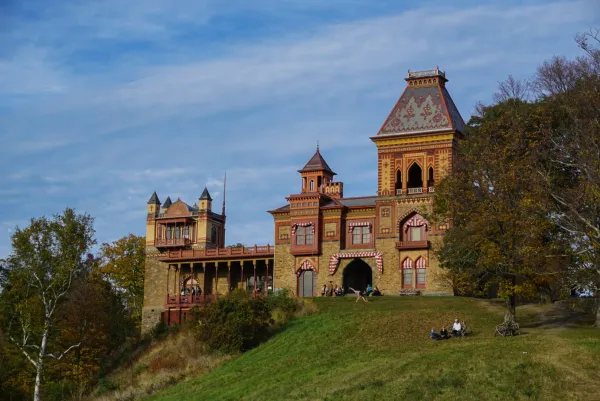
Frederic Edwin Church turns 200 this year—and the milestone is being marked not with a single exhibition or anniversary weekend, but with a yearlong, national initiative anchored at Olana and radiating outward to museums and cultural institutions across the United States and beyond.
Led by The Olana Partnership, “Frederic Church 200” will unfold across 2026 through exhibitions, publications, and public programs that reconsider Church not only as the most famous American landscape painter of the 19th century, but as a globally minded artist whose work was shaped by science, travel, politics, and environmental thinking. The bicentennial formally kicks off this spring, with events at both the Metropolitan Museum of Art and Olana State Historic Site, before continuing throughout the year.

“’Frederic Church 200′ allows us to honor not only his breathtaking artistic achievements, but also the expansive vision and civic spirit that continue to inspire audiences across the nation and around the world,” says Sean Sawyer, Washburn & Susan Oberwager President of The Olana Partnership.
The celebration begins April 22 with the 26th Annual Frederic Church Awards at the Met, followed by a public birthday celebration at Olana on May 2. On May 17, Olana will open “Frederic Church: Global Artist,” a major new exhibition that serves as the flagship presentation of the bicentennial year and runs through October 25.

Church’s paintings—vast, immersive, and meticulously detailed—were spectacles in their own time, drawing crowds and critical attention on both sides of the Atlantic. But the bicentennial’s framing emphasizes something broader than scale or technical mastery: Church as an artist who experienced the world firsthand and absorbed its complexity into his work. Over the course of his career, he traveled widely, sketching volcanoes in South America, icebergs in the North Atlantic, tropical landscapes in the Caribbean and Mexico, and ancient sites in the Middle East. Those journeys informed a body of work that was simultaneously American, scientific, and cosmopolitan.
That global reach is central to “Frederic Church: Global Artist,” curated by Tim Barringer, Elizabeth Kornhauser, and Jennifer Raab. The exhibition brings together monumental oil paintings, drawings, oil sketches, and photographs that trace how Church’s encounters with diverse environments shaped his visual language and ambitions. Works will be drawn from Olana’s own collection as well as major public and private lenders, including the Cooper Hewitt, The New York Historical, and The Terra Foundation for American Art.

“’Frederic Church: Global Artist’ reveals the extent of Frederic Church’s artistic ambition as a global traveler in the age of empires,” says Barringer, Paul Mellon Professor of the History of Art at Yale University. “It explores his fascination with the natural world, with the hemispheric cultures and histories of the Americas, the Caribbean and the Middle East, and presents Olana as the outcome of his world-wide entanglements.”
Olana itself plays a crucial role in this reassessment. Designed by Church as a total environment—integrating architecture, landscape, art, and viewshed—it remains the most intact artist-designed environment in the United States. Beyond its aesthetic impact, Olana reflects Church’s broader civic commitments. He was a founding trustee of the Metropolitan Museum of Art, a commissioner for Central Park, and an early advocate for preserving Niagara Falls, situating him at the center of 19th-century debates about public space, conservation, and national identity.
The timing of the bicentennial also invites contemporary reflection. As the United States approaches its own 250th anniversary, Church’s career offers a lens onto how art, science, empire, and environmental awareness intersected during a formative period of American history. Sawyer notes that Church “stands out as a powerful model of American creativity, environmental awareness, and global connection.”

Beyond exhibitions, “Frederic Church 200” will include a significant publishing program. Four books are slated for release across 2026, including Frederic Church: Global Artist (Yale University Press), edited by Barringer, Kornhauser, and Raab, and Olana: Frederic Church’s Vision of Architecture and Landscape (Rizzoli), by Barry Bergdoll, Sawyer, and Thomas L. Woltz. Together, they promise new scholarship on Church’s art, travels, and architectural thinking, including the first holistic biography of his life by Victoria Johnson.
More than 70 museums and public institutions that hold works by Church are expected to participate in the bicentennial year through exhibitions and programs, reinforcing the national scope of an artist whose reputation was international even in his own lifetime. For the Hudson Valley, however, the center of gravity remains Olana, where Church’s panoramic vision continues to frame the landscape he helped define.