
Breaking Down the Taylor Swift Net Worth: Core Assets of a $2.1 Billion Empire
When evaluating celebrity wealth, financial analysts often separate liquid earnings from hard assets. According to her profile on Forbes, Swift represents a historic shift in modern entertainment economics. Unlike many entertainment moguls whose fortunes stem primarily from outside consumer goods—such as cosmetics lines or clothing labels—Swift’s balance sheet is built almost entirely upon intellectual property, performance revenue, and direct asset ownership.
Her estimated $2.1 billion empire is broadly anchored by four core asset pillars:
- Music Catalog and Publishing Rights (~$900 million): The combined valuation of her songwriting copyrights, publishing shares, original master recordings, and "Taylor's Version" re-recordings.
- Live Touring and Performance Retained Earnings (~$800 million): Retained, after-tax profits accrued from the record-shattering Eras Tour, prior arena and stadium runs, global merchandise operations, and direct-to-consumer theatrical film distributions.
- Real Estate Portfolio (~$110 million to $154 million): Prime historic estates, luxury penthouses, and residential compounds spanning New York City, Rhode Island, California, and Tennessee.
- Cash Reserves, Liquid Investments, and Endorsements (~$250 million+): Conservative cash management, select blue-chip brand relationships, streaming license proceeds, and private aviation assets.
Music Catalog Valuation and the Master Recordings Re-Acquisition
The bedrock of Swift's long-term financial security is her music catalog. Valued at roughly $900 million, it generates consistent annual royalties through digital streaming, physical record sales, sync licensing in film and television, and performance rights.
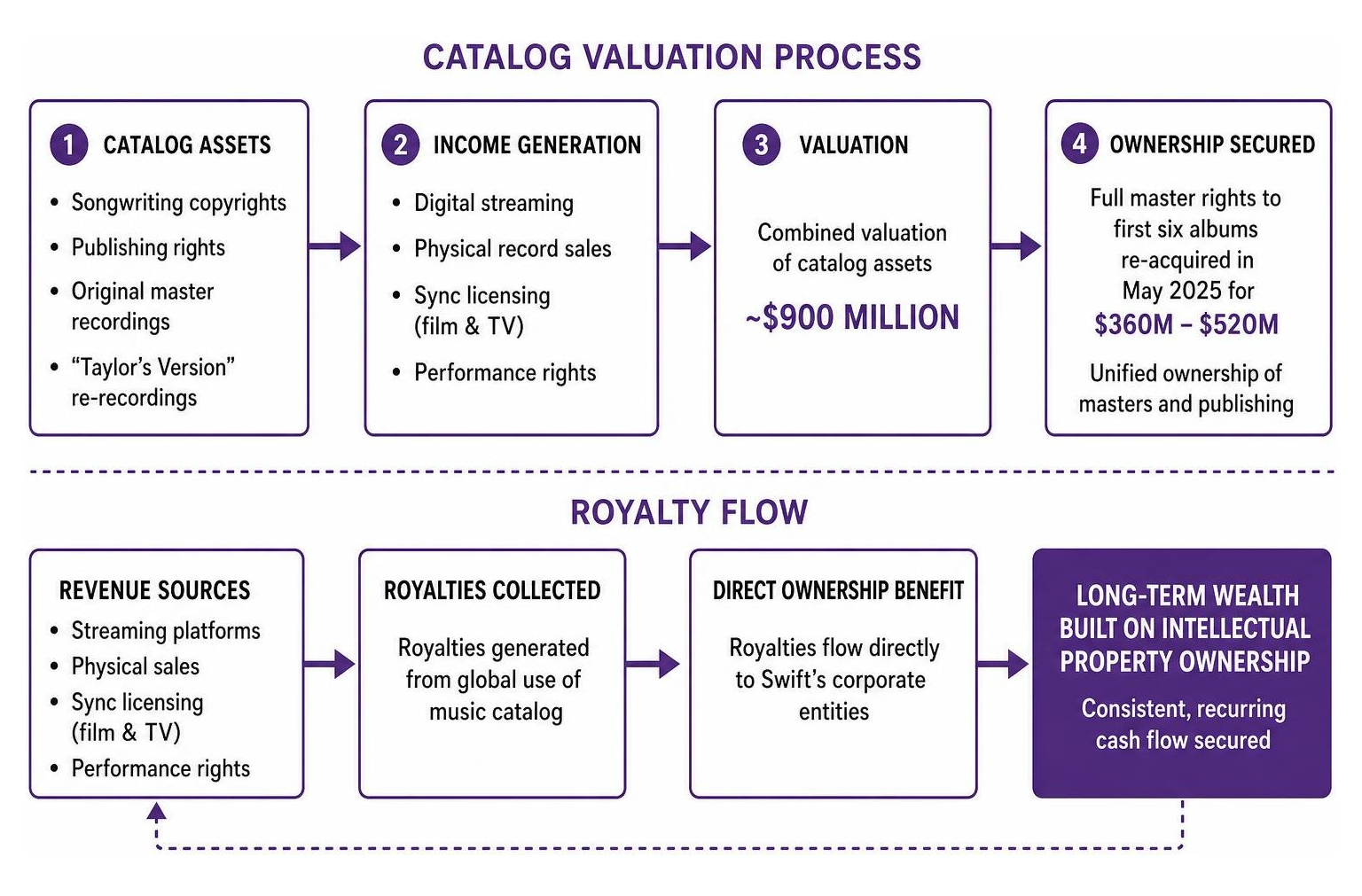
The path to catalog ownership was a defining chapter in music business history. After her initial six-album catalog was sold to private equity firm Shamrock Capital via Ithaca Holdings, Swift executed an aggressive counter-strategy: re-recording her first six studio albums under the "Taylor's Version" banner. By pairing these re-recordings with previously unreleased "From the Vault" tracks, she created direct alternatives for streaming and commercial sync licensing.
This maneuver systematically shifted commercial leverage back to the artist. In May 2025, Swift officially re-acquired the full master rights to her original first six albums from Shamrock Capital for an estimated $360 million to $520 million. As a result, she now possesses unified ownership over her entire discography's masters and publishing rights, permanently securing discounted future cash flows directly into her corporate entities.
Historical Taylor Swift Net Worth Growth from 2006 to 2026
Swift’s trajectory illustrates the compounding power of retaining equity over a twenty-year career:
| Career Era & Milestone | Year | Estimated Net Worth | Primary Revenue Catalyst |
|---|---|---|---|
| Self-Titled Debut Release | 2006 | $1 Million | Early country radio royalties & opening-act touring |
| Fearless & First Headlining Tour | 2009 | $20 Million | Breakthrough global album sales & Fearless Tour grosses |
| 1989 Pop Transition & World Tour | 2015 | $200 Million | Pop crossover dominance; $250M 1989 World Tour gross |
| Reputation Stadium Tour | 2018 | $320 Million | First all-stadium tour grossing $345.7 million |
| Republic Records Deal & Folklore Era | 2020 | $365 Million | Master ownership secured for future albums; streaming surge |
| Eras Tour Launch & TV Re-recordings | 2023 | $1.1 Billion | First musician billionaire via songs & performance |
| The Tortured Poets Department Record | 2024 | $1.6 Billion | Historic streaming numbers & multi-format vinyl sales |
| Masters Buyback & Showgirl Era | 2026 | $2.1 Billion | Unified master ownership; $2B Eras Tour final totals |
The Economics of The Eras Tour and Live Performance Dominance
Live performance has served as the primary accelerator of Swift's transition from multi-millionaire to multi-billionaire. The Eras Tour reshaped global live music economics by grossing over $2 billion in ticket sales across 149 stadium dates on five continents.
Unlike standard touring agreements where booking agencies and external promoters absorb a significant portion of the margin, Swift functions as the primary owner-operator of her touring enterprise. While standard arena tours yield modest margins after production, travel, venue rent, and insurance costs, the stadium-scale economics of the Eras Tour delivered an estimated personal retained profit exceeding $460 million after taxes, local operations, and production expenses were settled.
Swift also made headlines for distributing over $197 million in operational bonuses to the production crew, dancers, sound engineers, caterers, and equipment transportation drivers, setting a new benchmark for industry compensation.
Box Office Power: The Eras Tour Concert Film and Direct Streaming Deals
When bringing Taylor Swift: The Eras Tour to the screen, Swift disrupted traditional Hollywood distribution channels. Rather than selling the project to a legacy movie studio that would take a standard distribution fee and backend percentage, her team negotiated a direct agreement with AMC Theatres.
This direct-to-exhibitor structure allowed Swift to bypass intermediaries and retain an estimated 50% cut of the theatrical box office gross. The film generated over $261 million worldwide, making it the highest-grossing concert film of all time.
She subsequently monetized the asset again in the secondary market, securing a licensing deal with Disney+ valued at more than $75 million. Complementary physical releases—such as an exclusive tour photo book distributed directly through select retail partnerships—sold hundreds of thousands of copies in single weekends, capturing direct-to-consumer profit margins rarely seen in traditional celebrity merchandising.
Album Rollouts and Commercial Records: From 'TTPD' to 'The Life of a Showgirl'
Swift’s physical album distribution strategy represents an essential pillar of her financial durability. In an era dominated by fractional streaming payouts, Swift has built a strong physical sales ecosystem. By late 2023, industry metrics showed that one out of every 15 vinyl records sold in the United States was a Taylor Swift album.
Her eleventh studio album, The Tortured Poets Department (2024), debuted with 2.6 million first-week equivalent units in the US alone, generating over 5.6 million pure sales globally within its release year. Her follow-up 2025 release, The Life of a Showgirl, shattered historical benchmarks by debuting with 4 million first-week units on the Billboard 200. Swift has accumulated over 116.7 million total album units in the US, including more than 54 million pure sales, reinforcing recurring publishing royalties alongside ongoing streaming performance.
Luxury Real Estate Portfolio from Watch Hill to Tribeca

Taylor Swift’s real estate holdings represent a carefully curated, appreciating asset portfolio valued between $110 million and $154 million according to comprehensive real estate data tracked by Celebrity Net Worth. Her acquisitions focus heavily on architectural provenance, private enclaves, and long-term land value.
Swift’s major residential holdings include:
- Watch Hill, Rhode Island ("High Watch"): Purchased for $17.75 million in cash in 2013, this 11,000-square-foot 1930s colonial estate sits atop the highest point in Little Narragansett Bay. Serving as the creative inspiration for her track "The Last Great American Dynasty," the estate is currently valued at roughly $18 million to $22 million.
- Tribeca, New York City (Franklin Street Compound): A multi-property portfolio comprising two adjacent penthouse units converted into a single sprawling duplex, a neighboring three-story townhouse, and additional residential loft space, totaling an estimated $45 million in Manhattan real estate.
- Beverly Hills, California (Samuel Goldwyn Estate): Acquired in 2015 for $25 million, Swift underwent an exhaustive historical restoration of the 1934 mansion, successfully petitioning for the property to receive official local historic landmark designation. Its present market value exceeds $30 million.
- Nashville, Tennessee (Music Row Penthouse & Belle Meade Estate): Her earliest property purchases include a luxury penthouse at the Adelicia in Midtown Nashville, complemented by the historic 1930s Greek Revival estate known as Northumberland in the prestigious Belle Meade community, collectively valued at roughly $22 million.
Regional Luxury Properties and Historic Architecture
For those of us observing architectural heritage throughout the Northeast, Swift’s preservation approach stands out. Rather than modernizing historic landmarks with generic contemporary finishes, her estates—from the colonial coastal grandeur of Watch Hill to the Goldwyn Estate in Los Angeles—demonstrate a commitment to structural restoration and historic preservation. These properties not only offer personal privacy, but their historical provenance and location ensure strong capital preservation over time.
How Travis Kelce's Assets Compare to the Taylor Swift Net Worth
Swift's personal fortune also intersects with prominent media attention regarding her marriage to Kansas City Chiefs tight end Travis Kelce. While Kelce is exceptionally wealthy within professional sports—boasting an estimated net worth between $100 million and $115 million fueled by $159 million in career NFL contract compensation, consumer endorsements, and a $143 million multi-year podcast agreement with Amazon Wondery—the financial profiles operate at vastly different orders of magnitude.
Financial advisors and legal commentators note that the couple operates under comprehensive prenuptial agreements overseen by Swift’s advisory team, led by her father and longtime business advisor Scott Swift. The legal structure isolates pre-marital intellectual property, catalog rights, publishing royalties, and existing real estate assets, ensuring complete business independence and separate property protection for both parties.
Brand Partnerships, Endorsement Strategy, and Creative Governance
Swift’s approach to brand endorsements is defined by disciplined selectivity. While standard commercial agreements in the entertainment industry frequently involve dozens of regional branding partnerships, Swift has limited her corporate endorsements to a small group of high-profile entities, including Capital One, Stella McCartney, and historical marketing alliances with Sony and Diet Coke.
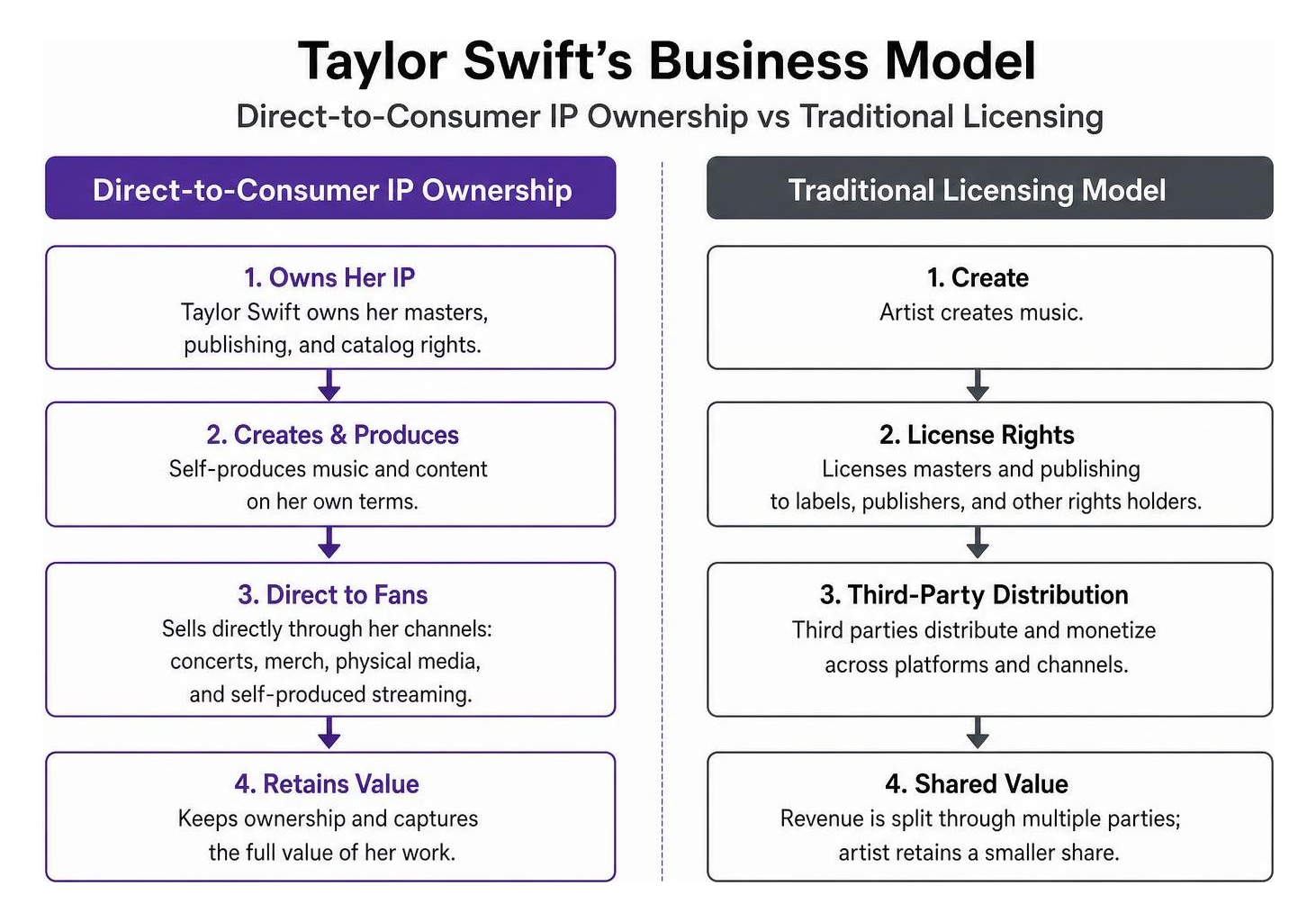
By turning down numerous speculative endorsement deals—such as declining major promotional campaigns for unregulated financial products during the early 2020s—Swift maintains brand equity. Her primary revenue engine remains her direct relationship with her audience: direct concert ticketing, physical media sales, tour merchandise, and self-produced streaming assets.
Frequently Asked Questions about Taylor Swift's Wealth
Is Taylor Swift currently the richest female musician in the world?
Yes. As of 2026, Taylor Swift is recognized as the richest female musician in the world, with an estimated fortune of $2.1 billion. While other prominent female artists have achieved billionaire status through beauty and fashion conglomerates, Swift is the first musician to attain this ranking primarily through songwriting, music catalog valuation, record sales, and live stadium performances.
How much did Taylor Swift pay to re-acquire her master recordings?
Swift purchased the master rights to her original first six albums from Shamrock Capital in May 2025 for an estimated sum ranging between $360 million and $520 million. This acquisition, funded largely by retained cash flows from the Eras Tour, reunited her entire recorded music catalog under her direct control.
What is Taylor Swift and Travis Kelce's combined net worth?
The combined marital net worth of Taylor Swift and Travis Kelce is estimated at approximately $2.2 billion to $2.25 billion. However, their financial estates remain legally distinct through binding prenuptial agreements that preserve independent asset ownership across music rights, real estate, podcast production contracts, and athletic compensation.
Conclusion
Taylor Swift’s ascent to a $2.1 billion net worth demonstrates the difference between temporary celebrity visibility and enduring commercial ownership. By treating her creative output as core intellectual property, taking measured financial risks to reclaim her master recordings, and bypassing traditional distribution gatekeepers, Swift has established a new operational standard for the music industry.
At Rural Intelligence, we continually examine the intersection of regional culture, architectural history, and artistic integrity across our communities. To explore more about the creative and cultural landscape shaping our region, take a look at our coverage of visual art and local creators. Swift's career reinforces an enduring creative lesson: ultimate artistic freedom is built upon the discipline of owning your work.