Chekhov’s Short Stories Take to Local Stages in “Chekhovek” This Month
Director Melania Levitsky adapts nine short stories by Anton Chekhov into a five-actor theatrical collage that highlights the Russian writer’s humor, compassion, and absurdity of everyday life.
“Chekhovek” is an inventive theatrical collage that transforms the short fiction of Anton Chekhov into a fast-moving ensemble performance. Directed and adapted by Melania Levitsky, the production draws from nine of Chekhov’s short stories, weaving them into a single evening of theater that highlights the writer’s sharp eye for human folly, tenderness, and absurdity. The play will be staged at various locations in the region March 11-28, details below.
Chekhov is best known for his four major plays—”The Cherry Orchard,” “Uncle Vanya,” “The Seagull,” and “Three Sisters.” But Levitsky, who studied Russian literature and language, turned instead to the author’s vast body of short fiction. “I was reading some of the short stories and had this very strong impulse to make them into a staging,” she says. “Mostly they’re narrative descriptions of personalities and struggles, but I found them hilarious. Absolutely hilarious.”
Her adaptation centers on one of Chekhov’s best-known stories, “The Lady with the Dog,” which Levitsky structures into six chapters that anchor the production. Around it she has assembled scenes drawn from dozens of other stories—selecting those with the most dialogue and dramatic action. The result is an episodic but cohesive piece that moves between comedy, poignancy, and philosophical reflection.
The title itself hints at the project’s conceptual frame. “Chekhovek,” Levitsky explains, comes from a suggestion by a Russian colleague. In Russian, chelovek means “human being.” The hybrid title gestures toward “the human being in time, in the context of Chekhov’s mind,” as Levitsky puts it—a portrait of humanity as Chekhov observed it: self-deluding, tender, ridiculous, and often unintentionally funny.
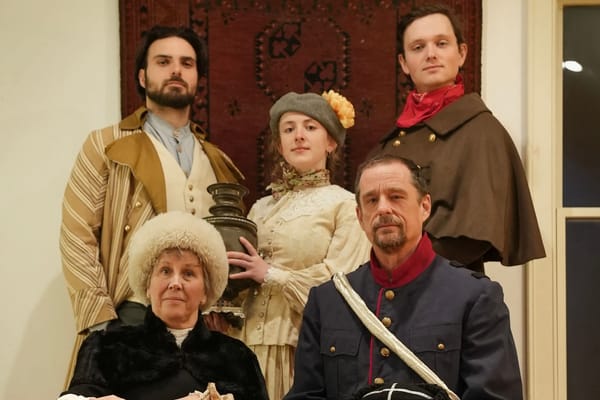
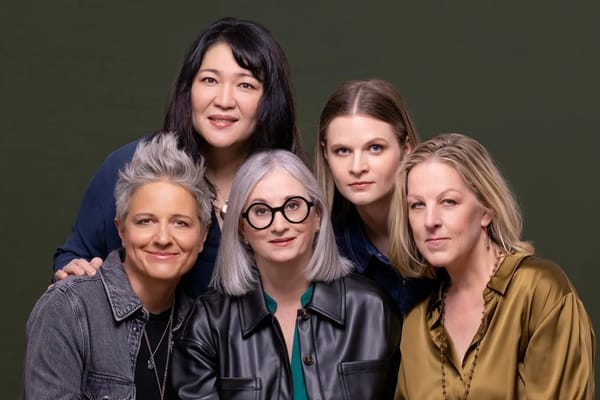
The cast of “Chekhovek” with director Melania Levitsky.
That humor is central to Levitsky’s interpretation. Chekhov productions are often staged with a heavy emphasis on melancholy, but Levitsky is drawn to the way his writing balances suffering with absurdity. “He captures the irony of being a human being,” she says. “Especially in the short stories, there’s this innocence to people’s egotism and their self-delusion. And he can make it so funny.”
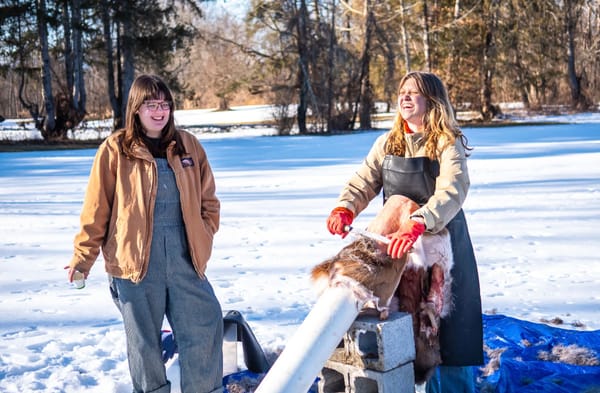
The staging leans into theatrical simplicity. Five actors—Berenika Lehrman, Jordan Zakka, Sean Allison, Tristan Geary, and Jessica Loy—portray dozens of characters, shifting roles with minimal costume changes—adding a kerchief, an apron, or a jacket in full view of the audience. Levitsky describes the approach as “exposed theater,” emphasizing transformation and imagination rather than illusion. “I love the challenge of pushing actors to change environments instantly,” she says. “Every story has its own atmosphere.”
The ensemble format also reflects practical realities. Levitsky’s company is touring the production through a handful of regional venues, which means the set must remain portable and adaptable. For the Hudson performances, rehearsals were conducted on a taped-out floor plan matching the dimensions of the Park Theater stage, ensuring the actors could adapt to the intimate space.
Music plays a vital role as well. Accordionist Laura Geilen underscores the transitions between stories, providing emotional continuity across the episodic structure. “The music is central,” Levitsky says. “It creates the environment and supports the transitions. It helps carry the whole piece along.”
Within that framework, Levitsky’s direction focuses on physical form and timing—small gestures, breath, and body position that allow Chekhov’s subtext to emerge without overstatement. The play includes moments of delicate restraint alongside sudden expansions of theatricality, such as an excerpt from Chekhov’s mystical story “The Black Monk,” in which a self-styled philosopher imagines himself destined to lead humanity toward enlightenment.
For audiences unfamiliar with Chekhov, Levitsky hopes the production offers a fresh point of entry into his work. More than anything, she says, she wants viewers to encounter the humor and humanity embedded in his stories. “The biggest impact is just how hilarious it all is,” she says. “There are poignant moments too, but what comes through is the absurdity of human beings—the innocent ways we fool ourselves.”
At a moment when public life can feel relentlessly cynical, Levitsky believes that recognition has its own emotional power. Chekhov, she suggests, understood that human contradictions—vanity, longing, self-importance, vulnerability—are not only tragic but deeply comic. “To see those innocent foibles,” she says, “is both moving and very funny.”
“Chekhovek” will be performed at Mettabee Farm in Hillsdale onn Wednesday, March 11 at 7:30pm; Camphill Village USA in Copake on Friday, March 13 at 7:30pm; Camphill Village in Ghent on Sunday, March 15 at 3pm; Buttonball Barn in Egremont on Wednesday, March 18 at 7:30pm; Park Theater in Hudson on Friday, March 20 at 7:30pm, Saturday, March 21 at 7:30pm, and Sunday, March 22 at 3pm; and Threefold Auditorium in Spring Valley on Saturday, March 28at 7:30pm.
Brian is the editorial director for the Chronogram Media family of publications. He lives in Kingston with his partner Lee Anne and the rapscallion mutt Clancy.