Free Professional Shakespeare in a Great Domed Cow Barn that Mimics the Globe
The Columbia County Players return to Churchtown Dairy this month for a two-weekend run of "The Comedy of Errors," staged in the local answer to Shakespeare's own theater.

The Columbia County Players return to Churchtown Dairy this month for a two-weekend run of "The Comedy of Errors," staged in the local answer to Shakespeare's own theater.
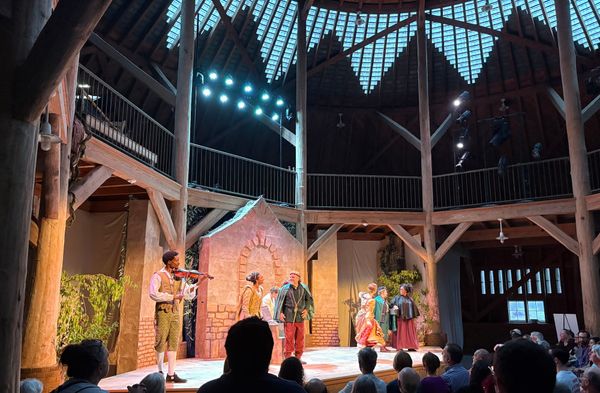
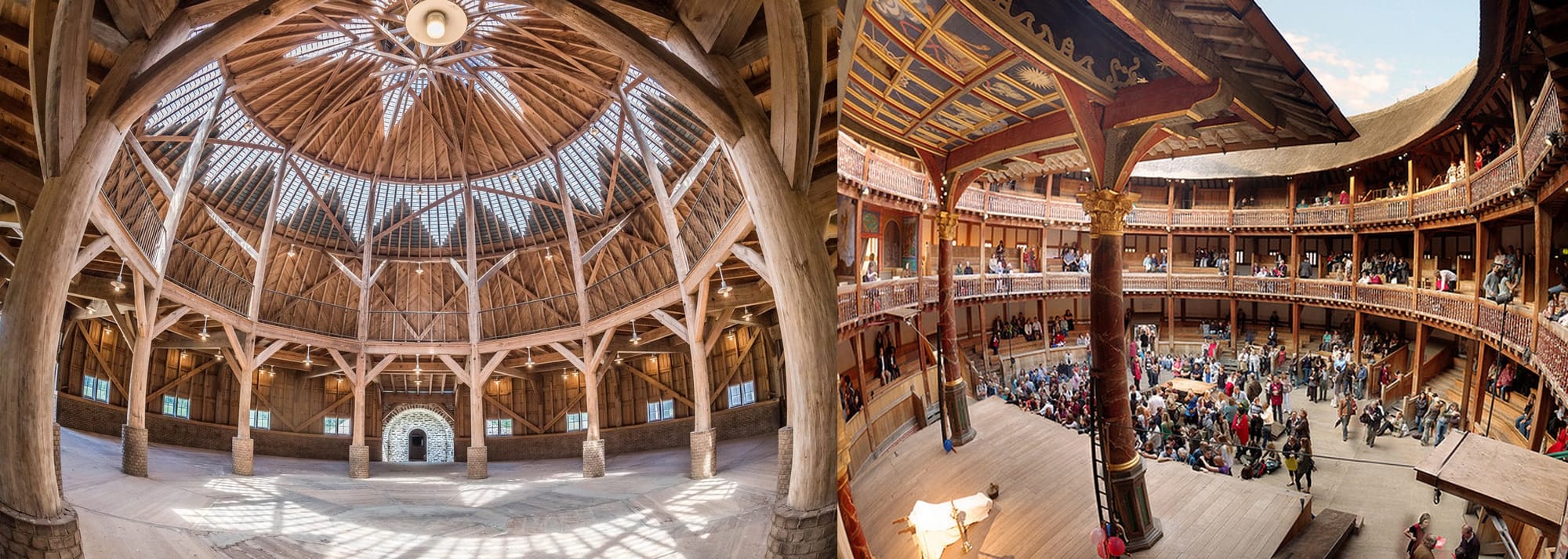
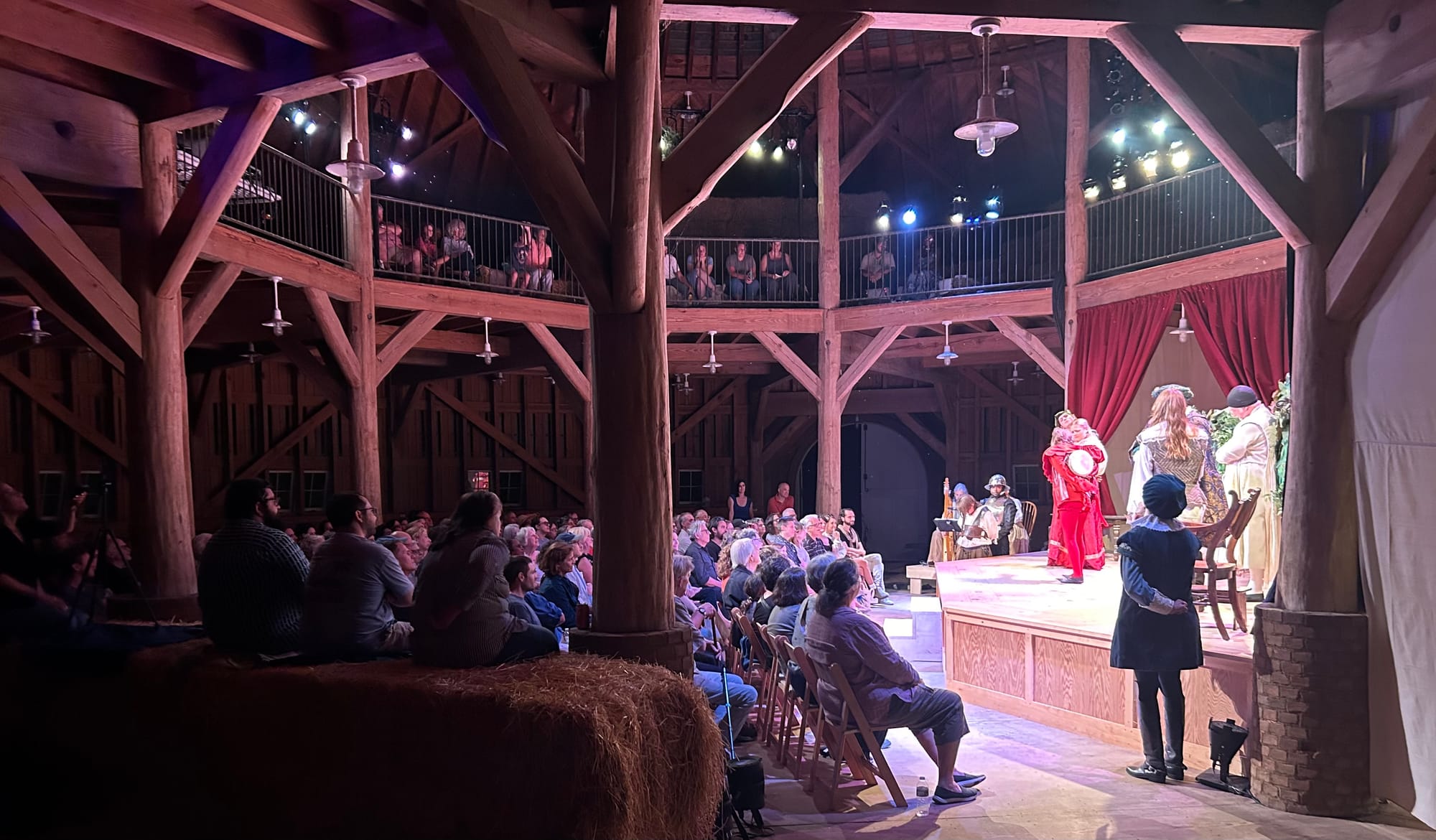
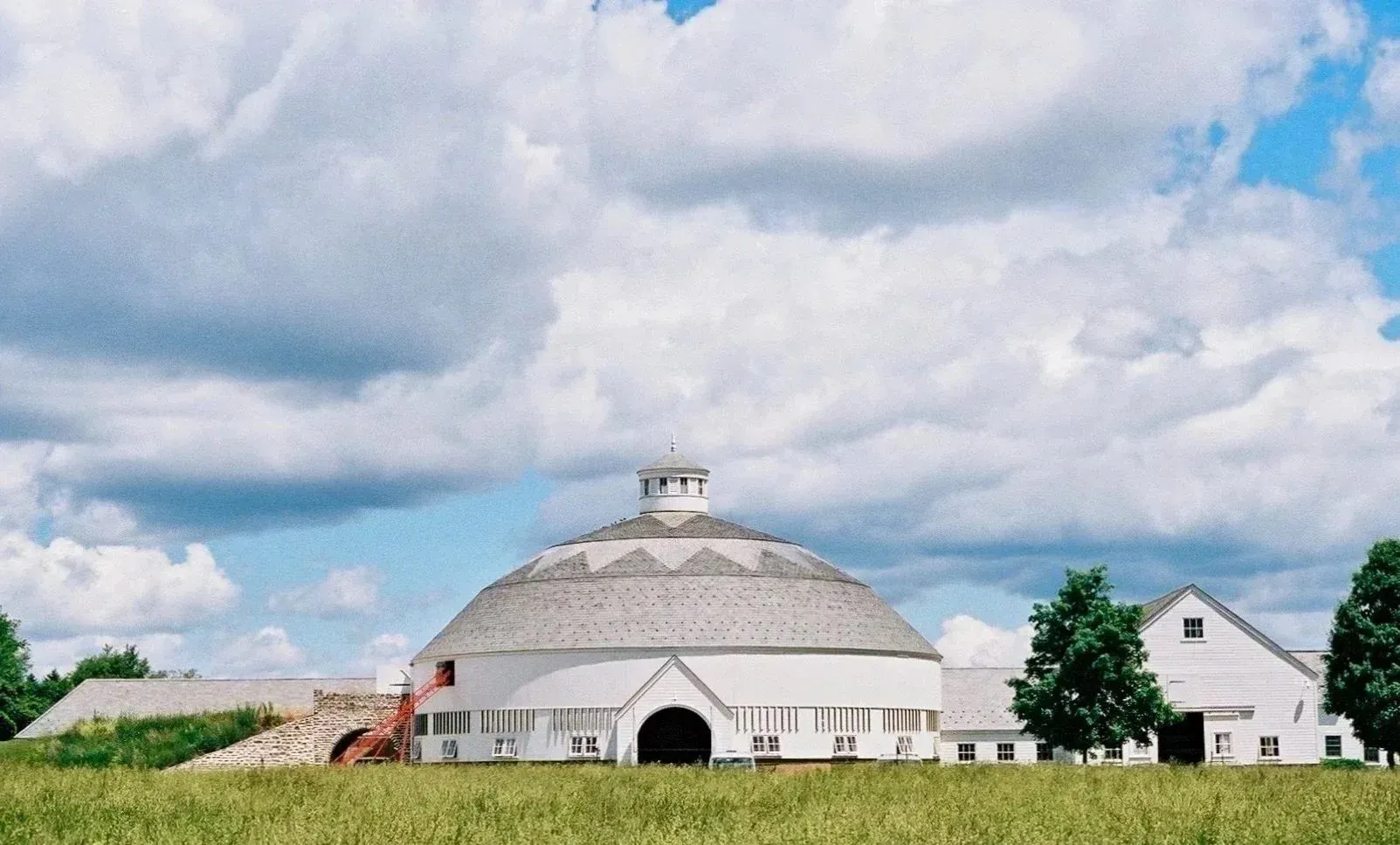
The round barn at Churchtown Dairy was not built to be a theater. It was built to be a beautiful domed, sky-lit dairy barn on environmentalist Abby Rockefeller's 250-acre farm in Claverack, in 2012 by architect Rick Anderson. But nine years ago, Carol Rusoff—an accomplished theater veteran, teacher, and director who would go on to found the Columbia County Players—wandered into the bovine cathedral, looked up at its light-filled dome, and thought of a very different circular building 3,000 miles away.
"I said it would look good with a stage in it, this is like the Globe [William Shakespeare’s 17th-century London theater] and that got Rick as an architect very excited," Rusoff remembers. "And then he approached Abby, and after a few years of coaxing, she said, 'Okay.' And then we said, 'Will you also please pay for our production?' And she said, 'Okay.' And we've been doing it ever since.”
Now the Columbia County Players are about to stage their fourth season. This year's production, "The Comedy of Errors," runs two weekends instead of the company's usual one—August 14, 15, and 16, then August 21, 22, and 23—and all of it is free to attend. Doors open at 7pm, with the show at 7:30pm, and reservations, while not required, are recommended at ColumbiaCountyPlayers.org.
In a kind of noble modern magic trick, the Players offer free theater while still paying their artists. It's a real commitment, but managing producer Frank Segro is quick to complicate the story of how they pull it off—the company isn't simply living off Rockefeller's seed funding. What actually sustains the company, he said, is closer to a hustle than patronage: "We have been able to scrimp, save, and scrap."
Actor pay has been able to increase each season as a result. "We try to make them not lose money when they come here, and we've been able to pay a little bit more every year," Segro says. "We had great retention of the cast,"
Creating a recurring professional cast has created lasting connections. "Shelli was an actor two years ago, as Maria in “Twelfth Night,” and she was so funny and terrific and insightful and smart and patient," Rusoff says of Shelli Koffman, now the company's creative producer and, this season, her co-director. "I'm getting old—I need someone to help.And so she does."
(In the room that sounded more like a compliment than it does written here. Rusoff is an archetypal old-school theater matriarch—dramatic, wise, beautiful, and elegantly steely—sitting in her director’s station before the stage, projecting orders that are quickly followed.)
The choice of "The Comedy of Errors," Shakespeare's early, farce-heavy tale of two sets of separated twins colliding in the port city of Ephesus, came together naturally. "I think we chose ‘The Comedy of Errors’ because we wanted to do something that would bring a real sense of cathartic laughter, like really just letting go," Koffman said. "'The Comedy of Errors’ is so ridiculous that it allows for that in a different way than some other of Shakespeare's works."
Underneath the farce, though, both directors point to the play's more serious undertow: a story about people separated from their families, washed up in a strange city, trying to find their way back to each other. Koffman calls it a search for identity. "How do we define who we are in the world? Is it something internal, or is it external?"
Rusoff ties it directly to the present moment, paraphrasing one of the play's most quoted lines—"I to the world am like a drop of water / That in the ocean seeks another drop"—as a message that "reminded us of the immigrant situation, about our people, different people coming in."
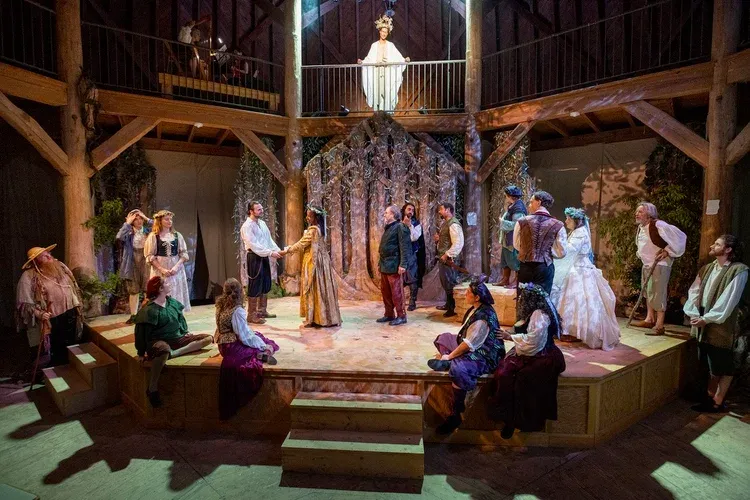
That theme is built into the design itself. Scenic designer Carmen Borgia of Catskill, working with intern Wyatt Dawson of Hudson, is transforming the barn into a version of Ephesus set in present-day Turkiye—a port city rendered as bustling and colorful rather than ancient and remote.
What the Barn Does to People
Both directors return, unprompted, to the barn itself as a kind of collaborator. Rusoff describes the ritual of walking new performers through the space for the first time: "The actors first come in and we give them a tour. They take a breath and say ‘Wow.’”
That mix of first-timers and vets is, for Rusoff, the actual point of the enterprise. "The best part for me is having some people who have had no experience mix it up with people who are very experienced, and the same in the audience," she says. "I want to have people here who never go to theater because it's expensive and difficult and privileged and elite,” she says. “that you can just be shoulder to shoulder and be laughing at the same thing together in this barn, it's just a very precious idea to me."
Recalling a performance of “Twelfth Night,” Koffman described, her eyes welling with tears, spotting a child in the crowd, visibly transported: "I remember looking out into the audience and seeing a child being so engaged with what was happening." The child, it turned out, left determined to perform herself, and to learn more about Shakespeare.
For Segro, whose background is mostly in nonprofit arts work in more urban, more diverse environments, the barn offers something he considers genuinely rare now: "There is something unique about getting people that don't agree with each other into a space to see and do a thing together and laugh," he says. "These ideas of identity and social status from 400 years ago are still so resonant, unfortunately."
"The Comedy of Errors" runs at the Round Barn at Churchtown Dairy, 357 County Route 12, Hudson, NY (it’s a Hudson mailing address but not really in Hudson) on Friday, August 14; Saturday, August 15; Sunday, August 16; Friday, August 21; Saturday, August 22; and Sunday, August 23. Doors open at 7pm, with performances beginning at 7:30pm. Admission is free, with advance tickets required and available at ColumbiaCountyPlayers.org. Audiences are encouraged to arrive early to walk the grounds, grab dinner from This & That Food Truck, and pick up a glass of something from Klocke Estate before the show. Donations are welcome; the production is supported in part by the New York State Council on the Arts' Statewide Community Regrant Program, administered locally by CREATE Council on the Arts, along with the Berkshire Taconic Community Foundation and the Upstate Theatre Coalition for a Fair Game.