Kaatsbaan Festival Ignites Tivoli with Dance, Theater, and Music
Set across three separate Saturdays, on August 29, September 5, and September 12, Kaatsbaan’s Annual Festival returns.

Set across three separate Saturdays, on August 29, September 5, and September 12, Kaatsbaan’s Annual Festival returns.
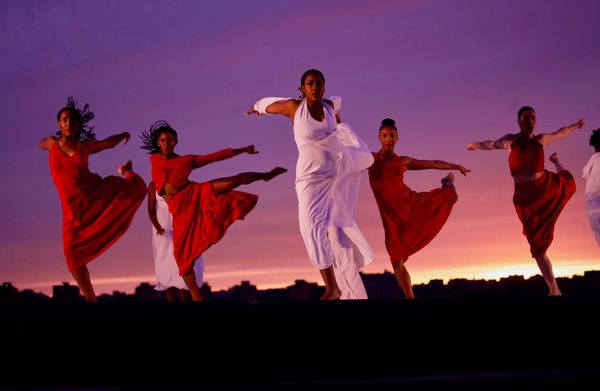
Evidence, pictured here, will present "Where the Light Shines Through" and "Torch" at the festival. Photo by Justin Chao.
After spending more than a month in Tivoli during last year’s Kaatsbaan Festival, guest curator Michele Steinwald noticed something about Hudson Valley audiences. They weren’t simply looking to be dazzled by dance. They wanted context. They lingered after performances, asked questions, and gravitated toward artists eager to talk about their work.
That observation reshaped this year’s festival.

“The audiences are just really hungry, and they really lean into stories,” Steinwald says. “When we had artist talks, people would come and ask me questions to deepen their knowledge of the artists and the work they were seeing. So for this year’s festival, I really leaned into storytelling.”
Returning for her second year as curator, Steinwald has organized Kaatsbaan’s Annual Festival into three distinct Saturdays—August 29, September 5, and September 12—each with its own character. Rather than presenting a grab bag of dance, theater, and music, she envisioned “three separate mini festivals,” each with its own narrative arc inspired by the rhythms of Tivoli itself.

The opening weekend is designed as an all-ages celebration, pairing performances by Calpulli Danza Mexicana, Ballez, and choreographer Anna Sperber with an evening concert by Grammy-nominated singer-songwriter Valerie June. Art-making workshops, a bike maintenance clinic, and family-friendly activities are intended to make Kaatsbaan feel less like a traditional performing arts venue than a community fair.
Labor Day weekend shifts toward theater with the debut of Playwrights’ Platform, an anthology of new works and staged readings by artists including Ty Defoe, Vickie Ramirez, Jeanette Harrison, Rose Jarboe, Sylvan Oswald, Lucy Sexton, Adrienne Truscott, and the late playwright Rachel Jendrzejewski, whose work Steinwald was determined to honor. The evening concludes with a sing-along by the Bearded Ladies Cabaret and a concert and dance party from queer supergroup CRICKETS.
The final Saturday returns dance to center stage with performances by Ronald K. Brown’s EVIDENCE and Courtney “Balenciaga” Washington’s MasterZ at Work before Miguel Gutierrez’s Sadonna and the Slutinos close the festival by reimagining Madonna’s pop catalog through a more vulnerable, reflective lens.
While storytelling became Steinwald’s organizing principle, she says another theme gradually revealed itself.
“I had this real feeling of positive forces,” she says. “All of the artists are very rooted in this time, and there’s a resiliency and a generosity to what they’ve built that is necessary in this political climate. It feels really nourishing.”
That sense of resilience extends beyond the performances themselves. The festival revives its Performance Lending Library—self-guided audio experiences scattered across Kaatsbaan’s 153-acre campus—and encourages visitors to spend entire days wandering between performances, exhibitions, and Tivoli’s downtown businesses.

For Steinwald, the landscape is as important as any performer.
“Landscape was definitely the first collaborator for everything we’re doing,” she says. Choreographer Anna Sperber’s acclaimed “Bow Echo,” originally created for a Brooklyn rooftop during the pandemic, has been reimagined for Kaatsbaan’s fields, where dancers, sound, and the Catskill Mountains become part of a single performance. “The sound carries so beautifully outside,” Steinwald says. “It’s a completely different context.”
The festival also reflects Steinwald’s belief that art shouldn’t end when the curtain falls. Partnerships with Bard’s Center for Indigenous Studies, Oblong Books, local artists, and community organizations extend the experience beyond the stage through conversations, workshops, and participatory events.
At a moment when arts organizations everywhere are competing with streaming services and shrinking attention spans, Steinwald believes live festivals offer something digital media cannot. “Nothing replaces being in proximity,” she says. “Bodies together, building empathy, reading somebody’s body language, sensing somebody’s breath—going on that ride together. There’s nothing that replaces it.”