Melissa Auf der Maur on Her New Memoir of the ’90s Rock Scene
With a new memoir revisiting her volatile 1990s rise in alternative rock, the Hudson-based musician and Basilica cofounder reflects on grief, survival, and reclaiming music on her own terms.
Melissa Auf der Maur answers the phone from home in Hudson, the fire lit, cats nearby, the house still. In a few weeks, she’ll be back in the media maelstrom, promoting a memoir that reopens a decade—the 1990s—that she spent years not wanting to relive. “You’re catching me early, before the storm,” she says, when we speak in early February.
Before the storm. It’s an apt phrase for someone who once entered alternative rock at its most volatile moment and then chose, deliberately, to step away. For the past 15 years, Auf der Maur has lived and worked largely out of view, building Basilica Hudson into a robust cultural institution while raising a daughter and learning how to hold intensity without being consumed by it.
The word hibernation comes up more than once in our conversation. It’s how Auf der Maur describes the years after she withdrew from the public life that once defined her: years spent in Hudson, years spent mothering, years spent redirecting creative energy outward rather than performing it herself. The memoir she’s about to release—Even the Good Girls Will Cry, coming from Da Capo on March 17—is not a comeback vehicle so much as a reckoning—an attempt to understand how a young woman from Montreal found herself thrust, almost overnight, into the myth-making machinery of 1990s alternative rock, and what it cost her to survive intact.
“I chose to write just about that one decade—1991 to 2001—because it defined me,” Auf der Maur says. “It was a small enough bite that I could actually go deep without doing some giant, flattened recap from 25 years later. I needed to relive it, honestly, for my own processing. Not just what happened to me, but what our generation went through.”
Late Bloomer
The story she tells resists the usual arc of ambition and ascent. Auf der Maur did not claw her way into a band or hustle for proximity to fame. She describes herself as a late bloomer, musically and socially, hiding out in what she calls the “fantasy land” of her native Montreal when she was invited—plucked, really—into Hole in 1994. Auf der Maur was 22, relatively inexperienced as a bassist, and suddenly standing on global stages in the immediate aftermath of Kurt Cobain’s suicide and the overdose death of Hole’s bassist Kristen Pfaff. “It really was a Cinderella situation,” she says. “I wasn’t out there trying to be in a band. They found me.”
Melissa Auf der Maur on the Basilica Hudson campus.
From the outside, her trajectory reads like destiny. From the inside, it felt governed by forces she didn’t fully understand but couldn’t deny. Auf der Maur speaks plainly about believing in energies beyond personal will—about feeling chosen rather than self-directed. “My life proved it,” she says. “There were too many tiny things that had to happen for the big thing to happen. It had to be bigger than my little hands and plans.”
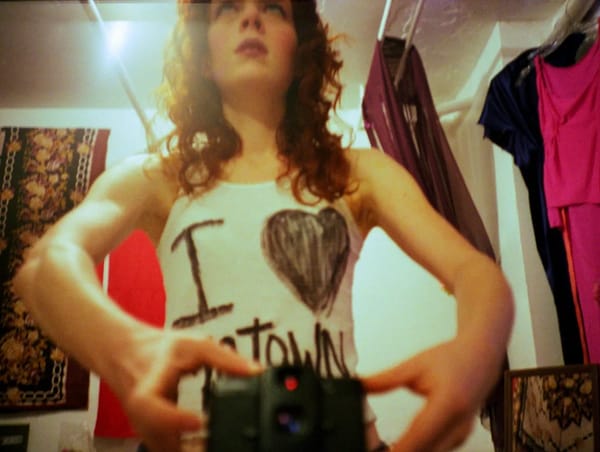
That sense of scale—of being inside something vast and uncontrollable—runs through the memoir, which is structured not as a linear rock narrative but as a series of memories, interludes, and dreamlike passages. Throughout, Auf der Maur casts herself not as a star but as a witness. Onstage, she occupied what she calls the bass player’s position: close enough to feel the charge, far away enough to observe. Offstage, she documented obsessively, photographing nearly everything around her, often turning the camera on herself as a way of staying grounded.
She was surrounded by mythic figures—Courtney Love, Billy Corgan, Dave Grohl—each of them, she says, a force unto themselves. “They come into a room and you feel it,” Auf der Maur says. “You hear it in their music. They’re unstoppable.” The danger, for her, was obliteration: being absorbed by someone else’s gravity, whether as a bass player, a lover, or a supporting character in someone else’s story.
Addiction culture compounded that threat. Auf der Maur is clear-eyed about her position as a non-addict inside environments structured around addiction. “If you’re not an addict, you’re either the enemy or the enabler,” she says. “That’s a very tricky place to live.” Corporate pressures didn’t help. As a socialist Canadian, she bristled at watching art transformed into consumer product, integrity flattened by market logic. “That part devastated me,” she says.
Sacrificing Music
In Even the Good Girls Will Cry, Auf der Maur returns repeatedly to the idea of armor—literal and symbolic. She describes the talismans she wore early on: Botticelli pendants, a Celtic cross inherited from her mother, baby barrettes in her hair, symbols layered onto her body as protection. The book’s cover image, a photograph of her during her first weeks with Hole, captures that paradox. She looks young, almost serene, fortified even as she was stepping into what she now recognizes as profoundly unsafe terrain.
If the first half of the book is about surviving intensity, the second is about what happens when survival strategies fail. The pivotal loss is her father, Nick Auf der Maur, a towering figure in Montreal—journalist, politician, provocateur—whose charisma and damage shaped her understanding of power early on. His death in 1998, when she was still in her twenties, reframed everything. “Grief overtook music as the defining force in my life,” she says. “It took me 20 years to even understand how anomalous that loss was.”
The tools that had carried her through the 1990s—disappearing into music, becoming invisible inside motion—no longer worked. Music itself became tangled with pain: the loss of her bandmate Patty Schemel, Hole’s drummer, to addiction, her father’s decline, the cumulative weight of witnessing self-destruction up close. “I kind of sacrificed music along the way,” she says. “It was sacred to me, and it got messed up.”
When she became a mother, she made a radical decision: she quit. She stopped playing bass almost entirely for a decade, choosing presence over performance. “I didn’t want to be an absent mother,” she says. “I delivered to my daughter what I didn’t get.” That choice brought her to Hudson, where she and her partner, filmmaker Tony Stone, helped build Basilica Hudson—an industrial space on the waterfront that became a home for experimental music, performance, and community gathering.
View from the bassist: Onstage with Smashing Pumpkins, 2000. Photo: Melissa Auf der Maur
Basilica was never meant to be a brand. It was an offering. “It was our way of honoring music without me being part of it,” Auf der Maur says. Programs like Basilica SoundScape and the 24-Hour Drone became her ode to sound as a sacred force, even while she kept herself offstage. For a decade, she poured her creative energy into building something communal rather than performative.
Expression Without Erasure
The timing was right. When she arrived in 2011, Hudson was still rough-edged, under-resourced, full of possibility. “There were barely coffee shops,” she says. “You could imagine something.” Over the years, she became deeply embedded in civic life, navigating the realities of running a cultural space in a small city. Then came Covid—and with it, a rupture. Hudson transformed almost overnight, flooded with new money, new residents, and new pressures. “We came back to a changed town,” she says. “During Covid, the 12534 zip code was the most moved-to zip code in America. Billionaires moved here. Like—actual billionaires. It felt like another identity crisis.”
That shift forced a reckoning. Basilica had reached its 15-year mark. Auf der Maur and Stone stepped back from day-to-day operations, announcing new partnerships with established promoters like Bowery Presents to carry the music forward. “We gave our all for a decade,” she says. “Now it’s time for us to return to our own creative voices.”
For Auf der Maur, that return has been physical as much as emotional. She describes how stepping away from bass playing took a toll on her body—how, without realizing it, she’d stopped moving energy through herself. Slowly, cautiously, she’s begun to reconnect. Sitting in with old collaborators—stepping onstage with Billy Corgan for a song, then flying to London to record vocals with Courtney Love—she’s begun to reconnect with music not as survival, but as pleasure. She’s working on new projects—an EP of covers chosen purely for joy (from The Weeknd to Depeche Mode) and a score for an upcoming exhibition of her photography at the Art Gallery of Ontario. The archive she once saw as chaotic—15,000 photographs, thousands of artifacts—has become a time capsule, one she’s learning to see through the eyes of others.
The memoir is part of that integration. She wrote it from memory, without consulting her journals or photographs, trusting that what remained was what mattered. One of her motivations, she says, was to reclaim music for herself—not as survival, not as identity, but as healing. Another was to leave something honest for her daughter, a way of being known on her own terms.
Auf der Maur with Hole drummer Patty Schemel in 1995.
As she prepares to step back into public view, Auf der Maur is clear about what she’s not interested in: nostalgia, spectacle, or myth maintenance. What she’s after is continuity—between who she was, who she withdrew to become, and who she’s allowing herself to be now. “I’ve forgiven my childhood,” she says. “I’m grateful for the strange life I was given. At the end of the day, I have to live with myself.”
As she prepares to step back into public view, Auf der Maur is clear that this is not a return to the life she left. The memoir, the photography archive, the tentative re-engagement with music—they aren’t about reclaiming a past identity so much as testing new forms of presence. She’s no longer interested in intensity for its own sake, or in disappearing inside other people’s gravity. What she’s after now is movement with boundaries, expression without erasure. “I don’t need to be back in it the way I was,” she says. “My eyes are wide open now.” The point, at this stage, isn’t arrival. It’s choosing how to keep going.
A release party for Melissa Auf der Maur’s memoir “Even the Good Girls Will Cry” will be held at Basilica Hudson on March 19 at 7pm in conjunction with The Golden Notebook. Auf der Maur will be joined in conversation by Oscar-nominated casting director Jennifer Venditti. A book signing and DJ set from Auf der Maur to follow.Tickets via this link.
Brian is the editorial director for the Chronogram Media family of publications. He lives in Kingston with his partner Lee Anne and the rapscallion mutt Clancy.