New Documentary Highlights Biodiversity in the Hudson Valley
A new DEC-produced documentary “The Nature of Nature” celebrates the Hudson Valley’s extraordinary range of life—and the people working to understand and protect it—ahead of a screening at Bard College on February 8.
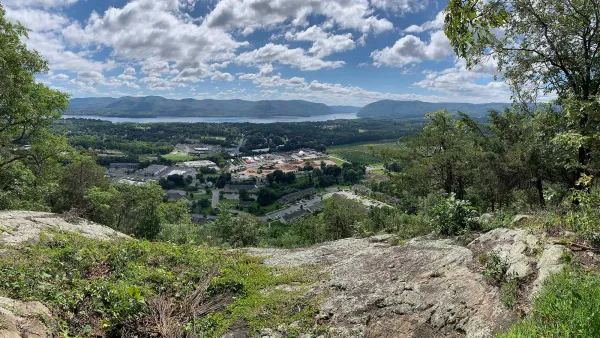
View of the Hudson River from Snake Hill in Newburgh. Credit: Laura Heady
The New York State Department of Environmental Conservation is not, as it turns out, just in the business of permits, regulations, enforcement, and land management. Sometimes, it makes movies.
One of them, “The Nature of Nature: Biodiversity in the Hudson Valley,” will screen February 8 at Bard College. (RSVP here for the free screening.) Over 30 minutes, the film traces the extraordinary range of life that inhabits the Hudson River estuary watershed, from high-elevation forests to globally rare tidal marshes, guided by scientists, conservation practitioners, and community advocates who know these places intimately.
The film was conceived and shepherded by Laura Heady, who works for the DEC’s Hudson River Estuary Management Program. It was directed directed by Emmy-award winning Laura deNey and produced by Flicker Filmworks in New Paltz. The Hudson River Estuary Program has spent more than two decades helping municipalities, land trusts, and conservationists understand and protect biodiversity in the region—but until now, Heady says, there was no general-audience film that simply told the story of how remarkable the Hudson Valley really is. “We’ve been teaching communities about biodiversity for over 20 years,” she says. “And we didn’t have something that was just for everyone.”
Biologist Carl Herzog in front of a cave in Rosendale which is home to a large population of bats.Photo: Laura Heady
The idea grew out of earlier, shorter DEC video projects made with Flicker Filmworks in New Paltz, many of them action-oriented pieces tied to the state’s Climate Smart Communities program. When an opportunity arose in 2024 to pitch a new project, Heady realized the subject demanded a longer format. The result is a film long enough to “give the landscapes room to breathe,” as she puts it, but concise enough to pair easily with a panel discussion, classroom conversation, or community forum.
That flexibility has already paid off. The film premiered last November at the Rosendale Theatre to a sold-out crowd—twice. A screening at the New York State Museum in Albany drew more than 130 people just before the holidays. Since then, it has been taken up by libraries, environmental commissions, schools, and community groups, often without DEC’s direct involvement. The film is also available on YouTube, where it has amassed tens of thousands of views.
Reading through the comments, Heady says, has been one of the most gratifying parts of the experience. Many reflect a renewed sense of pride—or surprise—at the complexity of the region’s ecosystems. “People recognize they live in this amazing place,” she says, “but they weren’t aware of the intricacies of how incredible it is.”
Those intricacies are central to the film’s structure. Rather than spotlighting the Hudson Valley’s most familiar landscapes—the Catskills, the Shawangunks, the Hudson Highlands—Heady chose lesser-known sites drawn from the Estuary Program’s biodiversity conservation framework, which identifies 23 “significant biodiversity areas” across the region. Each location helps illustrate a key concept: genetic diversity, habitat connectivity, micro-habitats, and the way ecological systems function as networks rather than isolated parcels.
One of the film’s more striking statistics underscores why that network matters. About 85 percent of the species found in New York State have part of their range in the Hudson Valley. Roughly 90 percent of the state’s bird species pass through or live here. That concentration is the result of geography—elevation changes, varied landforms, and the Hudson River itself—but also of history and human pressure. “We have a lot in a relatively small area,” Heady says. “And we also have a lot of people.”
Filming with Sarah Fernald of the Hudson River National Estuarine Research Reserve at the Stockport Flats.Photo: Laura Heady.
That human presence is not treated as an afterthought. One of the film’s most powerful segments takes place in Newburgh, which is not designated as a significant biodiversity area, but is home to vital pockets of urban nature. Featuring the work of Ron Zorrilla and Outdoor Promise and community leaders working to expand access to green space, the segment makes the case that biodiversity and equity are inseparable.
Throughout the film, Heady is careful to avoid lecturing or doom-scrolling in cinematic form. There is no blunt call to action at the end, no checklist of behaviors to adopt. “There’s so much doom and gloom already,” she says. “This was meant to give people space to be in awe, to celebrate what we have here.”
That doesn’t mean the film is apolitical or disconnected from real-world decisions. On the contrary, Heady hopes it nudges viewers toward greater engagement—attending planning board meetings, joining environmental commissions, supporting land trusts, or simply paying closer attention to how land-use decisions shape the places they care about.
For Heady herself, one of the most rewarding aspects of making the film was experiencing familiar landscapes through the eyes of others. Even after decades of working in the region, she found herself repeatedly surprised—sometimes to the point of needing her own expressions of wonder edited out of the final cut.
One comment from the film lingers with her: a reminder from longtime Hudsonia ecologist Gretchen Stevens about the importance of keeping our eyes open in nature. In the film Stevens notes, “As a biologist, keeping my eyes open has been my work.”
“That really stayed with me,” Heady says. “Staying curious. There’s always something new to learn.”
“The Nature of Nature: Biodiversity in the Hudson Valley” screens February 8 at Olin Humanities Auditorium at Bard College. (RSVP.) Additional screenings are planned throughout the region this spring.
Brian is the editorial director for the Chronogram Media family of publications. He lives in Kingston with his partner Lee Anne and the rapscallion mutt Clancy.
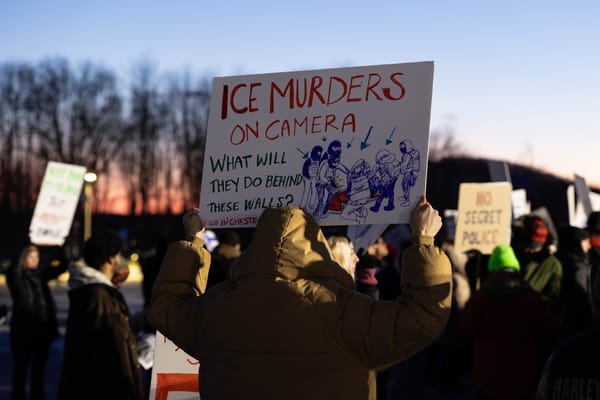
A protester at a rally against the proposed ICE detention center location in Chester New York. Photo by Tony Ramirez, CCSM Multimedia Organizer.
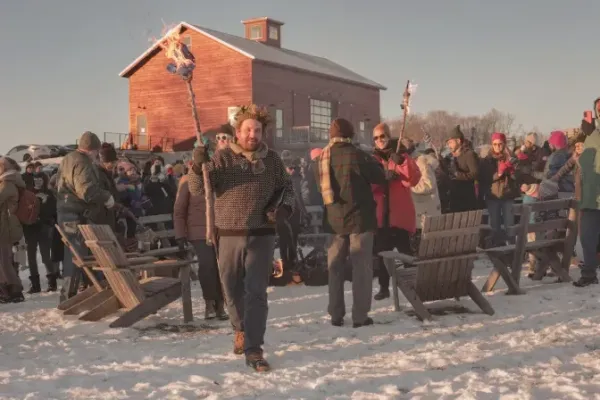
A winter procession winds through the orchard at Rose Hill Farm as Wassail revelers raise a joyful racket, reviving an old English tradition meant to bless the apple trees for the season ahead.