Photographer Jeff Brouws and the Afterlife of the Steam Age
In his new photobook, “Silent Monoliths: The Coaling Tower Project,” photographer Jeff Brouws documents the concrete giants that once fueled America’s railroads—and still haunt the landscape.
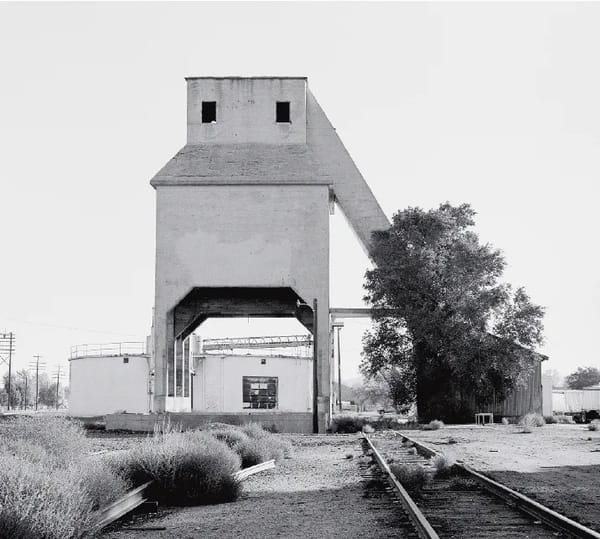
Glenns Ferry, Idaho Union Pacific 42°57’09.8”N 115°18’01.9”W Credit: Jeff Brouws.
For more than three decades, Jeff Brouws has photographed the American landscape at moments of transition—when buildings, industries, and systems are falling out of use but not yet erased. His latest photobook, Silent Monoliths: The Coaling Tower Project (MIT Press), is a concentrated expression of that long-running interest, focused on the massive concrete coaling towers that once fueled America’s steam-powered railroads.
Brouws will celebrate the release of Silent Monoliths: The Coaling Tower Project on February 26 at 6:30pm at Morton Memorial Library, in an event produced by Oblong Books.
Built primarily between the 1910s and 1930s, coaling towers were essential infrastructure, designed to rapidly refill locomotive tenders with coal. When railroads converted to diesel power after World War II, the towers became obsolete almost overnight. Yet many still stand today. Not because anyone made a sentimental choice to preserve them, but because they are extraordinarily difficult to remove. “They’re made of concrete and they’re all rebar,” Brouws says. “There’s reinforced steel that runs throughout, so they’re very hard to take down.”
Brouws came to the project almost by accident. While looking at a photobook by a younger photographer, he noticed an image of a coaling tower paired with an unrelated photograph. The image stuck with him. Curious, he searched online and discovered a Wikipedia page cataloging every coaling tower still standing in North America. The list included names, locations, and GPS coordinates. “I was just aghast,” Brouws recalls. “I thought they were mostly gone. And the number was over a hundred.”
Irvington, Kentucky, Louisville & Nashville, 37°52’53.9”N 86°16’53.6”W, Jeff Brouws
That discovery turned into a plan. Beginning in 2013, Brouws made an initial trip covering several states and roughly 4,000 miles. “I thought I’d just see how it went,” he says. “And I was hooked.” By 2015, with about 40 towers photographed, he committed to documenting them all. Over the next several years, he logged roughly 20,000 miles, often working alone, mapping distances, plotting itineraries, and photographing from early morning until nightfall. “It was very intentional,” he says. “Probably more organized than I usually am.”
Railroads are not new territory for Brouws. He began photographing trains at age 13, an early fascination that led him into photography itself. “If there hadn’t been that interest, I don’t know if I would have become a photographer,” he says. Today, he serves on the board of the Center for Railroad Photography & Art in Madison, Wisconsin, and has completed several railroad-related projects over the past two decades. The coaling towers allowed him to extend that interest while staying rooted in his broader engagement with vernacular architecture—grain elevators, gas stations, strip malls, and other structures shaped by utility rather than style.
Much of Silent Monoliths is organized as a typology: straightforward, frontal photographs presented with consistency and restraint. Brouws often photographed the towers under flat, overcast light, avoiding drama or atmosphere. “I didn’t want to impose my artistic effort on it,” he says. “I just wanted the facts.” He compares the approach to the ethos of “Dragnet”: “Just the facts, ma’am.”
New Buffalo, Michigan, Pere Marquette, 41°47’12.4”N 86°44’31.3”W, Jeff Brouws
The typological structure reveals both sameness and variation. Four major engineering firms based in Chicago produced most of the towers, each with its own standardized designs. Regional differences emerge as well. “Some of the biggest towers I saw were in West Virginia and Virginia,” Brouws says, where railroads like the Norfolk and Western ran enormous coal-hungry locomotives. “Then you go up to Canada, to these small short lines, and the towers are much smaller because the engines didn’t need that capacity.”
A second section of the book loosens the typological strictness, placing the towers more fully within their surrounding landscapes. Here, Brouws allows himself more narrative freedom. “That section is more landscapey,” he says. “It gives you a sense of where these things actually sit.” In some cases, he revisited towers over many years, documenting visible decay and structural change. One tower in Ohio appears in two photographs taken years apart, its steel framework noticeably leaning in the later image.
For Brouws, the towers are not relics to romanticize but evidence of economic and technological change. Steam locomotives required labor-intensive systems—coaling towers, water towers, large crews. Diesel engines did not. “There might have been eight people associated with a steam locomotive,” he says. “With diesel, you’re down to two. That’s a huge shift.” The towers mark that transition, standing as artifacts of a moment when industry, labor, and infrastructure were organized differently.
Coxton, Pennsylvania, Lehigh Valley 41°21’15.5″N 75°48’08.7″W, Jef Brouws
The persistence of the towers is also temporary. During the years Brouws was photographing them, several were demolished. More are slated to come down. “Railroads have to pay tax on that footprint,” he explains. “And if a tower arches over a main line, it becomes a safety issue.” Advances in demolition technology have made removal easier, accelerating their disappearance.
Underlying the project is Brouws’s long-standing interest in obsolescence—what he once referred to as TOADS: temporary, obsolete, abandoned, derelict sites. He traces that impulse back to Walker Evans, who described his work as photographing the “historical contemporary.” “It’s part of the material culture from the past,” Brouws says, “but I’m photographing it now.” For him, the throughline is change. “Everything has a lifespan,” he says. “Everything is trending toward entropy.”
Despite their industrial scale, Brouws admits to developing personal attachments to certain towers, especially those he returned to again and again. “Some of these towers are my friends,” he says. “There are places that just have a charm to them—the landscape, the location.” Revisiting them while editing the book felt, in a way, like renewing old relationships.
Brian is the editorial director for the Chronogram Media family of publications. He lives in Kingston with his partner Lee Anne and the rapscallion mutt Clancy.