Rare Calvin and Hobbes Illustrations and the Art of Revolution Shape NRM 2026 Schedule
The Norman Rockwell Museum's 2026 schedule views 250 years of American history through some of its most important cultural images, including Calvin and Hobbes.

The Norman Rockwell Museum's 2026 schedule views 250 years of American history through some of its most important cultural images, including Calvin and Hobbes.
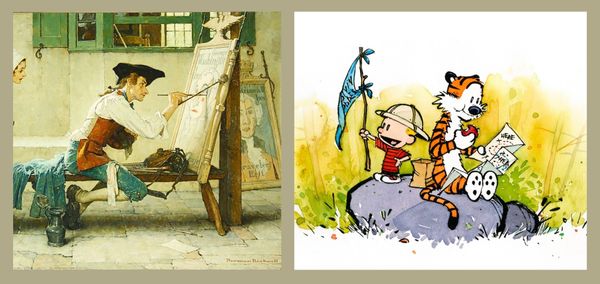
Above image: New Tavern Sign (Colonial Sign Painter), 1936. Illustration for The Saturday Evening Post, February 22, 1936. pp. 18-19. Oil on canvas. Private collection. ©1936 SEPS: Curtis Licensing, Indianapolis, IN. All rights reserved, Illustration from, The Indispensible Calvin and Hobbes. © Bill Watterson
When the Norman Rockwell Museum opens its doors for “Exploring Calvin and Hobbes” in November, it will no doubt be a meaningful moment for the kids in us all. Original drawings by Bill Watterson (among the most closely guarded works in modern American cartooning) will be presented as a full touring exhibition, and Stockbridge will be its second ever stop. For generations of children and adults raised on Calvin’s wild philosophical tangents and Hobbes’s wit, the show provides a rare chance to see Watterson’s work for the hilarious, insightful, and transgressive masterpieces they have always been.
That exhibition, which will run through spring 2027, anchors a jam-packed 2026 season at the museum, influenced by a moment of national reflection and institutional transition. As the United States approaches its 250th anniversary, the museum is leaning into illustration as a form that has long translated civic ideals, dissent, humor, and the flawed yet hopeful nation Rockwell iconified. 2026 also marks the final year of longtime director and CEO Laurie Norton Moffatt’s tenure, adding even more weight to the lineup this year.
“The year 2026 invites us to reflect on how our nation has evolved and to imagine the future we hope to build,” says Norton Moffatt. “Spanning heroic historical painting and inventive comic-strip art, NRM’s exhibitions and programs will illuminate the shared human experience at the heart of American life, moving from the iconic to the innovative.”
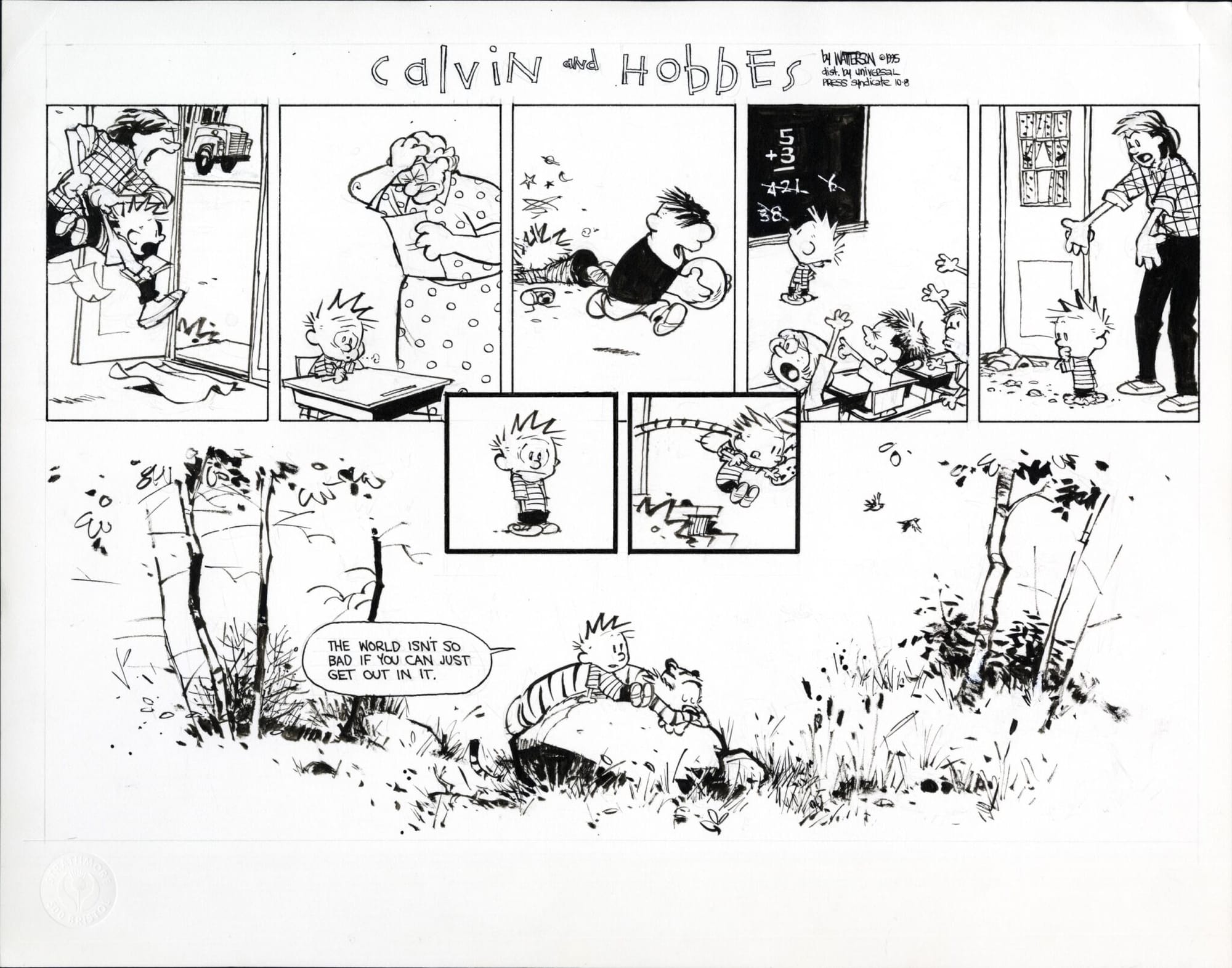
“Exploring Calvin and Hobbes” approaches Watterson’s work not as pop ephemera, but as a carefully constructed visual language. Museum representatives say the original pen-and-ink strips and watercolors reveal a cartoonist deeply invested in composition, pacing, and emotional ambiguity—qualities that link his work to earlier innovators like George Herriman and Charles M. Schulz, both of whom appear in dialogue within the exhibition.
Curated by Jenny E. Robb of the Billy Ireland Cartoon Library & Museum, the show traces Watterson’s influences and working methods, while arguing that the Sunday comics page became, in his hands, a site of formal medium experimentation and philosophical play.
If Calvin and Hobbes represents the imaginative edge of the museum’s calendar, “American Stories: From Revolution to Rockwell” supplies its historical context. Opening in June and occupying nearly the entire museum, the exhibition brings together more than 150 works spanning over two centuries of American visual culture.
From Revolutionary-era engravings by Paul Revere and Benjamin Franklin to contemporary digital media, the show examines how images have shaped and sometimes contested ideas of nationhood, labor, equality, and belonging. Rockwell’s own work anchors several chapters of this story, situating his familiar scenes within a longer continuum of image-making that has always been political, persuasive, and morally virtuous.
“As we mark the 250th anniversary of the formation of our nation, we invite visitors not just to look back,” Norton Moffatt says. “But to take stock of the present and look ahead: at who we’ve been, who we are, and who we might become, through the storytelling lens of American illustration art.”
The major exhibition is not isolated from the rest of the calendar, the museum weaves it into a yearlong parade of smaller gallery features and community-facing programs. A new rotating series drawn from the museum’s 30,000-object collection launches with “A Brief History of Illustration: The Abyss,” using the ocean as a lens to explore everything from wartime propaganda to fantastical undersea worlds.
And while warmer weather feels far away, pretty soon the annual Berkshire County High School Art Show returns with spring, connecting the history of American art to its future.
Throughout the year, the permanent Rockwell collection is recontextualized through newly developed thematic installations, including a gallery focused on Rockwell’s capacity for empathy—his ability to render everyday moments with a moral weight.
Programs and events mirror the exhibitions’ emphasis on storytelling as a lived experience. Literary evenings connect Jazz Age illustration to Edith Wharton and Nella Larsen; family days and school vacation workshops invite children to experiment with Rockwell’s techniques and take part in hands-on drawing sessions.
To find out more specific details about these and other programs visit the Norman Rockwell Museum on the web.