Review: Don't Miss Your Last Chance to See “On Fire” at TSL This Weekend
At TSL, “On Fire” pairs Jim Denney’s blazing landscapes with Dennis Gordon’s meticulous models of abandoned places.

At TSL, “On Fire” pairs Jim Denney’s blazing landscapes with Dennis Gordon’s meticulous models of abandoned places.
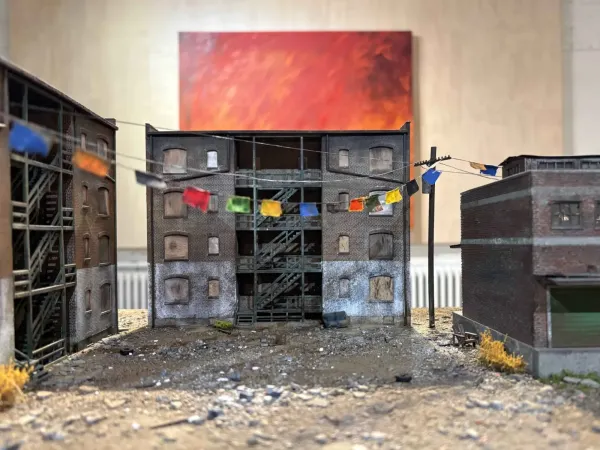
Pictured: Detail of "Fallen Flag," a sculpture by Dennis Gordon from "On Fire." Credit: Taliesin Thomas
In his book The Psychoanalysis of Fire, the French philosopher Gaston Bachelard writes: “Fire suggests the desire to change, to speed up the passage of time, to bring all life to its conclusion, to its hereafter.” When I arrived at Time and Space Limited in Hudson last weekend to see the two-person exhibition “On Fire” (through October 4), I was instantly swept into the electrifying “hereafter” that engulfs the room, and it took my breath away. The expert pairing of paintings by Jim Denney and sculptures by Dennis Gordon offers a sensational encounter with fire as the ultimate power, where the seduction of destruction gives over to a sublime experience.
Both artists share a history as firefighters, and Denney worked as a seasonal wildland firefighter in the forests of the Northwest for over 20 years. He describes his visual memories of the fires in those areas as emblems of the “omnipresent crisis of our time” and an embodiment of “the creation that man’s activities have resulted in.” Denney’s paintings are a compelling presentation of infernos in all their glory and artworks such as Ring of Fire (2025) and Behind the Door (2012) are sumptuous red-hot blazes that border on abstract. Other works such as Monolith and Fire (2026) and Stairway to Heaven (2010) are more representational images of a woody forest consumed by flames (the former) and a construction-laden building in the early stages of going up in smoke as a blaze takes over (the latter).

Among the most dramatic paintings by Denney are the ones that appear quasi sci-fi, including Burning Down Our House (2020) in which an image of a colossal mushroom-like shape that expands across the width of the landscape with an organic underworld below while above we see a raging volcano to the left, a sunrise-sunset (both at once) with Biblical charcoal-hued clouds in the middle, and a home going up in wild flames to the right. Denney’s ability to capture the fearful awe of fire and transfigure it into magnificent visions of alien-like beauty is fully realized in Barrier (2021), a painting of a dark pile of kindling that gives rise to a chalky ghostlike winged formation that is utterly stunning as it stretches across the sky. A series of smaller works in a side room include Foundation (2005) and the charred remains of a burnt forest scene, and Downsizing, My Fire Truck (1994) and a phantom-like image of this vehicle with two flat tires. Denney states that his paintings also serve as recollections and memorials for the forests and wildlands that have influenced his life’s path, and his oeuvre reflects a profound reverence for fire as Mother Nature’s foremost force.

Gordon became a New York City firefighter in 1978, and he states that “entering and navigating vacant structures became both a full-time job and passion,” citing constant fires throughout the city during those years. Over his lifetime, his fascination with abandoned spaces brought him through defunct and decrepit mills, warehouses, foundries, factories, asylums, prisons, schools, and hospitals. Gordon’s five meticulously crafted maquettes invite us to peek into petite recreations of scorched and forsaken locales, and each one is simultaneously ominous and astoundingly precise. With Badlands (year unknown), we encounter a blown-out block of neglected apartment buildings with boarded windows, collapsing street fronts, a crumbling sidewalk, and an overall feeling of urban entropy (three tiny garbage cans hugging each other are an unforgettable feature of this tableau).

Gordon’s Fallen Flag (year unknown) consists of an open courtyard with surrounding buildings and rows of multicolor banners hanging about, suggesting a celebratory time gone by. Gordon’s Inflection Point (year unknown) is a mini masterpiece of an industrial outpost-landscape with a parking lot in front, an electrical tower on each side, two dwellings with advertisements nearby, and a rusty green bridge with a sign that indicates “SURELY YOUR TIME WILL COME” all set against a vacant building complex. Gordon comments that ironically the loneliness and isolation that he experienced inside these structures provides him with a grounding feeling, and he points to the “wreckage of unchecked capitalism and real estate development” as a continued inspiration for these models. The scrupulous details of Gordon’s exquisite miniatures are astonishing, and must be experienced in person to believe.
Between Denney’s renditions of inferno-fests and Gordon’s dynamic scenes of deterioration, “On Fire” is—as they say in contemporary group-speak parlance—positively fire. Their combined artistic focus on flares, flames and forsaken realms yields an evident secret about impermanence and the reimagining of existence through transformation. As Bachelard states, “destruction is more than a change, it is renewal.”
“On Fire” is on view at Time and Space Limited in Hudson through October 4.