Writer Karen Rinaldi’s Cocteau-Inspired Copake Home a Refuge After Divorce
After a divorce upended her life, writer and editor Karen Rinaldi found a modest eyebrow Colonial in Copake and, with help from her sister, transformed it into a deeply personal retreat shaped by the spirit of Jean Cocteau.
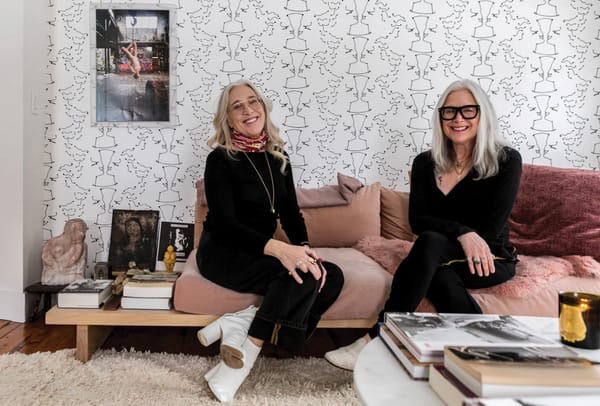
Pictured: Kristina (left) and Karen Rinaldi in the home’s living room. Kristina, an interior designer, had sourced the wallpaper based on Jean Cocteau’s iconic sketched portraits years earlier and, knowing her sister’s passion for the artist, had held on to it, just in case. On the wall, a photograph by Rinaldi’s daughter, Rocco Rinaldi-Rose, serves as a focal point. Credit: Winona Barton Ballentine
At 60, Karen Rinaldi found herself starting over. “After a divorce that shook out my hard-earned financial security, I went looking for a new home with what I had left,” Rinaldi says. It was 2023. She’d built an enviable life, but was no stranger to the idea of beginning again. As an editor, she’s shepherded multiple authors from murky beginnings to global success. As a writer, she’d penned successful novels and essays. As a surfer, she’d built a home in Costa Rica and maintained another on the Jersey Shore. But the divorce changed everything. “I lost surfing; I lost financial security; I had to give up a lot,” she recalls.
When facing a major life reinvention, it’s always wise to reconnect with old friends—even ones you’ve never actually met. For Rinaldi, that friend was Jean Cocteau, the French artist and filmmaker. Cocteau moved fluidly between disciplines and lived openly as a gay man in early 20th-century Paris. “He straddled multiple worlds with ease, causing, at times, severe criticism from all sides,” she explains. “I’ve often straddled several worlds at once—sometimes making me suspect, sometimes granting me insight. But I’ve nurtured connections to create art and celebrate union, even in unexpected places.”
Her modest 1,500-square-foot eyebrow Colonial in Copake was not originally what she’d planned. “It had no closets, an unusable kitchen, and a janky bathroom,” she remembers. However, it was close to both her son and her sister, and it had a saving grace. “It was far from my dream home, but the simple outbuilding—a space where I could work and write—was a bonus. A room of my own. My first.”
Vivre San Compromis
Rinaldi first encountered Cocteau when she was 22 and living in Paris. She’d just graduated with a degree in French, a love of literature, and no specific plan. The only thing Rinaldi knew for certain was that she wanted to move to France. “I bought a one-way ticket,” she explains. “I landed in Paris, and I felt like I was home. I knew it in my heart.”
After painting the first floor in a mix of hues, the sisters refinished a dining table and added a colorful portrait sourced in Hudson. Photo: Winona Barton Ballentine
That October coincided with the 20th anniversary of Cocteau’s death. “There were retrospectives everywhere about his life and work,” she says. “He was an amazing impresario who touched music, poetry, art, and film—he had his hands in all of it. He was never the best at anything, but he was really good and great in some ways. To me, it was just fabulous.”
Cocteau’s semi-autobiographical White Book, published in 1928, had a profound effect on Rinaldi, making her realize the circumspect way she’d been approaching her passions. “Cocteau’s public act of defiance—not only to write this book but also to publish it in the face of derision—is little acknowledged for its audacious act of agency by a homosexual in a time when such things were simply not done. I wondered, ‘How the hell did hedo that?’ His utter ballsiness really captured me. I was at a moment in my life when I didn’t have a clue who I was and this angel spoke to my heart as someone living out loud despite the slings and arrows it invited.”
Rinaldi bought the three-bedroom, three-bathroom house during a major life transition, after she and her sister took a pilgrimage to see Cocteau’s home in the French countryside. The trip inspired Rinaldi to create a hermitage where she could write and redesign the interiors to reflect her new chapter. “Buying the house in Copake felt like a kind of coming home to myself,” she says. Photo: Winona Barton Ballentine
Life intervened, and Rinaldi returned to the States, but always intended to return to Paris. “Then one thing led to another that led to another,” she says. “And I realized I also loved New York City.” A job in publishing allowed her to focus on literature and even potentially return to Paris one day. Nurturing the work of other writers also came naturally—another personality trait she shares with Cocteau. “He was a model of midwiving other artists’ talents,” says Rinaldi. “I love seeing the talent in people and helping to tease it out and realize their creative calling.”
Surfer Girl Impresario
Meanwhile, she’d gotten married and started a family. With two children and two step-children, as well as growing professional success, Rinaldi’s own writing fell between the cracks of her life, but didn’t disappear. “I’ve always written, but had no confidence about putting my work into the world. And I wasn’t good,” she claims. Her time claimed by kids or manuscripts, Rinaldi, like Cocteau, wrote in stolen moments. “Cocteau’s bursts of creativity came from pulling himself out of the fray,” she says. “He wrote wherever and whenever he could—a pencil and a scrap of paper always at the ready—I’d say we share a similar manic energy for better and worse.”
It was Rinaldi’s midlife passion for surfing that, circumspectly, led her to approach her own creative work with—if not seriousness—then a kind of meditative beginner’s mind. “I’d started late, and I was never very good at it, but I was devoted,” she says. It occurred to her that this was part of the appeal. “The beautiful thing about surfing was that I didn’t have to be good,” she says. “It was the one thing I could suck at.”
Inspired by Cocteau’s wall paintings in the “Tattooed Villa,” the sisters chose a botanical print for the walls of the 700-square-foot studio. Photo: Winona Barton Ballentine
She began to approach her own creative work with the same mindset, allowing herself to “write badly,” as she explains. The new approach worked, leading to her novel The End of Men, published in 2017, which was later made into the movie Maggie’s Plan. It also led to her non-fiction meditation on surfing, life, and the power of being an amateur, It’s Great to Suck at Something, which came out in 2019.
The Palimpsest
In 2021, Rinaldi’s divorce was an earthquake that would shake her life to its foundation. Set adrift by 2023, she realized she needed to reconnect with a deeper part of herself. So she turned to two time-worn relationships: Jean Cocteau and her sister Kristina.
That October, the sisters set out for the French countryside, seeking Cocteau’s home in Milly-la-Foret and the Basilica where he’s buried. Cocteau purchased the home, which he called My Milly, when he was 57 after the success of his film La Belle et la Bete. The pilgrimage jolted Rinaldi. “Cocteau was even more resonant than when I was young,” she explains. “I could see him more clearly, in all his flaws and missteps. This multitalented genius was also a wounded human, like the rest of us. I could forgive myself for my own stumbling through this messy gift of life.”
When Rinaldi found her ho-hum 1870 farmhouse in Copake, it was in relatively good shape but decidedly impersonal. “It reminded me of an Airbnb,” she recalls. Fortunately, her sister offered to help reimagine the space. Based on Rinaldi’s fascination with Cocteau, the sisters created a colorful, eclectic home that celebrates Rinaldi’s lifelong love affair with the artist. On the second floor, soft pink, hand-sketched “Coven” wallpaper backs a wall of art that includes lithographs by Cocteau. Photo: Winona Barton Ballentine
Hermitage in the Woods
The pilgrimage opened a door for Rinaldi into her next chapter—and her next home. When I was visualizing the next phase of my life, I kept thinking of my new home, wherever it was, whatever it was, as a kind of hermitage,” she says. “He loved his Milly simply because it was his. I wanted my next home to be a homage to him.”
Kristina, who operates the full-service interior design firm “Rinaldi Interiors,” stepped in to help. With a focus on creating spaces that reflect her clients’ stories and life experiences, she specializes in creating distinctive, coherent spaces. She immediately knew what Karen needed. “The house needed to be warm, embracing, safe—like a literal hug,” says Kristina. “To achieve that, we needed to avoid stark walls, use beautiful lighting to create a cozy feeling, and choose wallpapers that evoked her passions.”
With Cocteau as muse, she began reinventing the bland space into a refuge. Wallpaper reminiscent of Cocteau’s sketches became the perfect backdrop for the living room, which Kristina matched with sconces that mimicked the eerily sexy candelabras from La Belle et la Bete. After a kitchen renovation, Kristina painted the walls “Sulking Room Pink” to capture the color of sunrises and sunsets. Upstairs, softer pink-and-white wallpaper depicts a recurring motif titled “The Coven.” Layered into the design is art created by family, friends, and Jean Cocteau.
Working with Hudson-based Jasonaut, Inc., Rinaldi revamped the kitchen, and then her sister finished the space in “Sulking Room Pink” and added a photo by artist Mike Magers. Photo: Winona Barton Ballentine
Rinaldi’s first official writing studio is filled with Cocteau—in both style and substance. Wallpaper based on his botanical paintings lining the inside of St. Blaise Basilica inspires healing. Surrounded by his art and writing, Rinaldi is writing a book about the artist who’s guided her for four decades. “I feel such a deep familiarity with him—his work, his physical being—that it rarely feels abstract,” she says. “With my sister’s guidance, we’ve created a hermitage I didn’t know I needed in a place I didn’t know I’d love. Starting again at 60 brought me to my knees: first in grief, then in gratitude.”
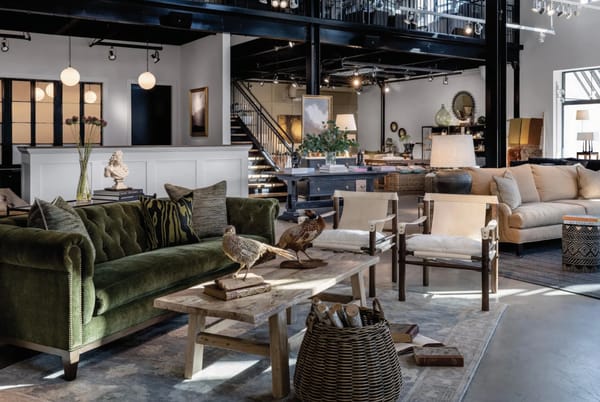
Hudson Home layers vintage furniture with contemporary design objects, creating interiors that feel lived-in, considered, and open to interpretation rather than styled to a script.