If you own more earrings than you wear, start with the pair you reach for most mornings. The others may have been gifts, vacation finds or purchases that looked better under store lighting. That reliable pair gives you something concrete to compare with any new design.
- Start with what you wear. Your favorite pair shows which shapes and finishes suit you.
- Read the details. Check karat, construction and handwork claims in the listing.
- Check the fit. Measurements and closures help you judge whether a pair will be comfortable.
Start With the Pairs You Already Wear
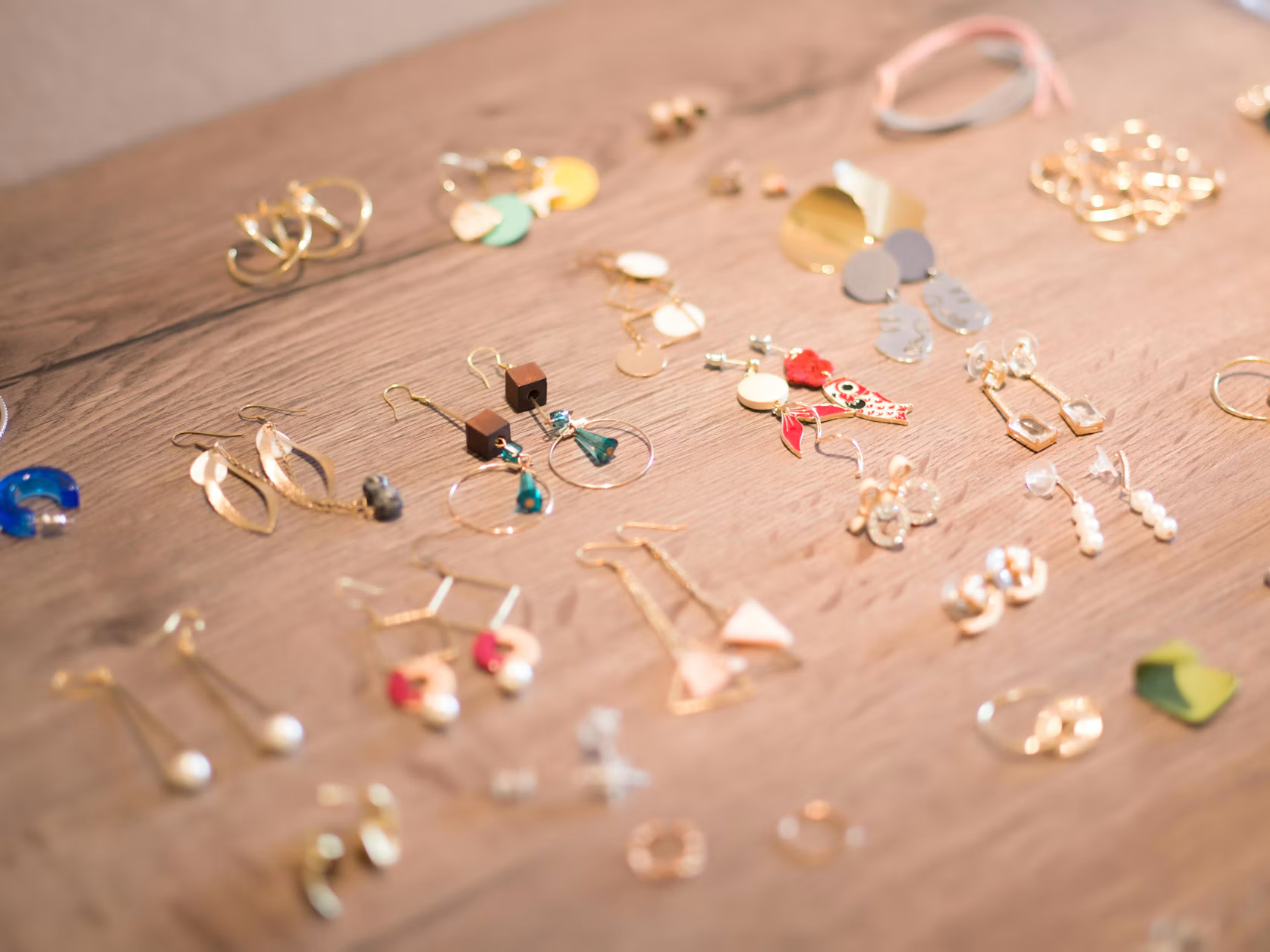
Notice your repeat pair. Put the earrings you reach for most often on the table. What makes them work? Maybe they're small enough to forget about, have a smooth rather than textured finish, or sit close to the ear and stay clear of a collar. Those qualities give you a practical way to compare new pieces, wherever they come from, whether that's a vintage stall at the FleaHive Market in North Adams or the bench of one of the region's artisan jewelers. Personal style need not come from a matching set.
Give the next pair a different job. Consider which gap the next purchase fills. A small rotation might cover three roles: a simple stud for days when you want almost nothing, a small hoop or huggie that adds a little presence, and a textured or short-drop design for dinner out or a gallery opening in Hudson. Those are suggestions, not a quota. If you already own studs you love, decide what another pair would add before buying. Differences in size, finish or movement can make a new pair useful without requiring an entirely different style.
Try them with real clothes. Compare the style you're considering with a favorite sweater, a shirt you wear to work and an outfit you save for dinner out. Notice whether the earrings catch on a collar, disappear under your hair or feel too large for the look you want. Compare listing photos and measurements with a pair you own if you can't try them on. This gives you a more useful reference than a photograph of the earrings alone.
Read the Gold and Craft Details
Read beyond the word gold. A listing that says gold can mean several things, so look for the karat number and construction. Jewelers of America lists 14-karat gold as 58.3 percent pure gold. Plated pieces have a surface layer of gold over another metal. The FTC Jewelry Guides describe vermeil as a sterling-silver base coated with gold, subject to additional fineness and thickness conditions. It isn't gold alloy throughout. The FTC's consumer guidance also explains that "solid gold" means the piece isn't hollow. Check both what the piece is made of and whether it is hollow.
Ask what the maker does by hand. The FTC Jewelry Guides set a specific standard for handmade claims covering shaping, forming, finishing and decoration. An uneven edge does not prove handwork, and a flawless one does not disprove it. Ask who shapes the piece, sets the stone and finishes it. A maker's identifying trademark can appear as a name, symbol or initials, according to the FTC's consumer guide. A maker that names its workshop and explains who shapes, sets and finishes each piece gives shoppers a clearer account of its handwork than appearance alone.
Compare like with like. Before comparing prices, check the selected metal. A product page may offer several karats or colors, and a collection title may not describe every variant. Check the dimensions, stone description, whether the price covers a single earring or a pair, and the total at checkout. To compare plain hoops with diamond-set designs, gold earrings by ENEA Studio provide examples of both within one collection. Check each listing's metal, measurements and selling unit so you know what you're comparing. Treat displayed prices as a snapshot, and read the specifications rather than relying on the product title.
Make Comfort Your Final Check
Compare measurements, not labels. Words such as mini, petite and classic don't tell you the dimensions. Measure a hoop you already find comfortable, then compare like measurements with the listing. A hoop's inner diameter describes the opening around the lobe, while its outer diameter describes the overall size. One mini diamond hoop listing, for example, gives an 8.10mm inner diameter and an 11.70mm outer diameter. Those are that product's dimensions, not a recommendation for your ears.
Check the back and closure. Pay attention to what happens behind the ear. Can you open and close the fastening easily? Does the post or backing press into your skin? Consider how the earrings sit alongside glasses, headphones or a scarf. Different closures suit different people and piercings. Check comfort during wear, and remove earrings that cause discomfort rather than relying on a claim that one closure suits everyone.
Choose color by preference. Yellow, white and rose describe color; karat describes gold content. GIA explains that rose gold gets its color from alloying gold with copper and sometimes silver. Compare the tones with clothes you already wear instead of following rigid skin-tone rules. You may prefer different colors with different outfits.
Treat sensitivity separately from style. Check the material of every part that touches your skin, including the posts and backs. The American Academy of Dermatology notes that nickel allergy commonly develops from wearing jewelry containing nickel, and Seattle Children's cautions that both white and yellow gold can contain it. A gold label alone is no guarantee for sensitive ears. Ask the seller about the metal composition of the posts, backs and any other contact points. If irritation keeps returning, consult a dermatologist or your doctor rather than guessing at the cause.
FAQs
How many pairs should I start with?
There is no required number. The stud, small hoop and expressive pair described above are possible roles to fill over time. Start with a gap in what you already wear; you don't need to buy all three.
Does handcrafted mean every step is done by hand?
Don't assume the process from the word alone. The FTC Jewelry Guides set a specific standard for handmade claims, including shaping, forming, finishing and decoration. Ask the maker which operations are performed by hand.
Are gold earrings always suitable for sensitive ears?
No. Seattle Children's notes that white and yellow gold can contain nickel, and the American Academy of Dermatology identifies nickel-containing jewelry as a common source of nickel allergy. Ask about all parts that touch your skin, and seek medical advice if irritation persists.
How should I clean and store them?
Follow the maker's care instructions for the complete piece. GIA gives warm water, mild soap and a toothbrush as a cleaning method for diamond jewelry, but that method may not suit every gemstone or delicate construction. GIA also warns that chlorine bleach can damage gold alloys. Jewelers of America recommends a fabric-lined case or a compartmented box to keep pieces separated.