Chronogram 2026 Great Barrington Profile: Polished but Sharp
How artists, restaurateurs, retailers, and organizers are shaping a Berkshire town determined to stay curious, ethical, and alive.

How artists, restaurateurs, retailers, and organizers are shaping a Berkshire town determined to stay curious, ethical, and alive.
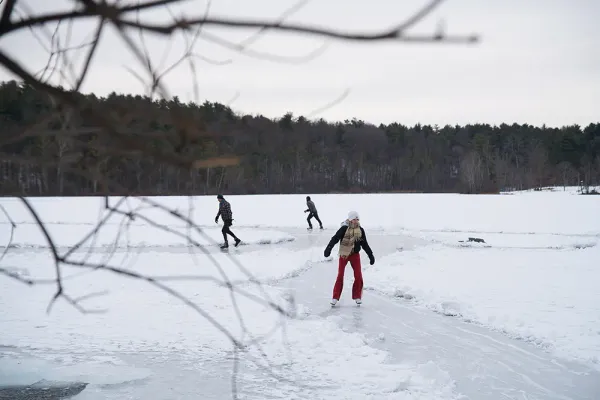
Ice skaters on Mansfield Lake in Great Barrington. Credit: David McIntyre
View the digital booklet version.
Great Barrington reveals itself in layers. Visitors arriving for the first time often see the postcard version: the handsome Main Street lined with shops, the stately brick facades, quaint cafes, the comfort of a picture-perfect New England town that knows how good it looks. But this town isn’t just pretty. It’s got depth, an undercurrent of creative unruliness, a streak of entrepreneurial experimentation, and a community constantly negotiating who it is, whom it serves, and what it wants to become.
The town’s polish is unmistakable. But its scrappy edge, generated by artists, chefs, local organizers, and a parade of imaginative weirdos, is what keeps the place from settling into complacency. A stylish boutique shares a wall with a high-energy community radio station; a historic theater coexists with developmental stages; a long-overdue monument rises just as the town reckons with the loss of a major institution. This is the story of a town that’s fighting to stay authentic.
Great Barrington’s commercial identity is arguably its most visible layer. Downtown hums with a curated, personality-forward experience of a town where nearly every storefront is a one-of-one.
An exception that proves the rule is the Eileen Fisher Lab concept on Main Street. While the brand is an international fashion presence, the decision to open a Lab (a test kitchen of design, sustainability, and limited-release styles) in a small Berkshires town signals that the company sees something unusual here. The Great Barrington storefront is only the brand’s second “Lab” store in the country, a place to pilot its most ambitious ideas. “It’s really important to Eileen Fisher to be part of a community,” says retail marketing manager Jaimie Lafrano, explaining why downtown Great Barrington felt like a natural fit. That a global label sees the town as fertile ground for risk and innovation says much about its consumer culture: discerning but curious.

This retail landscape is not homogenous. Locally raised indie fashion designer Ruby Jones, brought her earthy, sculptural clothing line back to Great Barrington for a Black Friday pop-up. “I’ve always been drawn to materials that feel alive,” she says. “Wool, linen, soft textures. Things that don’t look overly processed.” The town helped form that sensibility; now her work loops back. Working primarily in New York City, she’s bringing her rural Berkshire mindset to the metropolis.
The Great Barrington commercial ecosystem is thick with similarly thoughtful ventures, great and small. Hart Textiles, Mend Sustainable Spa, Shire Donuts, Rubiner’s Cheesemongers and Grocery, and amidst a cluster of cannabis dispensaries, a new bookstore, wellness studios, and vintage and home-goods shops create an atmosphere that’s less of a resort strip and more of an ongoing experiment in how taste, ethics, and small-town life can coexist.

About that new bookstore: When the Bookloft entered bankruptcy, and prepared to close last year, the loss felt immediate and existential to many in the community. Founded in 1974, its potential disappearance left a conspicuous gap in town life. Fortunately, the rescue came quickly, and from nearby. Darryl Peck, who had just opened Lakeville Books & Stationery in Lakeville, Connecticut, just last April, stepped in to take over the space on Route 7. “I just instantly went, ‘Oh no,’” he recalls of hearing the news of the Bookloft’s closing from a customer just five days after opening his Connecticut business. “Because I knew we were going to have to save it. There’s just no question. The town could not be without a bookstore.”
In November, the Great Barrington outpost of Lakeville Books & Stationery opened its doors—fully stocked, renovated, and busy. Peck, a veteran retailer whose career spans technology startups, early internet commerce, and independent Apple stores, approaches bookstores not as nostalgia projects but as finely tuned retail environments. He does all the buying himself, curating a visually driven mix of books alongside hundreds of notebooks, pens, and stationery items sourced from around the world. On opening day, cars were waiting in the parking lot before the doors unlocked. “It hasn’t stopped since,” he says.
If commerce supplies Great Barrington’s style, the arts supply its personality. The town’s cultural density is remarkable for its size—from the Mahaiwe Performing Arts Center, a jewel box of a historic theater hosting national acts, to the grassroots creative engine of Great Barrington Public Theater (GBPT), which has helped make the town a hub for new work.

Jim Frangione, actor, playwright, and co-creative director of GBPT with theater vet and educator Judy Braha, have little patience for safe programming. Their recent season included plays that dug into Amazon-era labor dynamics and contemporary political frustration, stories regional theaters in other areas might shy away from. “If you can weave into the story something about who we are and where we are in this moment, that, to me, is our responsibility as artists,” he says, adding that he believes “all plays are political,” whether they admit it or not.
Frangione is clear-eyed about the precariousness of his field. Across the country, developmental theaters are closing; major showcases like the Humana Festival in Louisville, Kentucky, have vanished. Yet in the Berkshires, something different is happening. GBPT is part of a collaborative web stretching from Williamstown to Stockbridge, with a world-class gaggle of theaters sharing artists, resources, and audiences.
“There used to be territorial rivalries,” Frangione reflects. “That has diminished. There’s a real confluence, a real community that’s being developed up here.”
Great Barrington and the surrounding area are replete with dining destinations beloved by locals and weekenders alike, from the farm-to-table warmth of Prairie Whale to the seasonal sophistication of Cafe Adam. For those craving classic comfort, Number Ten serves up steakhouse staples and well-crafted cocktails; lovers of sushi and Japanese flair love Bizen. For a casual but tasty bite, GB Eats offers all-day comfort; and after dinner, SoCo Creamery stands ready with spots of handcrafted ice cream. If you’re in the mood for Mediterranean flavors or a laid-back international vibe, Aegean Breeze brings gyros, grilled fish, and tapas, while Barrington Brewery keeps the hop-heads happy.
While the classics are executed perfectly, the newish No Comply Foods is rewriting the rulebook on what a community restaurant can be.
When Steve and Julie Browning opened No Comply two years ago, they weren’t looking to replicate the established fine-dining model. They wanted to dismantle it. The name comes from a skateboard trick, but it’s also a mission statement: “We looked at the things that are broken and toxic with the restaurant industry,” Julie says, citing the wage gap between front and back of house and the culture around alcohol. “We really want to address pay equity and making sure that everybody’s paid a fair wage.”

Their stance isn’t an indictment of their peers, just a different way of thinking. The result is a lean, adaptive restaurant built entirely around creative and economic honesty: no tipping, no servers, no alcohol, no reservations. It’s counter service only, and everyone on staff can do every job. “We don’t pass the payroll off on the customers,” Julie says. “It’s our responsibility, not the customer’s.”
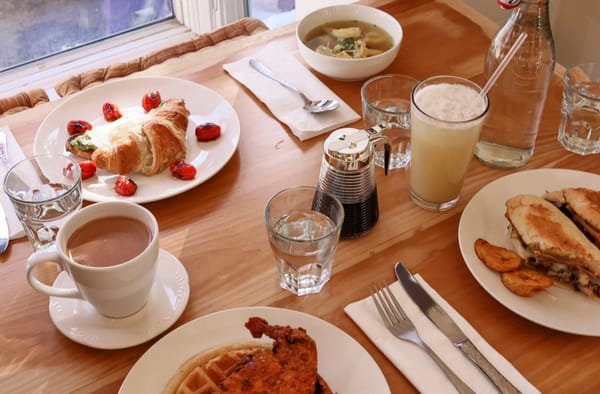
No Comply’s other disruptive practice is its menu, which changes every single day. Steve, a career chef who cut his teeth at places like Lutece and the 21 Club, thrives on those constraints, buying in small quantities and letting fresh local ingredients dictate the menu. “I always like limitations,” he says. “Limitations are good, because if you have everything you do anything.”
He and chef Dimitri Kofis sit down after every service and write a new menu based on whatever they have in stock and whatever local farms are offering. The result is a restaurant where regulars can eat four or five times a week and never see the same lineup twice.

“We wanted a place that was accessible for everybody,” Julie says, careful to acknowledge that “affordable” means different things to different people. The point is transparency: “When you come in, you know what you ordered is what you’re going to pay.”
If you do want a drink after your meal at No Comply, across town is Half Rats, the new natural wine bar from 20-something owner Abby Pendergist, provides a copacetic counterculture atmosphere, bringing a scrappy, raw edge to a business district better known for its polish, its vintage art and exposed brick infused with what Pendergist calls a confident but relaxed energy.
“‘Half rats’ is Victorian British slang for being slightly tipsy,” she explains. She found the phrase in an old dictionary while dreaming up a concept that fused her love of vintage clothing and natural wine.

Pendergist worked for years at Prairie Whale, where Mark Firth’s natural-wine list changed her life and helped train her palate. Now, at her own bar, she’s determined to keep things approachable. “Wine lists can be scary,” she says. “I like the idea of being able to come in and be like, ‘What the hell does a Georgian wine taste like?’ and you can just try it.”
The town’s community identity is mercurial. The most significant change of the past year is the relocation of Simon’s Rock’s at Bard College operations from Great Barrington to a property adjacent to the main Bard College campus on the Hudson River in Dutchess County. The small early-college campus long served as an intellectual and cultural engine for local life. Now, its expansive 270-acre Great Barrington property faces an uncertain future.
Frangione, whose GBPT hosted its summer programming at the campus’s Daniel Arts Center, is part of a working group exploring a possible collective purchase of the property to ensure community-centered uses for the land. There are “heavy hitters involved,” he notes—local leaders, nonprofit heads, and arts advocates who want to see a mix of multigenerational housing, affordable rentals, and sustained arts access, rather than another gated enclave or luxury resort.

“It’s still a mystery what will happen,” he admits. “But there are people working on this who have the best interests of the town in mind.”
The loss of Simon’s Rock as an anchor has brought economic, cultural, and emotional concern. But that’s far from the only challenge the town’s stakeholders are confronting. Housing—or lack thereof—is the issue that threads through nearly every conversation. Hospitality workers, teachers, artists, even mid-career professionals often cannot afford to live here.
Restaurateurs like Steve and Julie Browning build their businesses with that reality in mind, trying to keep prices reasonable while paying living wages. Steve describes success less in terms of expansion than equilibrium: “So many businesses I worked for, it’s like, ‘Oh, you only broke even this year,’” he says. “You paid everybody. You paid yourself. Isn’t that enough?”
It’s a view of economic sustainability that doesn’t always square with the region’s real estate market.
Great Barrington is not just wrestling with economic inequity of today but also reckoning with its contentious racial history. In July 2025, after generations of ambivalence, the town unveiled a life-size bronze statue of civil rights pioneer and Great Barrington native W. E. B. Du Bois, seated on a curved Sheffield-marble bench in front of the Mason Library. Sculpted by Richard Blake, the figure’s outstretched hand is meant to invite engagement, turning the library steps into a small civic space for reflection.
The statue is the culmination of a three-year effort by the volunteer Du Bois Sculpture Project, which raised more than $350,000 and navigated lingering discomfort over Du Bois’s socialist politics. It joins a growing constellation of local tributes like the renamed W. E. B. Du Bois Regional Middle School and the Du Bois Freedom Center’s new public learning space in the former Clinton A. M. E. Zion Church, where Du Bois once attended services.

These acknowledgments are more than commemorative, they’re emblematic of Great Barrington’s contemporary willingness to engage its cultural scars in a public way.
Community energy also displays itself here in a number of improbable and theatrical forms. In summer, the Berkshire Busk! street-performance festival turns downtown into a walkable carnival of music, circus, and oddball acts. The Berkshire International Film Festival (BIFF) brings directors, actors, and cinephiles to the Mahaiwe, the Triplex Cinema, and other venues; last year’s red carpets featured appearances from Brian Cox and Chevy Chase. This coming year’s 20th-anniversary festival sets a new bar as BIFF becomes the first US festival partner for the European Union’s new Transatlantic Rising Stars Project.
And then there was the Sunshine Orange Subaru Crosstrek Parade. On a bright Sunday morning this past September, 14 sunshine-orange Subarus, each topped with orange balloons, looped through town in a honking convoy, to the confusion and delight of onlookers. The event was the brainchild of local DJ, writer, and self-described fun-haver Michelle Kaplan. She freely admits there was no grand plan. “I just thought it was so funny and stupid to me, and then it just kind of caught on,” she says.

Kaplan framed the parade not as a fundraiser or marketing gimmick but as a small act of shared absurdity. “This is just a celebration of absurdity,” she says. Yet even she was struck by how much connection it generated. “The group was very diverse, all different ages and coming from all over the place.”
In a town negotiating its identity, these ephemeral celebrations serve as reminders that community isn’t only about policy and planning. Sometimes it’s about a convoy of nearly identical orange cars circling a rotary, and dozens of strangers finding themselves, briefly, on the same bizarre wavelength.
What’s going on inside Great Barrington almost pales in comparison to the natural splendor that surrounds it. Monument Mountain, just minutes from downtown, is a 503-acre preserve whose ridgeline views have inspired wanderers for centuries. Bash Bish Falls, with its 60-foot plunge, draws hikers looking for both exercise and awe. The Housatonic River Walk offering moments of quiet even at the height of summer bustle.
In a place where you can go from a glass of natural wine at Half Rats to a ridgeline trail in 10 minutes, the boundaries between culture and nature blur. The integration of outdoor vitality and town life isn’t a backdrop, it’s how people here define themselves.
What makes Great Barrington compelling is not that it has solved its contradictions, but that it sees them. It is both polished and punk, historic and experimental, a tourist destination and a community fighting for its long-term integrity.
Businesses like No Comply and Half Rats reject the notion that success requires conformity. The Great Barrington Public Theater insists on developing new plays rather than relying on the safe canon. A local organizer dreams up a parade of orange cars simply because it delights her. Activists and volunteers push for equitable housing and meaningful remembrance, organizing around Simon’s Rock’s future and Du Bois’s legacy with the same stubborn care.
Great Barrington is not static. It’s not finished. It’s in conversation about sustainability, creativity, identity, and place—about how a small town can navigate the pressures of being so desirable without losing its individuality.
Great Barrington isn’t perfect, but there are a lot of people here taking their responsibility as the temporary stewards of this place very seriously, even when they’re having fun.