Kingston has a claim on one of the odder ideas in American music. The composer Pauline Oliveros lived and worked there, and she asked audiences to listen to everything at once: the note, the room, the hum underneath. Sit near a crystal singing bowl and that idea stops being abstract. One sustained tone fills the space, and small differences in pitch start to matter.
Those differences are written into the instruments themselves. Retail listings for Crystal Tones alchemy crystal bowls give each bowl's note along with a sharp or flat offset in cents. Learning to read and hear that number is a small, satisfying piece of ear training. It also explains why some sets sound settled and others seem to wobble.
What Did Pauline Oliveros Teach About Listening?
Oliveros was a pioneer of "alternate tuning systems, contemporary accordion playing, electronics, and multimedia events," according to Rensselaer Polytechnic Institute's tribute to Oliveros. She founded her Deep Listening institute in 1985. Chronogram's own Oliveros profile calls her "the Kingston composer."
The practice took its name from a recording session. In 1988 she and two colleagues climbed down a 14-foot ladder into an underground cistern in Port Townsend, Washington. RPI notes the space had a reverberation of 45 seconds at low frequencies. Selections from their drone improvisations were issued on CD, and the name stuck.
Oliveros taught a Deep Listening course at RPI from 2001, and its Center for Deep Listening opened in June 2014. She died at home in Kingston on November 24, 2016, aged 84. Her idea still offers a sound bath audience something useful: attend to how the tones meet, not only to the tones.
How Do Cents Tell You Whether Bowls Agree?
A cent is a tiny slice of pitch. The retailer's tuning guide explains it in four steps worth knowing:
- One semitone equals 100 cents. A bowl marked "+10" sits a tenth of a semitone sharp of its note.
- Keep the spread narrow. The guide suggests the gap between the lowest and highest cents markings in a set stay within 10 to 15 cents.
- Hear the difference. Its sample C, E and G triad at +5, +10 and +0 sits in range. The same chord at +0, +25 and -20 produces "noticeable discord."
- Check unmarked bowls. A chromatic tuner or a tuner app shows both the note and the cents offset.
The guide's point is that nobody needs musical training to apply it. Kingston's Deep Listening Institute once supported artists who worked with that same patient attention.
Why Do Two Close Bowls Seem to Pulse?
Strike two bowls that are almost, but not quite, the same pitch. The combined sound swells and fades at a steady rate. Physicists call these interference beats.
The University of New South Wales has a clear guide to interference beats. It states that "the beat frequency equals the difference between frequencies of the beating signals." So two tones 4 Hz apart pulse four times per second. Push the gap past roughly 20 or 30 beats per second and the ear stops hearing pulses, the page explains.
The retailer's own pairing guide uses exactly that arithmetic. Its example starts with a bowl at 220 Hz and looks for partners near 216 Hz or 224 Hz. Those come out around 30 cents flat or 30 cents sharp of the same A.
The guide separates two listening setups. In one, a bowl sits near each ear so each ear gets its own tone. In the other, both tones mix in the air and the pulse is acoustic.
For a listener, beats are a free tuning tool. Slow pulsing means two bowls are close. Fast, rough pulsing means they are further apart.
How Do 432, 440 and 528 Hz Compare?
Bowls are often sorted by tuning labels. Here is how the retailer's tuning guide places them against standard pitch:
The same guide answers the obvious question plainly. Bowls do not have to be tuned to 432 Hz or 528 Hz to sound good together. They harmonize "if their tuning is close in cents." For an ensemble player, that is the practical takeaway.
What Shapes a Bowl's Pitch and Voice?
The guide also covers the physical side of the instrument:
- Size: larger bowls generally sound lower, and smaller bowls sound higher.
- Wall thickness: thicker walls produce higher pitches, while thinner walls produce lower ones.
- Range: crystal bowls typically span the 2nd to 5th octaves, with most in the 4th octave.
- Material: the alchemy mainly affects timbre and resonance, not the pitch or cents reading.

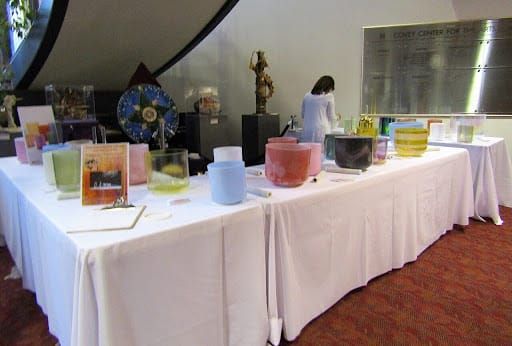
Sacred Sound of the Soul, a gallery in Encinitas, California, describes Crystal Tones bowls as quartz crystal, "99.992% pure," mixed with gemstones and precious metals. It says it holds over 500 hand-selected bowls, posts a video of each and ships within the US and worldwide. Its online filters let buyers sort by note, size, cents group and tuning.
How Can You Practice Listening to a Bowl Set?
You do not need to own a bowl to start. A sound bath, a gallery visit or a recording will do:
- Follow a single tone from strike to silence, and notice when you lose it.
- Listen for pulsing when two bowls ring together, and count it against your breath or a clock.
- Notice how the room changes the sound: carpet, stone, wood or open air.
- If you do try bowls, bring a tuner app and write down each note and cents offset.
That last habit is how players build sets that sit well together. It also makes any bowl listing far easier to read.
Frequently Asked Questions
What Does the Number After a Bowl's Note Mean?
It is the cents offset, meaning how sharp or flat the bowl is against the named note. A semitone holds 100 cents, so "+10" is slightly sharp.
Do Crystal Bowls Need to Be Tuned to 432 Hz?
No. The retailer's tuning guide says bowls harmonize when their cents markings are close. It suggests keeping a set within a 10 to 15 cent spread.
Why Do Some Pairs of Bowls Sound Like They Are Pulsing?
Two tones close in pitch create interference beats. The number of pulses per second equals the difference between the two frequencies.
What Was Deep Listening?
It is a listening practice developed by Kingston composer Pauline Oliveros. The name came from a 1988 cistern recording with a 45-second low-frequency reverberation.
Hearing the Room Around the Note
Crystal bowls are simple to play and surprisingly exacting to listen to. Cents markings, beats and room sound all shape what reaches the ear. Kingston's most famous listener spent decades asking people to notice all of it. A bowl set is a good place to practice.