Cynthia Erivo Defies Expectations and Creates Her Own Gravitational Pull With the Boston Pops at Tanglewood
In her Tanglewood debut, Erivo turned a night of standards into a happening and put the entire audience under her spell.

In her Tanglewood debut, Erivo turned a night of standards into a happening and put the entire audience under her spell.
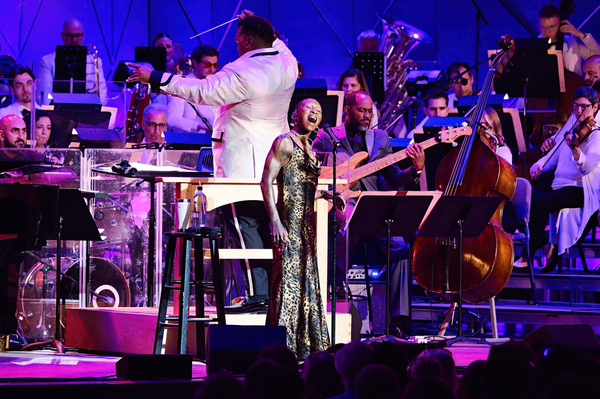
Cynthia Erivo opened the show by telling the audience it has been a tough year and this was the first time in 2026 she's been able to preform in an intimate setting. She sang with an air of relaxed self-satisfaction. Photo credit Hilary Scott, courtesy of the Boston Pops.
On August 21, Cynthia Erivo made her Tanglewood debut with the Boston Pops. By intermission the crowd around me was already in a state of shock. "This is the most incredible thing I've ever heard in my life," a Tanglewood regular said behind me. Another man, only half-joking, added: "Just so you know, she's singing to me. Just me." These were patrons who could probably not begin to count how many shows they’ve been here. Throughout the evening Erivo proved an elemental force, creating an atmosphere only she, Tanglewood, the Boston Symphony Orchestra, and this night’s audience could produce.
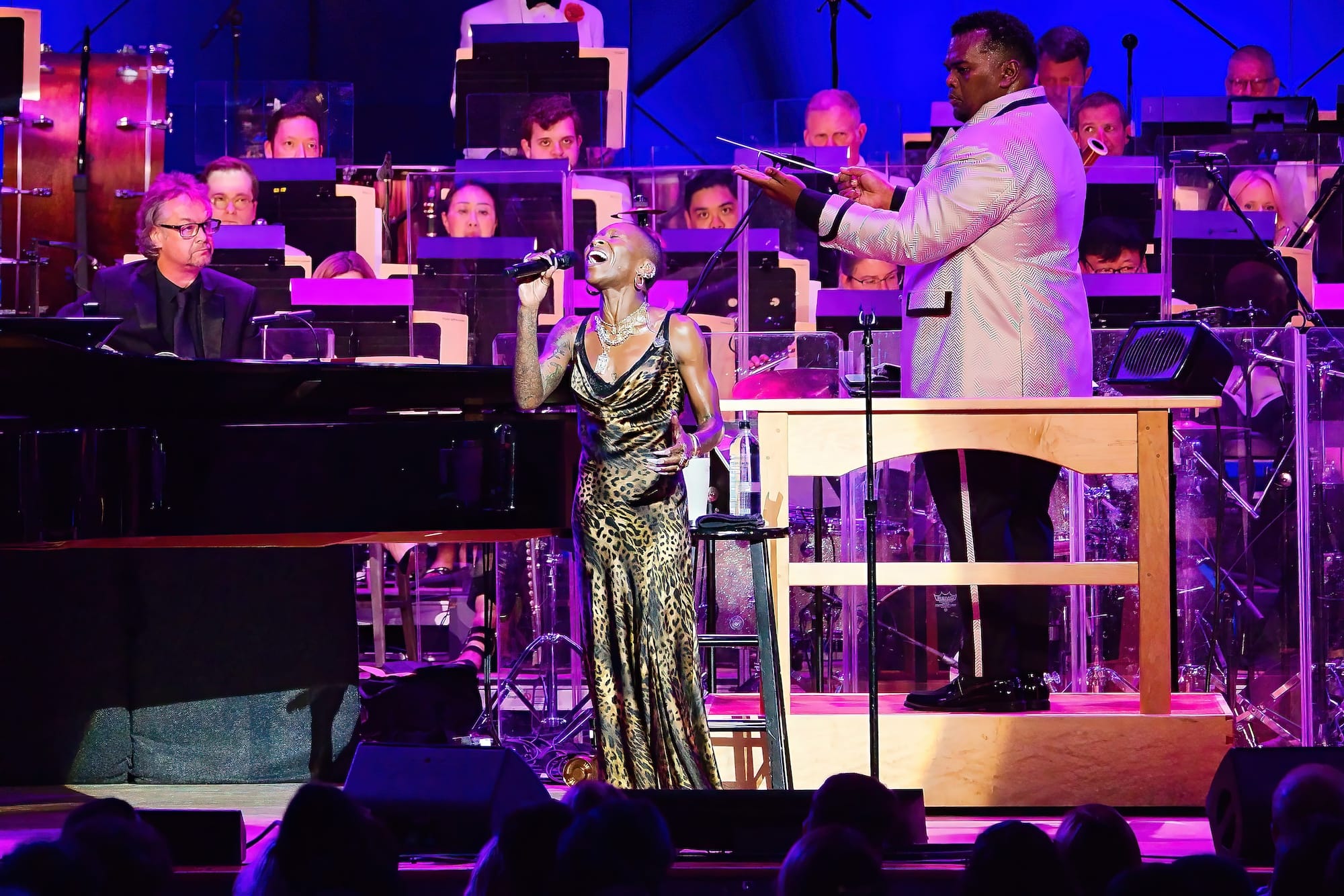
She didn't sing "Defying Gravity," her Billboard chart-topping ballad from the film version of Wicked, but it didn’t matter. Instead, this tiny bald woman proved her voice is its own cosmic power. Backed by the Pops as part of their “Popular Artists Series” under conductor Anthony Parnther (in his Tanglewood debut as well), Erivo created singular intimate moments and then blew the roof off the Koussevitzky Music Shed.
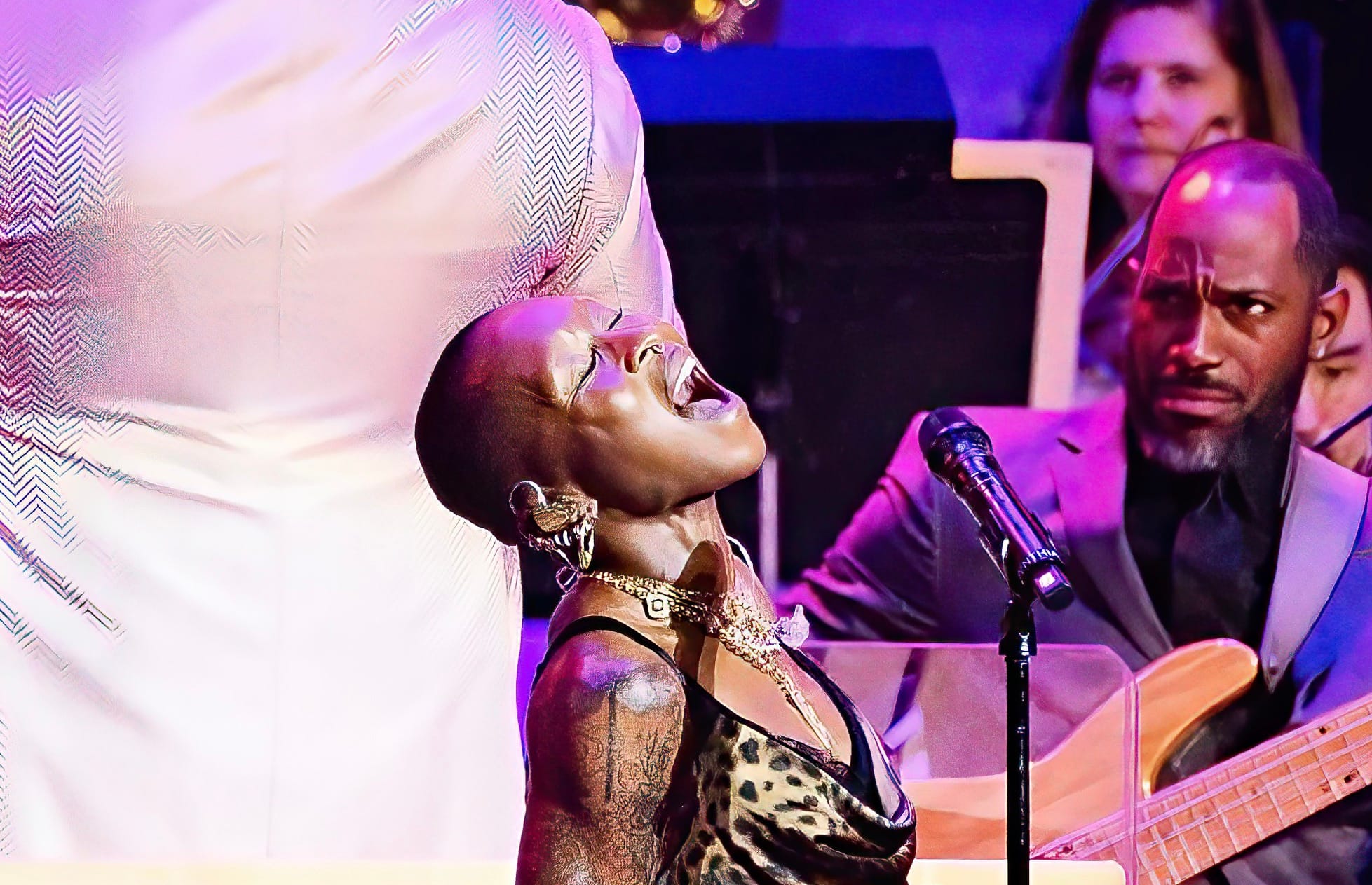
Erivo opened the night with two Barbra Streisand-associated numbers back to back: "Don't Rain on My Parade" and "Alfie." Both made the same point immediately—that Erivo houses within her a perfect vocal instrument. "Ain't No Way" followed, a song popularized by Aretha Franklin, one of the few singers in history who one could argue outrank her. Erivo, who played Franklin in the 2021 National Geographic series Genius: Aretha, took the song into the stratosphere with perfectly held soaring notes and emotionality.
Something shifted during "A Song for You." Between phrases, Erivo scattered plain, direct affirmations out into the crowd—"I see you," "I know you," "I know it's been hard," "I love you"—making eye contact as she went, giving people permission to stop performing their own composure and just sit in it. Putting a song like that so early in the evening set the rest of the night in a kind of relaxed, half-hypnotized register—the whole venue calmed. Toward the end of the song she set her microphone down at her side and kept singing on nothing but the room's ambient amplification. It felt like sweet nothings whispered into a thousand ears at once.
Her rendition of "Fields of Gold" was the best version of that song I've heard. "Let Me Go," and the stripped-down reprise that followed with only Erivo and music director Mark G. Meadows on piano, turned into a blistering Whitney Houston tribute with vocal runs so long and extravagant that Erivo crawled, actually crawled, from one end of the stage to the other and back, without a note going ragged. Doing that before intermission, rather than saving it as a closer, was a flex. "Feeling Good" closed the first half: classy, sexy, cool, incomparable.
After intermission, Parnther brought the orchestra back with the finale of Florence Price's Symphony No. 3 in C Minor, alone, and used the introduction to talk about the absence of women, and especially women of color, from the American symphonic canon. Price broke that specific barrier in 1933, when the Chicago Symphony Orchestra premiered her Symphony No. 1, the first symphony by a Black woman performed by a major American orchestra. The Pops used their orchestral showcase of the night to spotlight a composer who spent most of her career overlooked, then, brought back a performer who refuses to ever be.
Erivo came back for a run of compositions that didn't let up: "I Have Nothing," "What Are You Doing the Rest of Your Life," "At Last," "I Love You More Than You'll Ever Know." Banger after banger, without a dip in the set anywhere.
"Natural Woman" pulled the whole audience into a singalong before Erivo left the stage entirely and worked her way down into the crowd. Then came "Purple Rain," where the night tipped from incredible into something elementally joyous. Erivo called out to a single audience member waving a phone flashlight. "I see your light," she said, metaphorically. And within a few bars the entire shed lit up in response, a makeshift starfield spreading out across the lawn. "I wish you could see what I see," she said.
"Nothing Compares 2 U" followed as a gut-punch closer, Erivo's shaved head glinted in an unspoken, transgressive kinship to Sinead O'Connor, whose cover made the Prince song what it is. For an encore, she sat on the back edge of the conductor's riser, no orchestra, just her and a piano, and sang "Let It Be" like a personal parting gift.
What made the night feel singular to Tanglewood, and not just a great show that happened to stop there, was the scale of intimacy Erivo kept insisting on. She kept finding ways to make it feel like a room for one person at a time: a flashlight singled out, a microphone set down, a song sung in recline. It didn't feel like a performance of generosity. It felt like the actual thing.