Dassai to Brew Sake in Space: From Hyde Park to the Moon
From its Hyde Park brewery to the International Space Station, Dassai is testing whether one of Japan’s most tradition-bound crafts can survive—and evolve—beyond Earth.

From its Hyde Park brewery to the International Space Station, Dassai is testing whether one of Japan’s most tradition-bound crafts can survive—and evolve—beyond Earth.
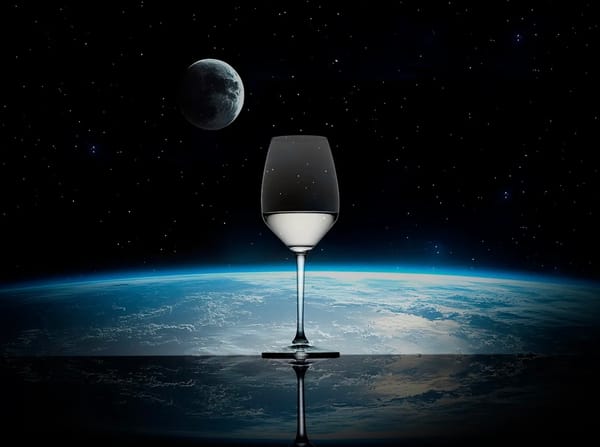
Dassai has spent the past decade building one of the most ambitious sake operations in the United States at its Hyde Park brewery, a light-filled, precision-minded facility across from the Culinary Institute of America. There, the Japanese brand—known for its exacting standards and modernist approach to brewing—has introduced American audiences to premium junmai daiginjo sake through a combination of craft discipline, technical rigor, and an almost evangelical belief in quality. Now, Dassai is extending that philosophy far beyond the Hudson Valley, toward a destination more often associated with science fiction than fermentation: the Moon.
The Dassai Moon Project, launched with the goal of brewing sake on the lunar surface by 2050, recently reached a milestone with the world’s first sake-brewing experiment conducted in space. In December, fermentation took place aboard the International Space Station, inside Japan’s Kibo module, in conditions designed to simulate lunar gravity. The resulting moromi—the fermenting mash of rice, koji, yeast, and water—was frozen after fermentation and is scheduled to return to Earth in late January for analysis and pressing.
For Dassai Moon Project Manager Soya Uetsuki, the idea of brewing sake in space was never simply a branding exercise. The project began after a Japanese space equipment manufacturer approached Dassai about the possibility of collaboration, at a moment when space agencies are increasingly focused on long-term human presence on the Moon. “As humanity looks toward a future in which people will expand their presence to the Moon, we believe that people on the Moon will also need ‘entertainment,’” Uetsuki says. Dassai’s ambition, he explains, is to offer a form of cultural enrichment—premium sake that adds “color” to life on the lunar surface.

There is also a practical dimension. Compared to grapes or hops, rice contains relatively little moisture, making it lighter and more efficient to transport through space. From Dassai’s perspective, sake has inherent advantages over other alcoholic beverages when it comes to off-Earth production—an unexpected alignment of ancient agricultural tradition and aerospace logistics.
The experiment itself yielded surprises. Although the plan was to run fermentation entirely under 1/6 G lunar gravity, an unforeseen issue meant the process began under microgravity conditions. The result, Uetsuki says, was striking. Fermentation progressed very slowly in microgravity, then became markedly more active once the environment shifted to simulated lunar gravity. “We were surprised to find that gravity also plays a critically important role in the fermentation process,” he says, adding that the company plans extensive post-return analysis, including genetic studies of yeast that developed in space.
The experiment was far from smooth. Uetsuki describes a cascade of minor problems that, taken together, were emotionally taxing precisely because they occurred in space, beyond immediate human intervention. Each response carried significant cost, reinforcing for him just how high the barrier to entry remains for non-aerospace industries attempting to work in orbit. The experience also exposed legal gray areas: while alcohol production on Earth is tightly regulated by national laws, outer space lacks a comprehensive legal framework for commercial activity. Uetsuki argues that a unified system will be essential as more industries look beyond Earth.
When the moromi returns, half will be pressed into just 100 milliliters of sake, released as Dassai MOON—Space Brewing—and sold for ¥110 million (approximately $700,000), with proceeds donated to space-related initiatives in Japan. The remaining half will be preserved as the world’s first space-brewed moromi, intended to support future research.
Despite the astronomical price tag, Uetsuki is candid about expectations. This first batch is not about producing a delicious sake. “The objective is to establish a proof of concept for brewing Japanese sake in outer space,” he says. Flavor, aroma, and texture are secondary to confirming that fermentation itself is possible beyond Earth. Still, as the world’s largest premium sake producer, Dassai cannot help but hope for something drinkable. Even a disappointing result, Uetsuki notes, would be valuable, offering clear direction for future attempts.

For those involved, the emotional stakes are high. The first sip, if and when it happens, will represent four years of work and significant investment. “I am hoping from the bottom of my heart that a first sip will be filled with joy,” Uetsuki says.
Looking toward 2050, Uetsuki envisions sake playing a familiar role in an unfamiliar setting—woven into daily life, ritual, and reflection, just as alcohol has been throughout human history. In the resource-scarce environment of space, he argues, Dassai’s values—care, commitment, and physical dedication to making something excellent—may matter as much as the beverage itself.
From the Hudson Valley to low Earth orbit, Dassai’s Moon Project suggests a future in which cultural practices travel alongside technology, and where, even on the Moon, humans may still pause to share a drink.
The public will have a chance to hear more about the project later this month. On Friday, January 23, Dassai Chairman Hiroshi Sakurai and Dassai Moon Project Manager Soya Uetsuki will appear at Japan Society in New York City for a lecture and conversation titled “Crafting DASSAI Sake on the Moon,” which will explore the science, philosophy, and logistics behind the experiment. The evening will include a sake tasting, with a VIP reception beginning at 6:30 pm and the main program starting at 7 pm. General admission tickets are $45.