Linda Kaye-Moses Turns 50 Years as a Jeweler Into Her Debut Novel About a Lost Jewish Treasure
The Berkshires jeweler, artist, and author reads from “The Argentera and the Tales of the Six Arabesques” at the Stockbridge Library on October 24.

The Berkshires jeweler, artist, and author reads from “The Argentera and the Tales of the Six Arabesques” at the Stockbridge Library on October 24.
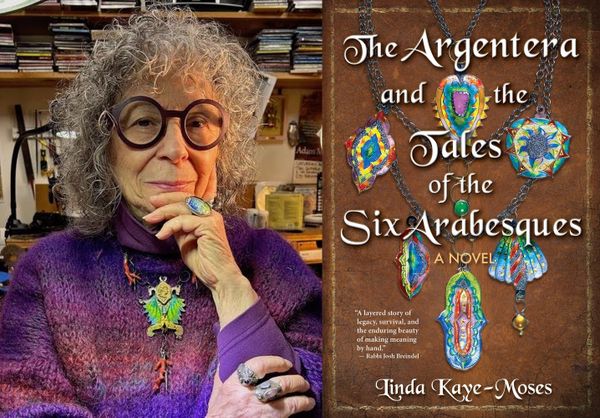
The Stockbridge Library will host Berkshire author, jeweler and teacher Linda Kaye-Moses for a free reading and Q&A from her debut novel, The Argentera and the Tales of the Six Arabesques, on Saturday, October 24, at 3pm.
The novel begins with a journal kept by a Jewish goldsmith in Alsace, France in 1349. It records the making of an enameled necklace that has since vanished. Centuries later the journal turns up in a local antiquarian bookstore. There it’s found by Miriam Kazofsky, a modern studio jeweler who becomes consumed with tracking down the lost necklace and the story behind it.
A working studio jeweler and teacher of the craft, Kaye-Moses brings her hands-on expertise to the narrative, which began taking shape a decade ago. Surprisingly the starting point wasn’t jewelry but her love of secondhand books. “My love of old books was the starting premise,” she says. Since she is a goldsmith herself, the journal’s author naturally became one too.
The history underneath the story is based in reality. In several Alsatian towns, caches of 14th-century Judaic objects were found hidden inside the walls of buildings, uncovered only during construction in what had been the towns’ Jewish quarters. During the Black Death, Jews across the region were blamed for the plague and forced to choose between baptism and slaughter. Some families burned their homes down around themselves rather than submit. Kaye-Moses’s fictional goldsmith hides his work in the walls and does the same. Only his daughter escapes, and she becomes the thread that runs through the whole book.
That thread winds through a remarkable number of eras. The novel visits ancient Persia in 470 BCE, where a weaver kidnapped from northern India is brought to the royal palace at Susa. It moves through 14th-century Alsace, Milan, Venice and Andalusia, then jumps to Venice in 1920 and finally to the present day. It’s a lot to untangle, and Kaye-Moses says that was the fun of it.
“I love doing the research, and I learned so much,” she says. She studied the portable backstrap looms her Persian weaver would have used and had her goldsmith’s name translated into Yiddish. She also discovered that Venetian is a distinct language rather than a dialect of Italian, so she tracked down an English-Venetian dictionary to get the period phrasing right. A glossary at the back keeps track of it all.
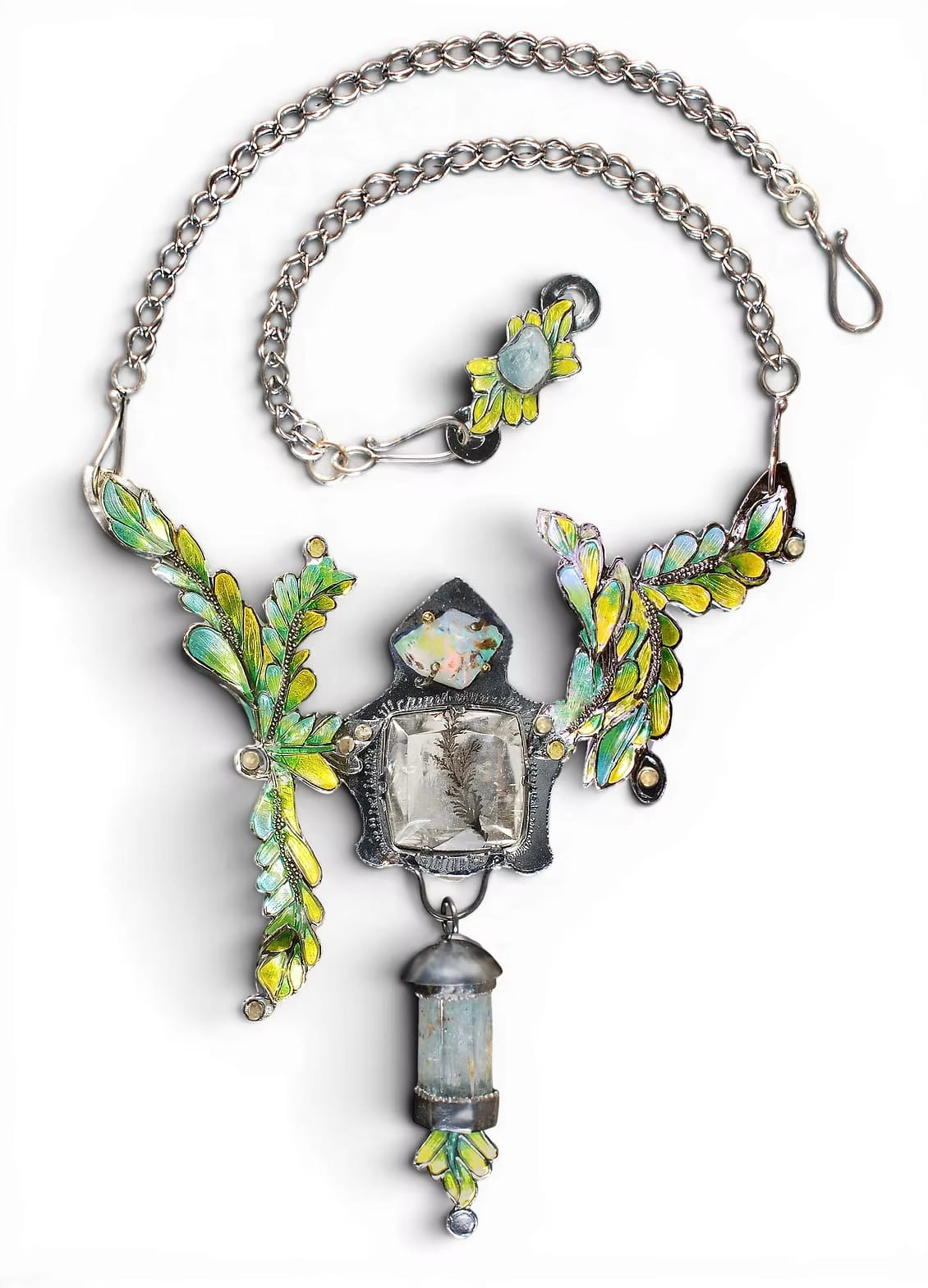
Kaye-Moses stresses that the book’s protagonist is not a stand in for herself, but her life clearly informs her character. Kaye-Moses first picked up a jeweler’s saw in 1976, in a one-night-a-week class. She has been largely self-taught since, working mainly in fine silver and sterling as both a metalsmith and an enamelist. Early on, she says, she had to talk herself into it each morning, announcing out loud: “I am an artist. I make jewelry, and after breakfast, I’ll be in my studio making jewelry.”
That confidence eventually took her to the front of the classroom. From 1994 to 2002 she ran the Metal Studio department at what was then the Interlaken School of Art in Stockbridge, now Berkshire Art Center, which makes this reading something of a homecoming. She became a certified precious metal clay artisan in 1999. “Metal clay” is a hard substance made of precious metal mixed with softening materials that allow it to be sculptable at lower temperatures. In 2001 she taught what are believed to be the first metal clay workshops held in New Zealand. Her jewelry has earned Massachusetts Cultural Council and Arts Lottery Council grants and two Saul Bell Design Award finalist nods.
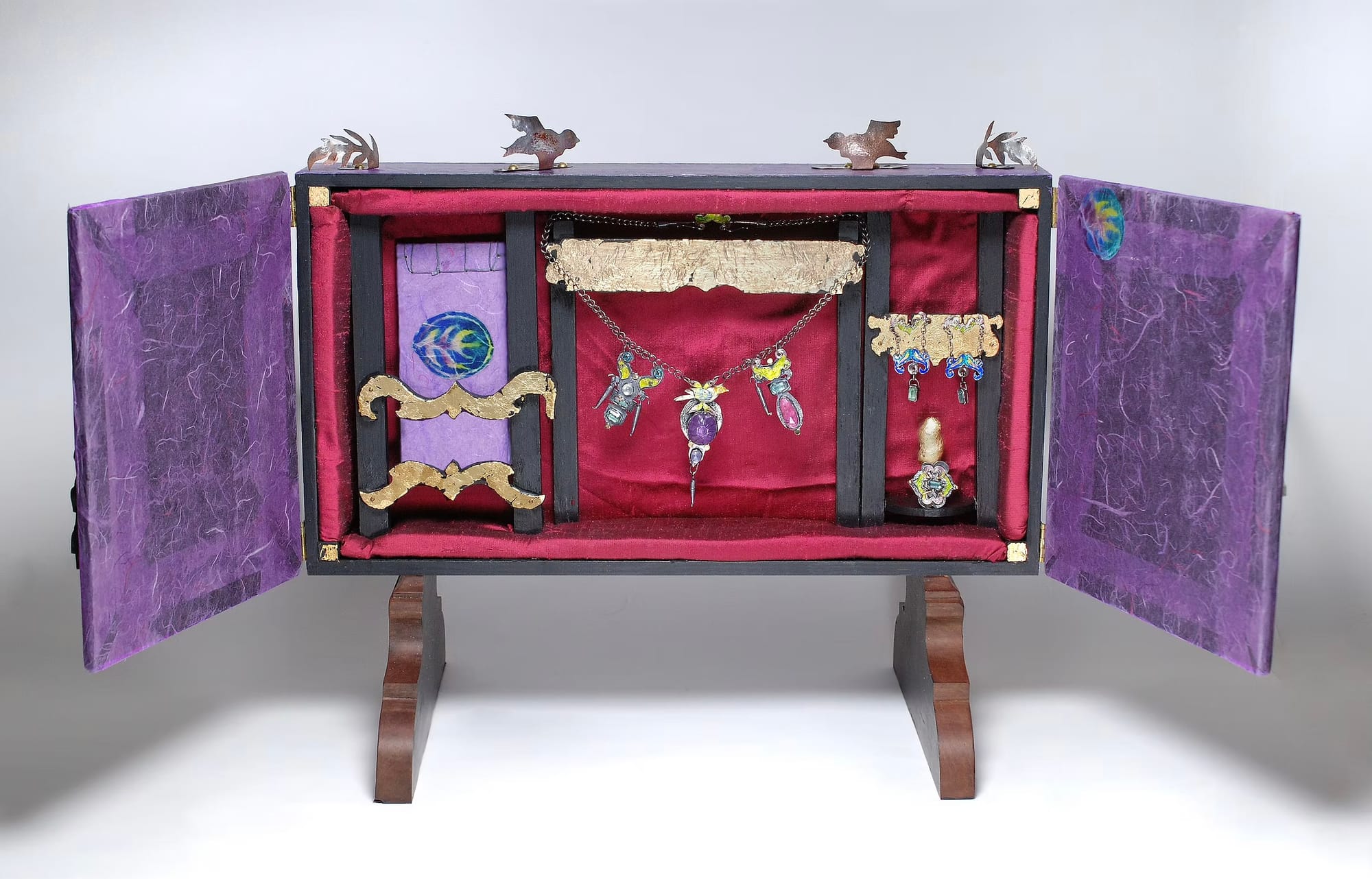
The craft spilled directly into the book. While laboring over the prose to describe the novel’s necklace, Kaye-Moses realized she could make it herself, and that piece now appears on the cover. She no longer owns it, because a collector bought it the first morning she displayed it at a show. “Everything I make is one of a kind,” she says. “I’ll never make that necklace again.”
The journal took on a life of its own as well. While writing, she kept reaching over to the side of her desk, as if it were sitting there for her to consult.
Barbara Newman, author of The Dreamcatcher Codes, calls Kaye-Moses “an artist with her hands and her words” and the novel a “page-turner.” Metalsmith Tim McCreight praised how it “maps the universal truths of love, loyalty and remembrance.” Kaye-Moses’s earlier nonfiction books include the how-to guide Pure Silver Metal Clay Beads and a memoir, Roots, Stems and Branches: A Recollection. Her writing has also appeared in the anthologies Strong Shoulders and Writing Fire, and she is a 2023 Writer’s Digest award winner.
Kaye-Moses, who describes herself as an “uppity, unruly octogenarian,” isn’t slowing down. She has two novellas she hopes to publish together, and she says writing gives her an excuse to keep learning: “I want to keep on learning till I’m 120.”
The October 24 reading runs 3 to 4pm at the library, 46 Main Street in Stockbridge, and is open to the public. The Argentera and the Tales of the Six Arabesques is available through her website at The Bookstore in Lenox, at the Art in the Berkshires gallery on Castle Street in Great Barrington, and on Amazon and Kindle.