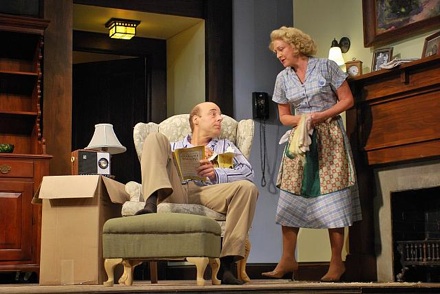
There's a new word -- "authentrification" -- that developers in New York City are using to justify renovating buildings that once served low-income communities and turning them into "authentic" hangouts for free-spending hipsters. Is this awesome or awful? The vicissitudes of gentrification are at the heart of Bruce Norris's articulate, searing and funny Clybourne Park, which has been given the Broadway-worthy production we've come to expect from Barrington Stage Company in Pittsfield (running through October 13.) Described as a sequel to A Raisin in the Sun, the 2011 Pulitzer Prize-winning Clybourne Park is the story of a white family in 1959 that is about to sell their very lovely house in an all-white middle class neighborhood of Chicago to an African American family; it then fast forwards 50 years when a young, affluent white couple buys the house and plans to extravagantly renovate it in a way that might have a devastating domino effect on the historic and now racially mixed neighborhood. You don't have to remember A Raisin in the Sun to be startled, disturbed and thoroughly entertained by this play that weaves together race and real estate, two of our nation's most primal and personal obsessions.
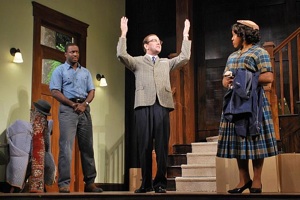
Produced in conjunction with Vermont's Dorset Theatre Festival, Clybourne Park is a play that raises more questions than it answers, in the tradition of Arthur Miller and Edward Albee. It's less a morality tale than an ethical puzzle: In our market-driven society, home is not a birthright but a prize that goes to the highest bidder. The American Dream of home ownership, it turns out, is as much about anxiety as security. The text cleverly lays out our relationship to our notion of place in the first few minutes when the white homeowner Russ (empathetically played by Remi Sandri) and his wife Bev (the divine Carol Halstead) discuss the etymology of "Neapolitan"--he is eating a carton of tri-colored ice cream as Bev cleans out the icebox before the move--and they wonder why the people of Naples are called Neapolitans, which leads to a discussion about the difference between "Mongoloids" and "Mongolese." The clever banter lays a foundation for the play, which is a meditation on identity and place. One of the treats of Clybourne Park is that all of the actors play new roles in the second act, so you get a clear sense of just how talented and versatile they are. As the 1950s housewife whose perkiness is a form of denial, Carol Halstead keeps her character from being a caricature, and then becomes a world-weary, hot-shot Chicago lawyer in Act II. Lynette R. Freeman as her uncomplaining-but-seething housekeeper in the first act emerges as a vivacious-but-resolute concerned neighbor after the intermission. All of the actors are at the top of their game: Kevin Crouch as a Capraesque preacher and then a lawyer who's gay-but-it's-hard-to-tell; Greg Jackson as both the vintage and contemporary version of the uptight, supercilious neighbor; Andy Lucien as the conscientious African American husband who defies stereotyping in two different eras; Clea Alsip as a pregnant, deaf woman in Act I and then the loquacious wife who is willing to berate her husband in front of strangers in Act II. The direction by Giovanna Sardelli makes the production run like an expensive Swiss watch: It's so well calibrated that it moves along with precision and a sense of inevitability. The only disappointment is that the play doesn't have an Act III, because you'd be happy to spend another hour watching these fine actors deliver Norris's crisp and cutting dialogue. Clybourne Park (through October 13) Barrington Stage Company Boyd-Quinson Mainstage 30 Union Street Pittsfield, MA