Luke Lawrence piloting his ice yacht, Ariel, in the recent Van Nostrand Challenge Cup on the Navesink River in Red Bank, New Jersey. Credit: Photo: T. S. Pfeffer

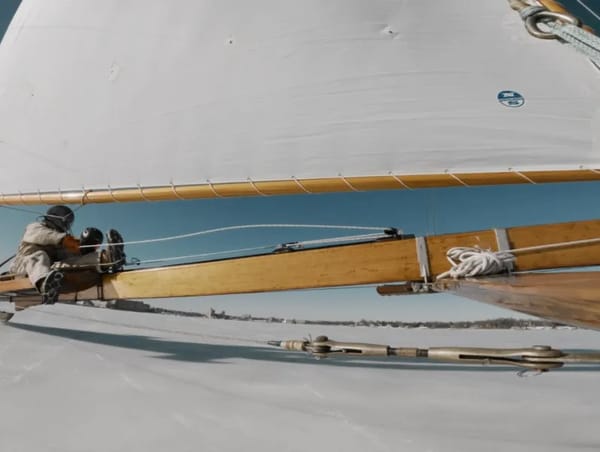
Imagine the river stretching ahead into the horizon as you maneuver your boat upwind, the gusts lifting the sides of the vessel off the surface. To react, you steady your stance and carefully distribute your weight, positioning the boat at the most optimal angle to the force of the wind. Now, imagine instead of water, you’re atop a thick layer of ice, ripping through the air at speeds nearing 100 miles per hour, your body prone atop a wooden hull, the steel blade runners cutting through the hard surface inches below. 

That’s the way Luke Lawrence, professional sailor and lifelong member of the Hudson River Yacht Club describes the sport of ice boating. “I’ve done snowmobiling and other fast sports, but there’s nothing like getting locked into an ice boat and going for a proper rip,” he claims, his expression visibly lighting up with excitement. “You’re at the mercy of physics. When you get it dialed in right, there’s no experience like it.”

0:00
/0:34

Luke is a fourth-generation ice boater, along with his cousin, Kevin Lawrence. “The first time I can remember being on an ice boat was when I was four years old at Orange Lake,” Luke recalls of his time spent with his family on the four hundred acres of solid ice in Newburgh. “I remember it was fast, and I was in the cockpit between my mom and dad.” As a child, his earliest memories also included trying not to get in the way of the adults at the woodshop where the vintage vessels would be meticulously altered and fitted, housed on the grounds of Lawrence Farms Orchards, the family farm in Newburgh. 

Ice boaters rely on steel runners and spiked footwear for traction as they maneuver vintage ice yachts across frozen rivers at high speed. Photo: T. S. Pfeffer

Ice boating began in Holland in the 17th century as a method for transporting cargo across frozen canals. It didn’t appear on the Hudson River as a sport until the late eighteenth century. The conditions for ice boating are specific, requiring thick ice, surfaces clear of snowfall with smooth, preferably black ice, and the right amount of wind. When the stars do align, it’s fleeting, and enthusiasts need to be ready to act. “It’s the spur of the moment, you take it while it’s there,” explains Lawrence of the unpredictable nature of the ice boating lifestyle. “You get the call, and you have a few days to get out there. There’s a lot of variables. You go, and suddenly, there’s eight inches of snow, so you end up working on optimizing the boats in the shop instead.” Ice boats, especially the vintage models, require intricate repairs and upkeep to ensure seconds and meters are maximized in preparation for “riding the edge” of the ice. Members of the Hudson River Yacht Club generally sail in the Mid-Hudson region, on the river and surrounding bays and lakes.

Ice boats on the Navesink River in Red Bank, New Jersey for the recent Van Nostrand Challenge Cup.Photo: T. S. Pfeffer

Being an active ice boater means spending the winter season regularly checking the local ice reports and keeping within close proximity to the shoreline should a call be made that a race was on. The Lawrence family’s commitment to the centuries old watersport paid off when the Ariel, manned by Lawrence and his partner, Max Lopez, raced to victory on the frozen Navesink River in Red Bank, New Jersey, during a February cold snap allowing for the Van Nostrand Challenge Cup to take place for the first time since 2003. The crew competed on behalf of Hudson River Yacht Club and reclaimed the sterling silver Tiffany & Co trophy from the defending North Shrewsbury Ice Boat & Yacht Club, where it had resided over the past century. The two clubs have rivaled for the cup since the event first took place in 1891, but the relationship has grown more respectful over the recent years. “The competition has gotten much friendlier with the new generation emerging,” Lawrence reports, “there’s a lot more cooperation.” 

Winning sheet tender and captain, Max Lopez and Luke Lawrence, during set up for the race. Photo: T. S. Pfeffer

Due to the limiting variables of weather and availability, most avid ice-boaters are also practiced catamaran sailors, referred to as “soft water sailing.” Growing up in South Florida provided Lawrence with ample opportunities for sailing, even going out solo for the first time before he hit his teenage years. As an adult, he’s secured three world championship titles, medaled in the Youth World Sailing Championships, and most recently won the Star Vintage Gold Cup with crewmate Mohamed Asif. “The skills formed in sailing translate well to ice-boating,” Lawrence says, “both forms of boating, especially in old vessels, the boats go where they want to go, and your job is to give them advice. Catamaran sailing enables you to see the ripples in the water to predict when the wind will hit, but with ice boating you can’t do that. It’s more reactionary.” Crew members on an ice boat, usually in pairs, use their bodies and weight distribution to steer the boat, laying their bodies forward on the hull with legs facing the back of the vessel, steering from behind. “You’ve got to roll with the punches and use basic principles of how to make the boat go fast,” Lawrence says. “It’s a lot of feeling and anticipating, but there’s nothing like being connected to the elements that way."

Be the first to know

Get the latest stories delivered to your inbox.

The patience and loyalty demonstrated by the Lawrence family in keeping the ice-boating tradition alive show no sign of waning. Both Lawrence and his cousin Kevin have children of their own and are already exposing them to the sport. “The kids are already little speed demons. They’re well into it, they love it. It means another 20-to-25-year process has started,” Lawrence says, calling it “a generational experiment.” 

Max Lopez and Kevin Lawrence on the ice. Ice boats can achieve speeds approaching 100 miles per hour. Photo: T. S. Pfeffer
Prospective participants and spectators can follow the White Wings and Black Ice sailing blog on the Hudson River Yacht Club website, and are urged to keep an open and flexible mind toward the short-notice sailing opportunities when the elements are in favor of action. “It’s so weather dependent, it’s practically impossible to schedule,” explains Alex Innis, Hudson River Yacht Club sailor, “the best way for those interested to get involved would be to join us. Club dues are only $25, and you can be in the loop when the conditions gel.” 

Share this post

Written by

How White Nationalists Weaponize Ancient Greece and Rome
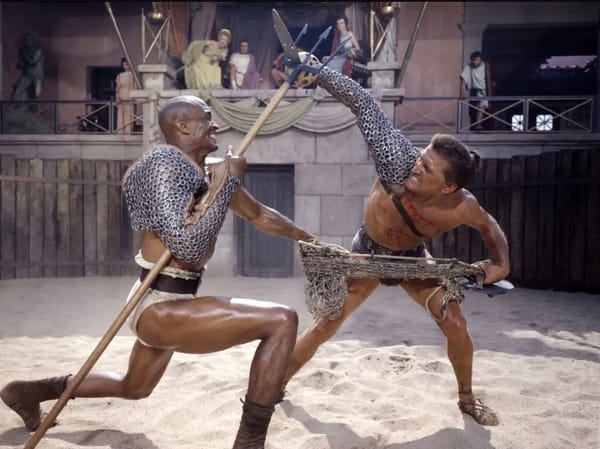
Scenes like this from Stanley Kubrick's "Spartacus" (1966) sit uneasily beside the idealized Rome so often invoked as a civilizational model—a tension at the heart of Curtis Dozier’s "The White Pedestal."

How White Nationalists Weaponize Ancient Greece and Rome