"The Testament of Ann Lee" Sings the Song of the Shaker Messiah’s Ecstasy and Tragedy
Local Shaker historic site leaders say the new film, starring Amanda Seyfried as Mother Ann, will help the public engage with the story behind the religion.

Local Shaker historic site leaders say the new film, starring Amanda Seyfried as Mother Ann, will help the public engage with the story behind the religion.
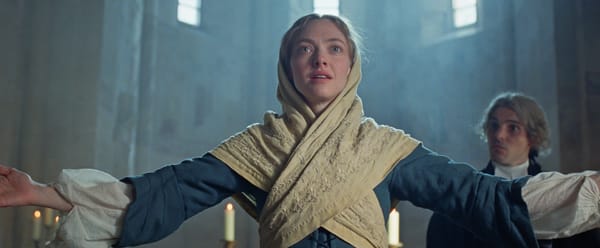
Actress Amanda Seyfried’s entrancing portrayal of Mother Ann Lee, founding matriarch of the Shaker movement in America during the Revolutionary War period, may go down as a pivotal moment in the history of the nearly extinct Christian sect. The Testament of Ann Lee, directed by Mona Fastvold and shot, in part, at Hancock Shaker Village, releases Christmas Day. The unconventional dance musical’s most significant attribute is bringing the people and beliefs of the Shakers to life in a way even the most beautiful round barn or elegantly crafted artifact cannot.
Seyfried’s trademark doe eyes shine with the pathos of a woman who lost all four of her children in infancy and was beaten and imprisoned multiple times for her beliefs in pacifism, chastity, and the conviction that she herself was a Christ-like second coming. Her performance resists sanctification or spectacle; instead, it locates Ann Lee’s spiritual authority in endurance, charisma, and radical clarity of purpose.
When we think of the Shakers and their legacy, it is most often through objects: spare ladder-back chairs, oval boxes, perfectly proportioned architecture, and an ethic of labor distilled into museum vitrines and coffee-table books. Even representatives from Hancock Shaker Village in Pittsfield, and the Shaker Museum in Chatham acknowledge that material culture has, for generations, overshadowed deeper engagement with Shaker belief systems and lived experience in the public imagination. Both institutions are hopeful that The Testament of Ann Lee will redirect some curiosity toward the Shakers themselves—particularly at a moment when both sites are undertaking major construction projects and rethinking how their old stories can be told in modern ways.
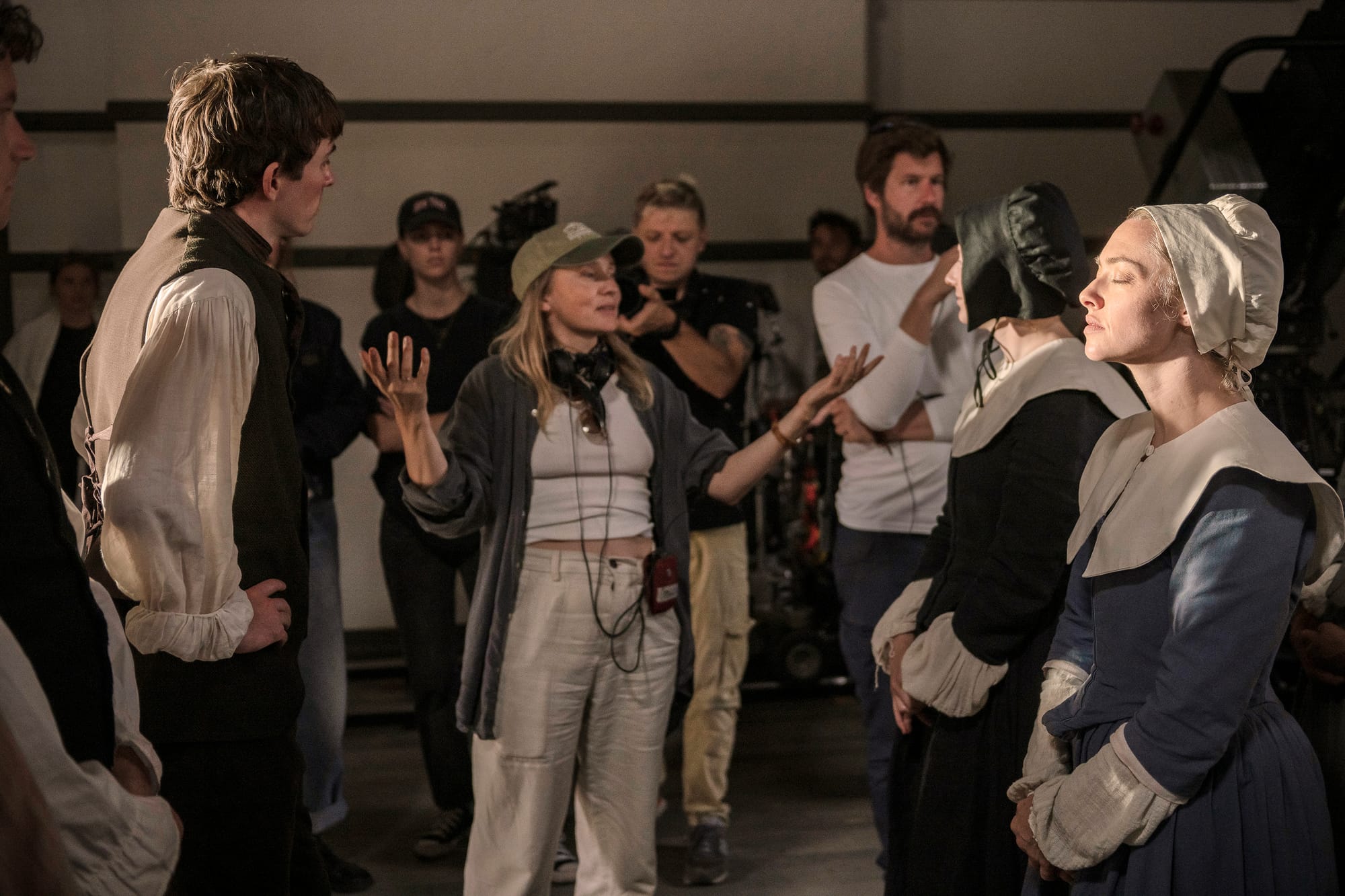
For Carrie Holland, executive director of Hancock Shaker Village, the film succeeds precisely where museums often struggle. “What film can do so powerfully—through music, movement, and emotion—is something that’s harder for us to convey through narrative and museum didactics,” she says. Seeing Ann Lee’s story embodied allows audiences to grasp not just the Shakers’ discipline, but “what it must have been like to have lived this life, and to have made the hard decision to join the Shaker movement.”
Fastvold’s decision to frame the film as a musical, using expressive, contemporary choreography rather than strict historical reenactment, is a daring and ultimately successful mechanism to convey when the Shaker faithful were filled with divine presence. For Sharon Koomler, collections manager at the Shaker Museum, the approach is less anachronistic than it might first appear. Music and bodily movement, she notes, were integral to early Shaker worship, particularly in the late 18th century, when ecstatic religious expression was common across rural America. While the film’s choreography is more structured than what would have occurred historically, Koomler views it as a good-faith translation rather than an invention. “The early days saw worship in a much more chaotic way than we would expect,” she says, emphasizing that visceral response was central to spiritual life.
Crucially, The Testament of Ann Lee does not present Shakerism as an aesthetic lifestyle stripped of its theological core. Instead, it foregrounds belief: revelation, discipline, communal accountability, and the radical gender dynamics of a faith led by a woman in an era that afforded women no public authority. Ann Lee’s leadership, supported by her brother William, who handled much of the movement’s external organizing, upended familiar hierarchies while remaining deeply structured. The film resists flattening this complexity into utopian fantasy.
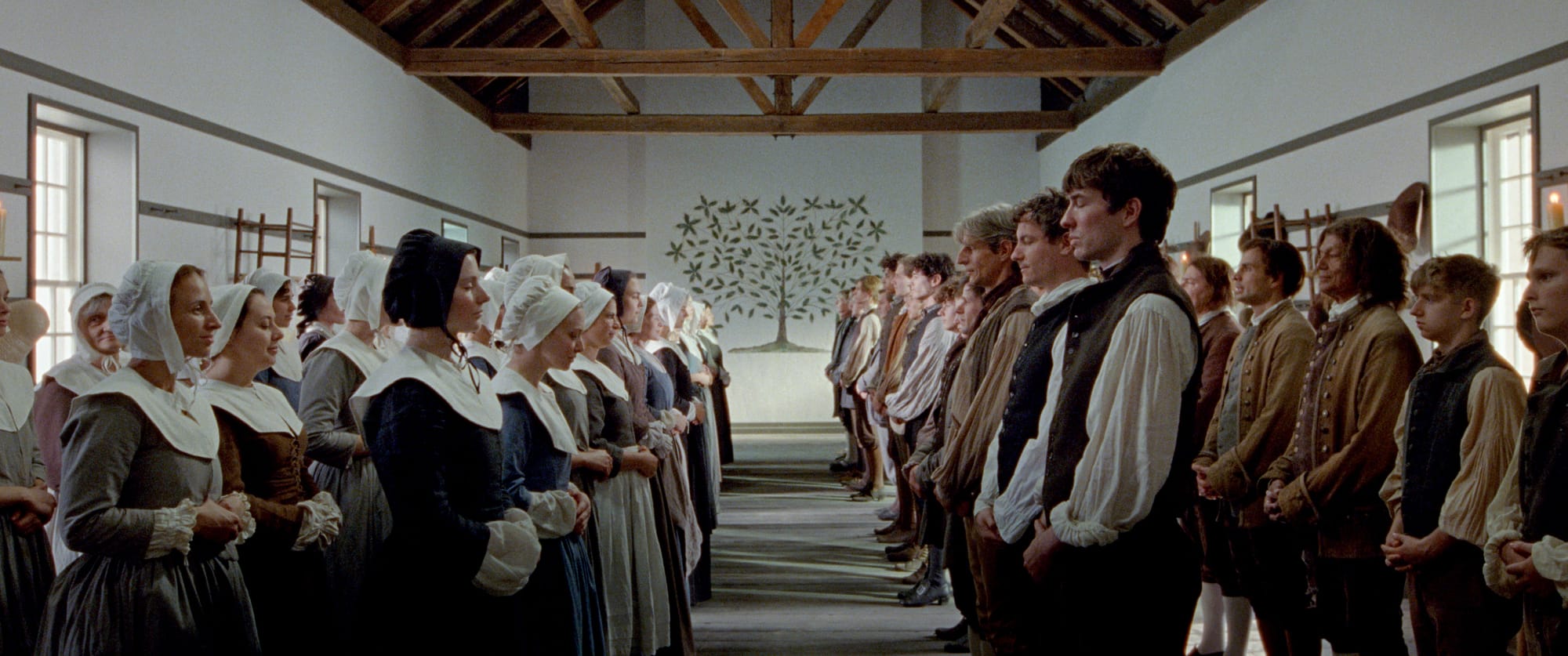
It would be easy, from a modern vantage point, to frame Shakerism as a trauma response—an attempt from Lee to impose order after catastrophic loss. Koomler cautions against that simplification. Contemporary accounts, she notes, describe Ann Lee as spiritually attuned from childhood, open to revelation long before tragedy defined her adult life. Her imprisonment in England in 1770, intended to silence her preaching, instead became the crucible in which her followers recognized her as a conduit for divine revelation.
The notion that the ubiquity of tragedy made people less sensitive to loss implies emotional dulling rather than adaptation. If anything, The Testament of Ann Lee suggests the opposite: that repeated grief sharpened the Shakers’ moral urgency and spiritual hunger.

The Testament of Ann Lee insists we acknowledge that the founding of Shakerism was neither quaint nor bloodless. Ann Lee’s migration to America in 1774 did not grant immediate religious freedom; she faced suspicion, violence, and repeated incarceration in the colonies as well. The film’s physicality makes palpable the cost of belief in a hostile world.
This reframing arrives at a moment of institutional reckoning. Both Hancock Shaker Village and the Shaker Museum are expanding and renovating their facilities, reimagining how visitors encounter Shaker history. The film, Holland suggests, may act as a “multiplier,” deepening interest among longtime supporters while attracting new audiences who come seeking story rather than furniture.
Koomler echoes that hope, noting that the museums now face both the challenge and opportunity of speaking more directly about faith. Without that context, she argues, “we’re not really telling the whole story.”
There is also something quietly radical in the film’s refusal to sanitize the Shaker experiment. Celibacy, communal ownership, and the dissolution of nuclear family structures are presented not as curiosities but as conscious, difficult choices. Choices that offered spiritual clarity to some while remaining untenable for others. Historical records suggest that Shaker communities were not free of conflict or transgression, but they were notably less marked by the systemic abuses that plagued many contemporaneous utopian movements and mainstream religions.
For a movement long reduced to an aesthetic, The Testament of Ann Lee restores stakes. It reminds us that the Shakers were not defined by objects, but by belief, and that belief, is still moving people centuries later.
Following its Christmas-week debut, The Testament of Ann Lee is rolling out gradually across the region. A sold-out advance screening at the Crandell Theatre on December 23 signaled strong local interest, followed by a free Woodstock Film Festival–hosted screening at the Rosendale Theatre on December 28. The film enters wider theatrical release beginning January 23, with screenings scheduled at independent cinemas including Upstate Films (in Rhinebeck and Saugerties), The Moviehouse, the Triplex Cinema, and Bantam Cinema & Arts Center. Looking ahead, Hancock Shaker Village, where portions of the film were shot, intends to host additional screenings both on site and at nearby theaters in 2026, with dates to be announced.