Dirty Gaia Defines Healthy Land with Farm and Garden Tour
The Good Dirt: Farm & Garden Ramble on July 19 tours 20 farms and gardens in Rhinecliff, Rhinebeck, and Red Hook.

The Good Dirt: Farm & Garden Ramble on July 19 tours 20 farms and gardens in Rhinecliff, Rhinebeck, and Red Hook.
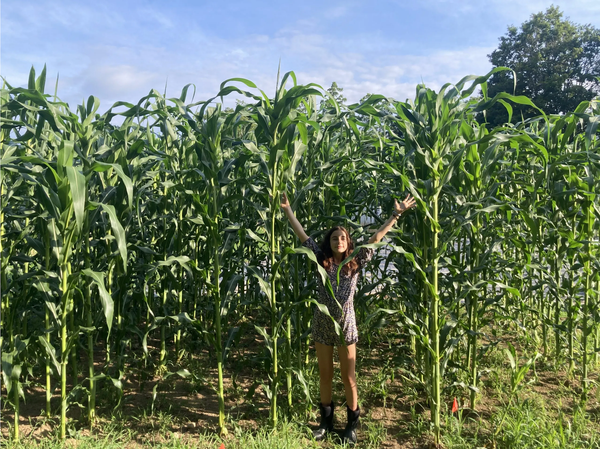
Cornfield at Neighbors Community Farm in Red Hook. Photo by Polina Malikin.
Cultivating a garden with perfectly placed flowers and neat grass can seem like an impossible task, even for those passionate about the environment. However, this is not the only type of healthy garden. Nonprofit ecological organization Dirty Gaia aims to expand the understanding of healthy yards in The Good Dirt: Farm & Garden Ramble, a tour of farms and gardens in northern Dutchess County on July 19.
The tour intends to show visitors that there is more than one way to have a beautiful yard. What may look arid and sparse is actually a healthy growing environment, just in dry sandy soil rather than the stereotypical grassy lawn. “For a long time in the United States there has been an ideal of a certain type of lawn,” says Polina Malikin, coordinator of the tour. “Sometimes that can be healthy, but it can also be toxic. We want to show there’s many ways to have a healthy yard.”

The annual farm and garden tour, covering Rhinecliff and Rhinebeck, returns for its sixth year with the addition of Red Hook locations. The tour focuses on a diverse range of 20 farms and gardens, feeding both humans and pollinators, promoting Dirty Gaia’s mission of educating people on environmentally sustainable land practices. “We want the tour to show people all the creative and diverse ways people are trying to be good Earth stewards,” says Malikin.
Malikin has focused on community and school gardens this year, expanding from privately owned farms. The tour will include the Bard College farm, the Red Hook Elementary School garden, and the Rhinebeck Elementary School garden. “We want to focus on all the work people are doing to support pollinators,” she says, “whether it be on their own land or in community projects.”
Community gardens can provide visitors who do not have land of their own with ideas on how to contribute to the environment through public spaces. These spaces can be especially helpful for new gardeners who are still learning. “It’s nice to be in a community of other people who can support you,” says Sue Sie, founder of Dirty Gaia. Sie created the organization in Rhinecliff in 2019, inspired by her work in the Ecological Literacy Immersion Program in Rhinebeck, intending to bring stronger education to gardening.
The tour this year will have two sections. The first part will start with registration at Rhinebeck Community Garden at 9am and cover the Rhinebeck and Rhinecliff areas until 1pm. After a lunch break, afternoon registration will open at 2pm and the Red Hook locations will be open until 5pm. Visitors can pick and choose which locations they want to go to and for how long they want to stay.

The day will end at Rose Hill Farm with a celebration and raffle from 5pm to 7pm. Food trucks and natural wine from the farm will be available. This is a new addition to the tour that allows the farmers and gardeners of different locations to spend time with each other and discuss their various projects.
Malikin hopes the tour will create a sense of community between the visitors, farmers, and gardeners. “Sometimes it can feel like it’s just you interested in ecological literacy,” says Malikin, “but it’s actually a very wide movement and there’s a lot of enthusiasm.”
Tickets for the tour are sold on a sliding scale of $5 to $50, and the money raised will be used to fund Dirty Gaia’s future projects. Their upcoming fall event, Thresh Fest, will take place at Morton Memorial Library in Rhinecliff at a currently undetermined date in late autumn. The event aims to teach people about how to preserve and take care of seeds in a changing environment. “Humans have survived by understanding how to grow food and take care of plants,” says Sie.