"Fork in the Road": Mary Berry, Nick Offerman, and Veteran "Chopped" Producer Expose a Food System in Peril at BIFF
The documentary, its makers, and stars come to the Berkshire International Film Festival May 29 and 30.

The documentary, its makers, and stars come to the Berkshire International Film Festival May 29 and 30.
There's a moment in the new documentary Fork in the Road that is hard to shake. Two handfuls of soil contrasted: One exhausted crumbling powder, the other rich and alive.
It's the difference between the overworked, polluted, corporate soil the majority of America's food is grown on, and that of a farm healing its land with regenerative practices and the support of a local regional foundation.
The documentary arrives at the Berkshire International Film Festival (BIFF) this week for two screenings, on May 29 at Lenox Town Hall and May 30 at the Triplex Cinema in Great Barrington, and it comes with the full creative team in tow: co-directors and executive producer Vivian Sorenson and co-directors Jonathan Natassi, executive producer and producer Lisa Holmes, composer Gary Meister and film subjects and Mary Berry, founder of the Berry Center, named for her father, the famed 20th century farmer, writer, and agricultural activist.

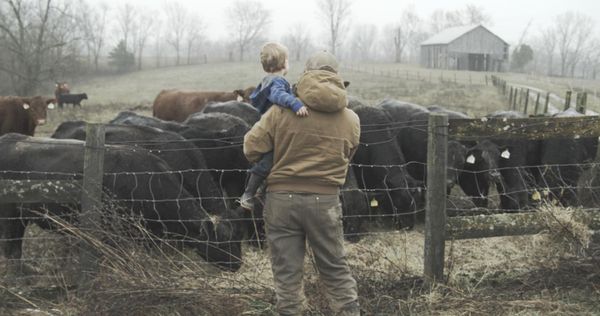
The film follows the farmers, chefs, and nonprofits fighting to make the American food system local again, from Alaskan kelp harvesters to dairy families in Kentucky. Friend of Mary Berry's, and down-to-earth actor Nick Offerman also perks up the production with his humor and earnestness. It premiered at the Sonoma International Film Festival earlier this year, supported by The Redford Center.
Shot over eight years, the film follows farmers, nonprofits, and chefs, from Alaskan kelp harvesters and Bronx urban gardeners to Kentucky dairy families. Their stories lay bare just how much has already been lost. The Combs family in Kentucky, Berry Center collaborators and one of the film's most affecting vignettes, watched generations of dairy farming effectively disappear overnight as the land around them was bought up and converted to corparate enterprises, leaving them, in Sorenson's words, land-rich but uncompensated for their labor.

They are not outliers. Small and medium farms are squeezed out of subsidies and unable to survive without off-farm income or philanthropic support. In Berry's telling, genuine farmers now represent fewer than three quarters of one percent of the American population—a number that has been declining, she says, systematically since the end of World War Two. Sorenson is insistent that the film isn't a dirge. "It's not just all darkness," she says. "There are so many good things going on."
Sorenson, who spent nearly 15 years producing "Chopped" and other shows for Food Network before turning her full attention to this project, isn't new to the issues of food justice. She grew up in New Mexico with parents who were activists and environmentalists. Her father's parents were labor organizers. The throughline, she says, was always present.

"I grew up knowing we have to do something. You don't just sit still, so that baton is just handed to you," Sorenson says. "I always like to say that your relatives, past and present, are at your neck sometimes, just saying you got to do it, so it's just been in me to agitate, to be a disrupter to some degree."
Sorenson's path from "Chopped" to Fork in the Road was not a departure so much as a deepening of her understanding. Working with chefs, she became obsessed with the farmers behind the ingredients. She fell, as she puts it, madly in love with agriculture.
"I wanted to tell the story of farmers who are adapting to change and figuring out how to grow our food," she continues. "And I began to understand that we all have this deep connection to agriculture. You just know it when you put your hands in soil. Something starts to change inside you."
American identity, she adds, has long been bound up in the mythology of the small family farm. It's a myth increasingly at odds with what is actually happening on the land.
"I do think we're deeply out of touch with our agricultural roots," Sorenson says. "It's pathetic. Our goal in making "Fork in the Road", is to lift up these farmers who are getting destroyed by climate change and extractive large-scale agriculture and keep on going anyway."
Sorenson sees a direct line between the story the film tells and the agricultural identity of this region. She is also honest that screening the film at festivals like this one involves a certain amount of preaching to the choir. Mary Berry says there are always members of the choirs that need to sing less and listen more.
"I think the choir can stand some more preaching to. These films are tools that tell a story in a way that gets some people's attention, and that's a gift, no questions."

Berry (not the British baking icon, but Mary Berry from Kentucky, Wendell Berry's daughter) is the film's moral compass. She runs the Berry Center, a nonprofit she founded in 2011 after years as a working farmer herself, focused on putting a viable economic infrastructure under small farms rather than simply celebrating them. There is kinship between the business assistance provided by Berry and local organizations like the Glynwood Center, which appears in the film.
"I don't know where else we're going to look for change other than nonprofits, because there's simply nothing serious going on in government. The corporations are running everything, and they're not going to change until they have to," Berry says. "What's going on now is destroying the land and destroying the people."
"I think often the choir doesn't know as much as the choir thinks it knows about the actual lives of farmers and what it takes to try to make a living farming," she continues (with all due respect to the choir). "It's been my job since I started the Berry Center to tell people that what you think is going on—seeing smiling farmers at your farmers markets, picking up your half bushel from your CSA, it doesn't mean that the situation for farming has actually improved. It hasn't. So, what we've got now, in spite of decades of a local food movement, and a lot of effort from good people all over the country, is a culture of industrial agriculture, and we have barely touched it."
She is also working under the conviction that regional food economies, not national ones, are where real change becomes possible.
"I'm thinking that what we're going to have to do is break this country up into regions and work toward regional food economies. It's going to take a long time to change this, longer than I have left. But you know what? One of the best things I've learned from the work here is that we don't get done, we don't win, we keep going, and as we go, things improve, and if you've got the scale right, you can see the improvement."

For Sorenson and Berry, the hope is that Fork in the Road contributes to something larger than awareness: genuine cultural change. The organic food movement, Berry argues, succeeded in making people care about what they eat, but the industrial system absorbed it without really shifting. "It hasn't become cultural change," she says. "And that's what we've got to do. That's the film's intention."
Sorenson says the urgency is real: Farm subsidies continue to favor industrial operators, farmland keeps disappearing, and the food supply chain grows more fragile by the season. What she and her collaborators are hoping for is that enough people, shown the truth plainly, in a handful of dirt, will decide to do something about it.