Just Days After Her Death, Oresta Szeparowycz's Sculptures of Talking Stones Go on View for the First Time in Millerton
The Ukrainian-born artist, who spent decades crafting collected shale into work she rarely showed anyone, died August 26—a week before her first major sculpture show opens at a friend's studio in Millerton.
Ukrainian-born artist and WWII survivor Oresta Szeparowycz died at home in Dover Plains on August 26, just a week before the opening of the first exhibition of her locally gathered work. This Saturday and Sunday, "Dreamt in Stone" opens at the Millerton studio of her friend and fellow artist David Crum, free and open to the public from noon to 4pm, now as celebration and tribute.
"She lived long enough to work with us on the show, to do the selection, to make the checklist," says Katie Crum, David's wife, an art historian, dealer, and retired museum curator who helped organize the exhibition. Szeparowycz was in home hospice by then, on palliative care for what had been a long creeping cancer, comfortable enough on painkillers to sit outside with the Crums and go through her life's work piece by piece. "I think it was kind of a nice way to spend your last week on Earth," Katie says.
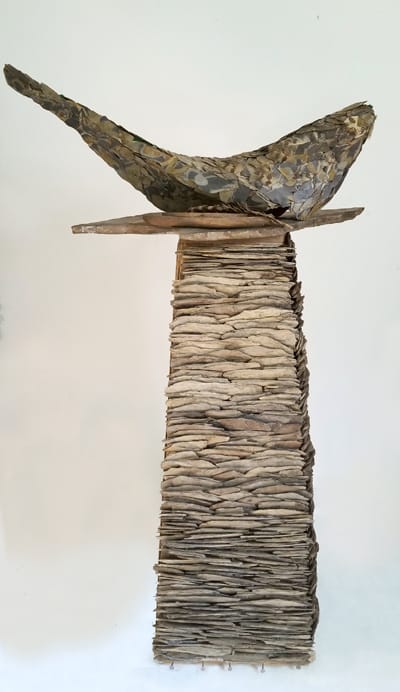
"Moojis Second Bird" by Oresta Szeparowycz
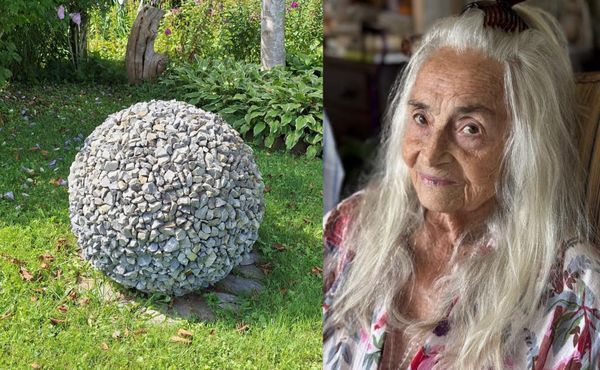
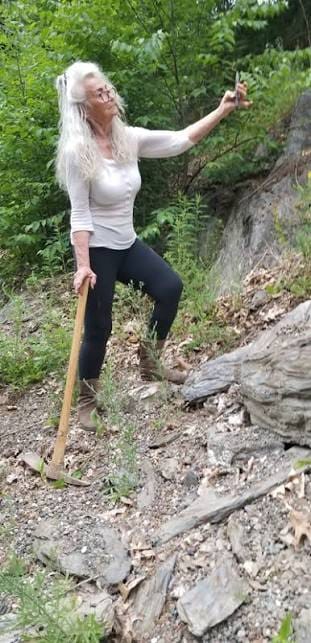
The work she completed in her last decades she kept mostly to herself. Trudging through the forest Szeparowycz collected stones, schlepping them home on her back, to be assembled in elegant abstract forms that were delicate, in spite of their weight. It was her private process and it is now the final piece of her legacy.
"It is uniquely my own language,” Szeparowycz said, shortly before her passing. “There are no rules or restrictions. Just the stones that speak to me with the voice of the ancestors."
From Refugee Camps to Bergdorf Goodman
Szeparowycz was born in Ukraine in 1938. When she was four her family fled the Nazi regime and she spent much of the next several years in displaced persons camps. The facts are murky, as Szeparowycz only gave friend's details in drips and drabs, but it's known the family reached New York in 1952, when she was 13, and settled in the Ukrainian community in the East Village. She earned a BFA at Pratt Institute and a scholarship to the Skowhegan School of Painting and Sculpture in Maine. She started her artistic career as a painter. In 1968 her work was selected to help bring the first American graphic arts exhibition to the Soviet Union, alongside work from Norman Rockwell. She attended the event in Kazakhstan and spoke with a somewhat befuddled crowd about abstraction. The moment was captured by the New York Times.
Oresta Szeparowycz
That same year, Szeparowycz designed window murals for Bergdorf Goodman in New York—visible, high-profile work that led to architectural commissions and, eventually, portrait work for Thai royalty and a commission from interior designers working for King Fahd of Saudi Arabia, for his palace and summer home in Jeddah. She spent time represented by Hanson Gallery on Rodeo Drive and the Dassain Gallery at the Pacific Design Center, painting large, boldly colored canvases with jungle and animal imagery that sold well in Los Angeles.
By the Crums' best estimate, sometime in the 1980s, that life stopped making sense to her. "She had some kind of realization that this is not it," Katie says. "She found no meaning in Beverly Hills." Szeparowycz left it behind to find herself in Crete, living without electricity or running water for roughly three years on the rocky island. It was there, alone with the landscape, that she found the material that would define the rest of her artistic life. "Just being in the presence of these stones, they came alive," Katie says. "They're actually sort of talking to her."
Among the stories that survive from that period was one unverified but often repeated tale of Jacques Cousteau passing through and photographing her living in the wild, among the rocks and sea. No one has ever produced the pictures, and the Crums are careful to call the tale it apocryphal, but Cousteau was in the area around that time, searching for the lost city of Atlantis.
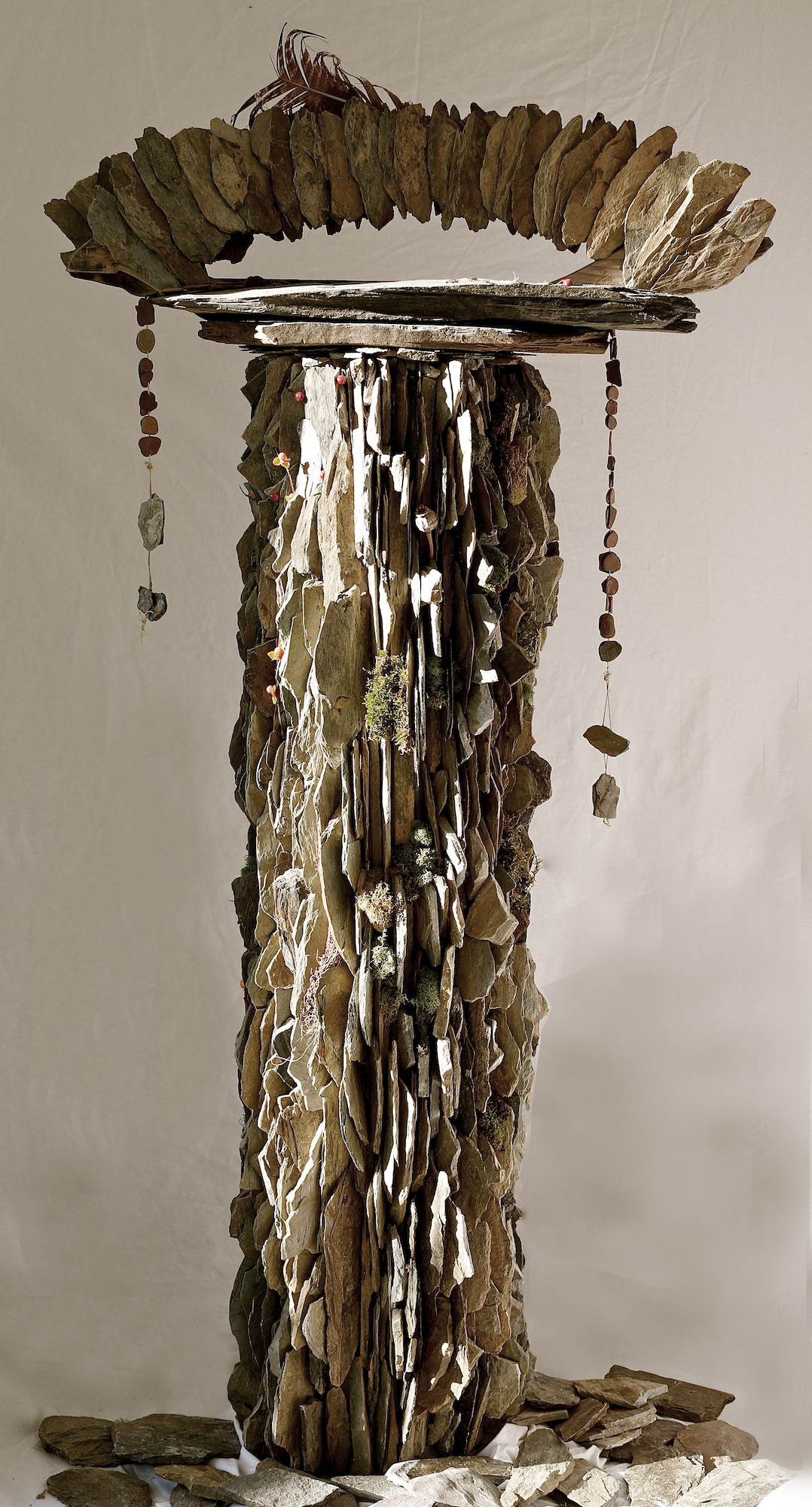
"Petras in the Light" by Oresta Szeparowycz
Twenty Years of Work, Hidden Away
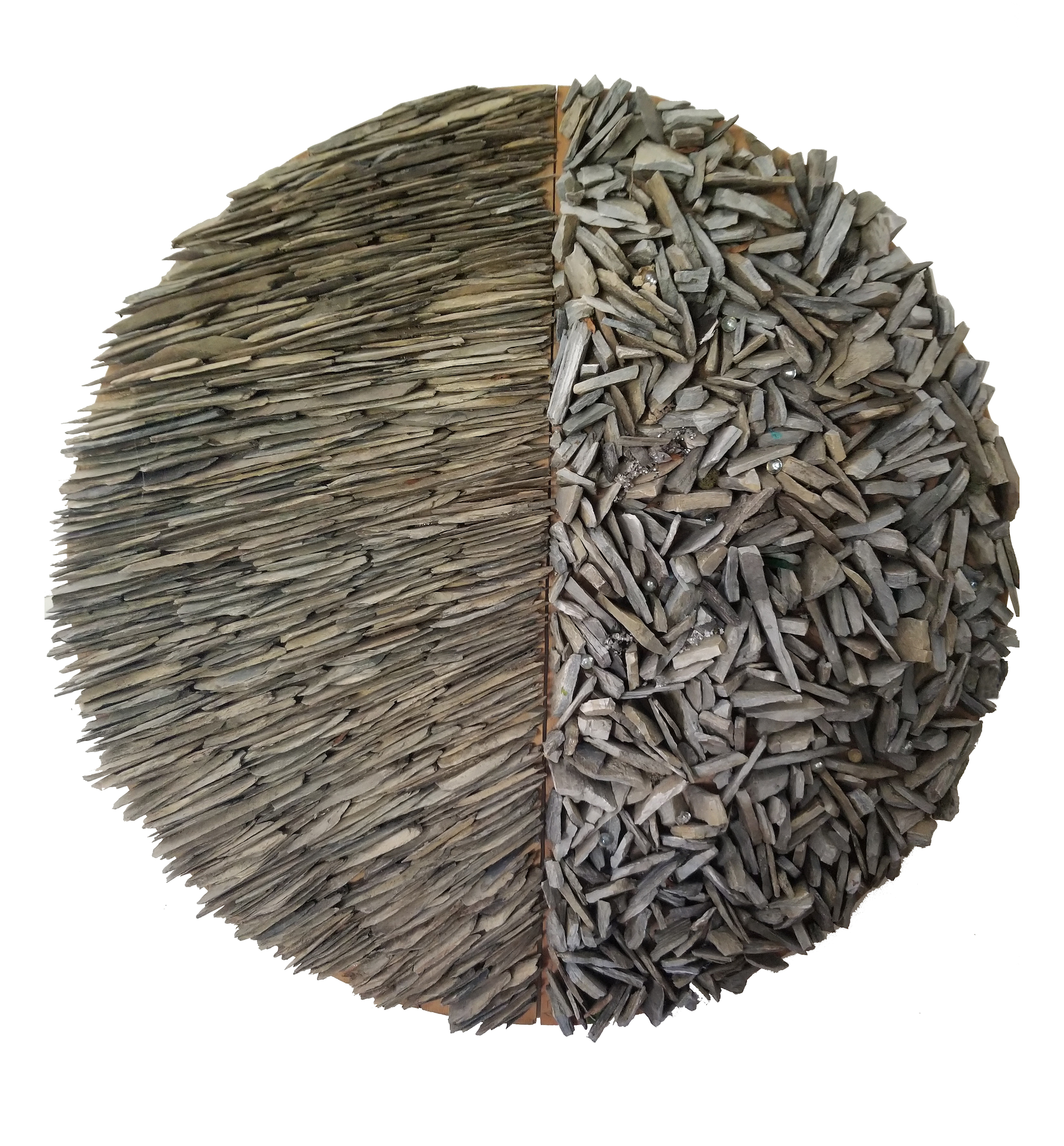
What followed was decades of stone sculpture, built from shale Szeparowycz gathered herself from meadows, fields, mountains, and riverbeds around Dutchess County. She didn't paint the stone; she worked with whatever color and grain it already had, coaxing it into forms that seem like feathers, flowers, or figures. One piece, "Set in Stone," captures what looks like a round boulder crashing partway through a stone pillar and freezing there, mid-impact—delicate and violent at once, out of material that weighs hundreds of pounds. "She gets stone to do things that stone shouldn't do," Katie says.
By her friends' account, Szeparowycz essentially never exhibited this body of work. Some of it sat stacked in the dark for years. Part of the reason was practical: she spent six years caring for her mother through dementia, lost her apartment in New York in the process, and ended up in Dover Plains, far from the gallery infrastructure that had supported her painting career. "This is not Chelsea," Katie says. Whatever the mix of causes, the sculpture that Szeparowycz herself considered the real statement of her life sat almost entirely unseen until now. "She wanted people to see what she had done," David says. "This was kind of a statement of her life. She wanted people to see her life in this work."
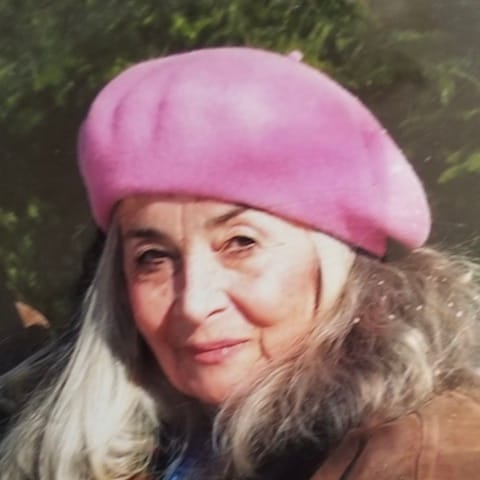
Oresta Szeparowycz at work somewhere in Dutchess County.
A Brief but Meaningful Friendship
The Crums didn't know Szeparowycz for long: they met in 2021, through mutual friends, the Wassaic-based artist Joel Foster and his wife, Tanya Shumitoff, a longtime writer for the Millbrook Independent. David and Katie liked her work enough to buy a piece when she was in need of money. The real closeness came later, through St. Thomas Episcopal Church in Amenia. David volunteers delivering groceries from the church's food pantry to people who can't get there themselves. Szeparowycz was one of his stops. The first delivery, he forgot her cat food and had to drive back out with it. "That impressed her a lot," he says. She started coming to services, became a regular, and the friendship grew from there.
David is himself a well known painter, an abstract colorist who has been showing his work for six decades. He was born the same year as Szeparowycz, in Peoria, Illinois, and studied independently alongside artists including John Chamberlain, Michael Heizer, and Willem de Kooning. Katie holds a PhD in art history and spent decades as a museum curator and director before becoming president of the Art Museum Partnership. Between them, they had both the eye and the practical know-how to pull a show together on short notice, once it became clear there wasn't time left to wait.
"Duality" by Oresta Szeparowycz.
Szeparowycz's cancer began in her right forearm. Friends say she was anxious throughout her illness about whether treatment would cost her the strength to keep working. For a stretch, she stayed with the Crums at their loft in Manhattan's East Village so she wouldn't have to make the trip from Dover Plains to Memorial Sloan Kettering for every appointment—surgeons, radiation oncologists, pain management, MRIs. "There were a zillion," Katie says. Once she moved into home hospice, the Crums finally had the occasion, and the time, to build the show they'd been talking about doing for years.
"It's not about the money," David says about why he, Szeparowycz, or any older artist desires attention in the last chapters of their lives. "It's not about being recognized in the airport. What we care about is having the work seen, and that goes right up until and after the time we die, I believe. It was certainly true for Oresta—she just wants to let people know: I did this, and here it is." Katie adds that, in her experience, artists think about the work far more than they think about recognition. "That's why hardly anybody's any good at the promotion part," she says. "Their energy does not go there."
A professional art installer, whose regular clients include the Cooper Hewitt and the Guggenheim, is placing the sculptures at David Crum's studio this week. "These pieces have been in the dark for years," David says. "They're going to be out in a nice clean space and I think it's going to be really fabulous."
"Dreamt in Stone," Saturday, September 5 and Sunday, September 6, noon to 4pm. 27 Old Post Road #2, Millerton, NY. The studio is just off Route 22, 1.5 miles north of the Main Street traffic light in Millerton: turn left onto Sawchuck Road, then take an immediate right onto Old Post Road #2. Free and open to the public.
After a decade of writing for RI (along with many other publications and organizations) Jamie took over as editor in 2025. He has a masters in journalism from NYU, a wonderful wife, two kids and a Carolina dog named Zelda.