Navajo Weaving Meets Computer Chip design at Bard
The first full survey of Marilou Schultz traces the unexpected territory between Diné weaving tradition and computer chip design, now on view at CCS Bard's Hessel Museum.

The first full survey of Marilou Schultz traces the unexpected territory between Diné weaving tradition and computer chip design, now on view at CCS Bard's Hessel Museum.
Through November 29 | Annandale-on-Hudson, NY
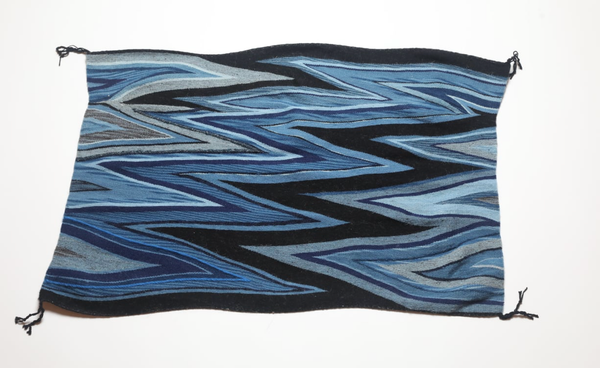
In 1994, Intel commissioned Navajo/Diné weaver Marilou Schultz to create a woven replica of its Pentium microprocessor chip. Schultz delivered the piece—and then kept going. Thirty years later, the Hessel Museum of Art at CCS Bard is presenting the first full survey of her 65-year career, organized around that commission and the body of chip-inspired work it sparked.
The connection between Navajo weaving and semiconductor technology is less unlikely than it sounds. Both are grid-based systems of exacting precision, and the visual language of microchip circuit boards turns out to rhyme closely with the geometric symmetry at the core of traditional Diné weaving. Schultz has spent the decades since the Intel commission exploring that overlap explicitly—incorporating metallic thread to evoke the aluminum and copper found in actual chips, working in wedge weave to achieve asymmetric and three-dimensional designs.
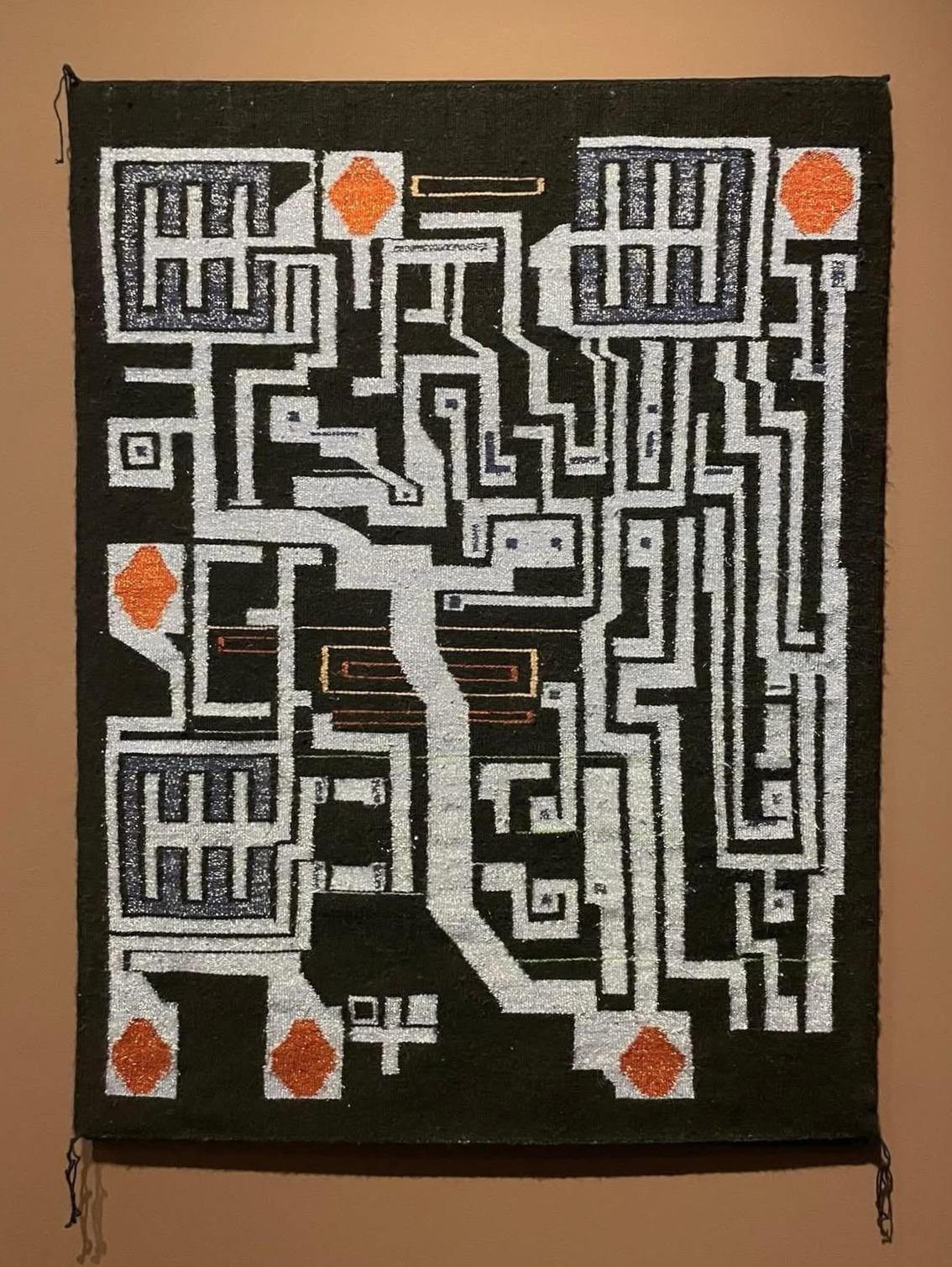
The exhibition, titled "Replica of a Chip: The Weaving Technology of Marilou Schultz," runs through November 29 and also carries a historical thread that sharpens the political dimension of Schultz's project. In the 1960s and 1970s, Fairchild Semiconductors operated a manufacturing plant on the outskirts of the Navajo Nation near Shiprock, employing primarily Navajo women. The plant closed in 1975 following reports of poor working conditions and a standoff between workers and local law enforcement.
Schultz's chip-inspired work, the exhibition argues, gives visibility to that largely unacknowledged history and to the technical expertise of those workers—a community of women whose contribution to American semiconductor manufacturing has never been formally recognized.
The show also situates Schultz within her family lineage. Her mother Martha Schultz and grandmother are represented in the exhibition alongside her niece Melissa Cody, all of them weavers, all in dialogue across generations—including through the Germantown style that emerged from the Navajo Long Walk, one of the last pieces Martha Schultz made before her death.
Schultz began weaving at seven, watching her mother and grandmother at the loom. She later became a mathematics teacher, describing weaving as a tool for learning and cultural preservation with direct applications in math.
The exhibition is curated by Candice Hopkins, a citizen of Carcross/Tagish First Nation and Executive Director of Forge Project, who first worked with Schultz at documenta 14 in Kassel in 2017. Schultz's work has since been included in major group shows at MoMA, the National Gallery of Art, and SITE Santa Fe, and is held in the collections of the Minneapolis Institute of Art and the Heard Museum. A catalogue co-published by CCS Bard and Forge Project accompanies the show, featuring an oral history with Schultz.
A Family Day event at the Hessel Museum is scheduled for Saturday, July 18 at noon.
Hessel Museum of Art, CCS Bard, Bard College, Annandale-on-Hudson, NY. More at ccs.bard.edu.