The Gallery Next Door: Elizabeth Moore Transforms a Captain Clapboard into a Living Showcase in Hudson
"The best environment for me is a gallery,” Moore explains. “Every apartment I’ve lived in I’ve approached as a space where art, design, and architecture work together. I always renovate my spaces to accommodate my collections. That’s how I live.”
Gallerist Elizabeth Moore long ago figured out her own, very particular, vision of a dream house—and it didn’t include bedrooms, square footage, or closet space. “The best environment for me is a gallery,” Moore explains. “Every apartment I’ve lived in I’ve approached as a space where art, design, and architecture work together. I always renovate my spaces to accommodate my collections. That’s how I live.”
Moore built her career in a similar art-centric way, with a knack for seeing potential where others don’t—in undiscovered art, forward-thinking gallery spaces, or neglected neighborhoods. “The key is having really good intuition and a trained eye,” she explains. “I read everything, look at everything in depth, talk to many smart people, and then ask myself, how do I swirl whatever’s at hand all together? That process results in all kinds of interesting, offbeat projects.”
In the summer of 2013, Moore’s out-of-the-box way of seeing led her to a run-down Federal-style row house off the beaten path of Warren Street “I went looking for an escape from the city,” she explains. “I’d been in Hudson during the ‘90s when it was really different from what it is today. It was rough. It was fun. It was discoverable. I loved it.” But Moore wasn’t just searching for a weekend home—she was also searching for a place that could accommodate her next professional chapter. “I didn’t want to come to the country and just be here,” she explains. “I wanted to work. I wanted to create things. I wanted to make something happen.”
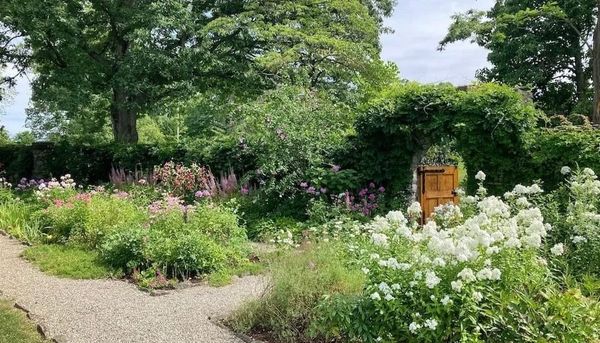
When she found her 1785 three-bedroom rental, she immediately recognized its potential. “When I walked in the front door, I could see all the way through to this beautiful chef’s kitchen, with gorgeous doors that look out onto a beautiful city garden,” Moore says. “That was it. I knew it was my house when I opened the door.” Moore jumped in with both feet, and didn’t look back.
One of the art pieces that hangs in Moore’s home. Photos courtesy of Amy Rose Photography + Motion.
Art Futures
Moore’s career had already taken her from gallery to boardroom to her own living room. After attending college in her native Massachusetts, she taught briefly in France, then moved to Manhattan, where she became the director of a gallery on 57th Street. It was a chance encounter in France, however, that set her on the career path less traveled. “I’d met the president of Atlantic Records, Ahmet Ertegun, at a dinner party,” she says. “We’d had a conversation about American art, how underappreciated it was, and how there was a whole untouched reserve of work out there.”
Moore reached out to Ertegun again when she was in New York. He remembered their conversation and suggested they team up to create an art fund, with him raising capital and Moore curating the collection. That was the beginning of the EC Group, an early private art-investment vehicle that lasted two decades. When Moore wasn’t working on 57th Street, she was visiting other galleries with Ertegun looking for undiscovered art. “We’d make offers on groups of paintings sitting in back rooms,” says Moore. “We unearthed this huge collection of American modern art.”
Once it came time to start selling, she quit her day job and worked for the fund full-time. Meanwhile, she continued collecting art, chairs, and copious amounts of art books to her own fancy. As the fund wound down, Moore decided to ditch the traditional gallery model altogether, displaying her own small collection in her second-floor walk-up. “I had a beautiful one-bedroom with a little fireplace on Lexington Avenue,” she says. “When I was ready to open my own gallery, I didn’t want to be in Midtown or in Chelsea; I wanted to be at home.” Her living room gallery became the template for what she’d create in Hudson on a larger scale.
Photos courtesy of Amy Rose Photography + Motion.
Weekender in the Context of Whaling Ships
Originally, Moore and her husband, Gary Purnhagen, rented the home for the autumn. She spent that time learning everything she could about the house and its history, as well as courting the home’s owner, who loved the house but had already relocated. “She was a real pioneer,” Moore explains. “The architecture on this block is some of the most beautiful in Hudson, but she bought it when the area was pretty sketchy.”
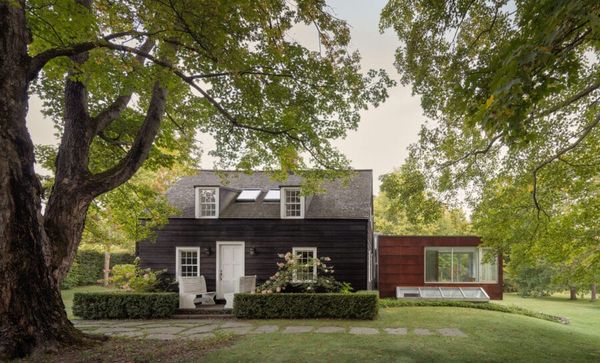
The clapboard-sided, two-story home was built by Jared Coffin, a sea captain, in 1785 during the city’s whaling days. “Legend has it that the beams and the wood were imported from Nantucket during the Revolutionary War,” says Moore. “It was a captain’s house, but not a fancy one. There are beautiful brick mansions on either side, and contiguous worker housing across the street.”
After the whaling industry declined, Moore believes the home fell on rough times along with the rest of the city. “It was supposedly a brothel at one point,” says Moore. “The ships were still coming up the Hudson and prostitutes came down from Albany. The sailors would land, get drunk, and go looking for women.”
Falling on hard times ended up preserving the home’s architecture, however, as the property was carved into four apartments and occupied by an extended family. “There were three generations and a vineyard out behind the garden,” says Moore. “The family harvested the grapes and made their own wine in the basement.” They also covered the original 18-inch-wide-plank floorboards with vinyl and carpet, inadvertently protecting them.
Sunken Treasure
Moore and Purnhagen eventually convinced the owner to sell, and decided on a preservation-first approach to the home’s redesign. “The previous owner had restored some beams, but she never really renovated,” says Moore. “She wanted a more traditional country house. I saw potential, however, in the bones and light.” Moore called in architect Carl Muehleisen, who was her Manhattan neighbor, to helm the restoration. “He’s incredibly sensitive to history and to the originality of houses and interiors,” Moore explains. “He understood the direction the architecture should go, based on the story the house was telling.”
They took the interiors down to the studs, stripping out molding, linoleum, and carpet, and revealing a treasure trove of original material underneath, including the wide-board flooring, locally sourced brick walls, and timber ceiling beams. After exposing the original materials, the redesign drew on the home’s historic whaling roots as well as Moore’s vision for another living room gallery. Muehleisen widened several interior doorways, opening the ground floor and fluidly connecting the spaces. He also relocated the central staircase, winding it from the ground floor up to the third-floor attic. “The vertical beams look like a ship’s mast when you’re looking up,” Moore says.
The chef’s kitchen became a centerpiece, with poured concrete radiant floors and French doors sourced from Argentina opening onto the garden. Upstairs, they left the original brick exposed. “It’s an homage to the craftspeople of Hudson,” Moore says, “And the masons who fired the bricks and installed them.”
Photos couresty of Amy Rose Photography + Motion.
Anchored in Art
Working with designer Andy Goldsborough, Moore reimagined the home’s interiors as pared-down, gallery-like spaces with a seafaring edge. Throughout the space, fabric panel dividers hang like sails. “We kept the spaces very solemn and simple,” says Moore. “The wide-board floors, white walls, and minimal moldings all make a statement. The design hearkens back to the sailing days.”
In 2014, Moore invited Goldsborough to bring his design blog, The Gilded Owl, to life inside the newly finished ground floor. In the years since, Moore’s living room gallery has hosted a series of exhibitions where art and objets d’art talk to each other and the home’s architecture. Germantown-based artist Paul Jacobsen photographed the home’s interiors mid-exhibition and hung the images on vinyl scrim outside. “That was one of my best exhibitions ever,” Moore says.
After the pandemic, Goldsborough relocated to Los Angeles, and Moore continued on her own at a slower pace. For Moore, the sea captain’s house has become its own objet d’art. “The house became the perfect backdrop,” she says. “The whole thing became synergistic. I found an old house, and fixed it up, but not in a traditional way. I fixed it up in a way that would accommodate my passion, which is art and design. We all create the environment to house our dreams. That’s what this house is for me.”