The Unstable Origins of Color Photography at The Clark
"Technical Difficulties: Early Color Photography and Conditioned Viewing" with art historian Rachel Lee Hutcheson.

"Technical Difficulties: Early Color Photography and Conditioned Viewing" with art historian Rachel Lee Hutcheson.
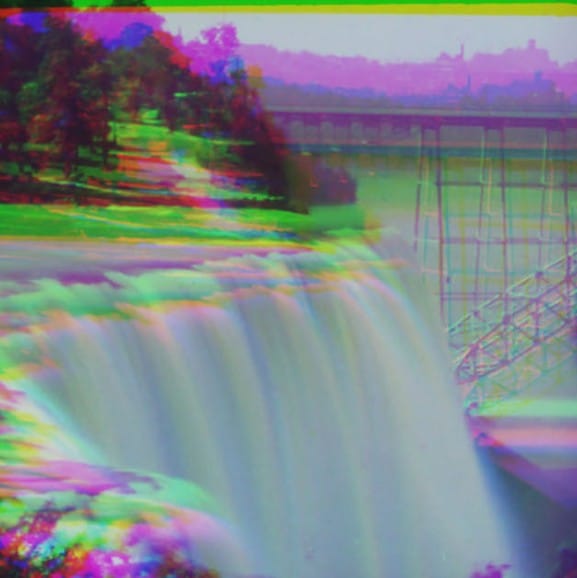
Frederic Ives, "American Falls, Goat Island" (detail), ca. 1890–1894. Kromogram. Collection Brian May Archive of Stereoscopy. Digital color composite by R. Hutcheson
April 10 | Williamstown, MA | 5:30pm | Free
What did it actually look like to see color photography for the first time? That question sits at the heart of a lecture at the Clark Art Institute on Friday, April 10, when art historian Rachel Lee Hutcheson visits to present "Technical Difficulties: Early Color Photography and Conditioned Viewing." A reception in the Manton Research Center reading room precedes the talk at 5pm; the lecture itself begins at 5:30. Both are free and open to the public.
Hutcheson is a visiting assistant professor at the Rochester Institute of Technology's College of Art and Design. She received her PhD from Columbia University in 2024. Her research centers on histories of perception, photography, film and video, and media theory, with a particular focus on the turn of the twentieth century, a period when photographers were wrestling with how to capture color not through hand-tinting or other applied means, but through the camera itself.
The lecture zeroes in on a set of early technologies that now seem almost fantastical: color images produced through arrangements of red, green, and blue separations and experienced through lantern projectors, stereoscopic viewers, or diascope mirror-boxes. These so-called "Natural Color" photographs were, paradoxically, both technically rigorous and inherently ephemeral. Their colors flickering into existence only under specific viewing conditions, making each encounter with the image something closer to a live event than a stable object. Hutcheson has conducted research on Frederic Ives, a pivotal figure in the development of color stereoscopic photography, whose "Kromogram" of Niagara Falls serves as an example in the lecture.
The larger argument is a compelling one: that the instabilities of early color technology reveal something important about photography's claims to reality, and that color itself has a history as a force that shaped modern perception, not merely a quality that cameras eventually learned to record.
Hutcheson's research has been published in Grey Room and presented at conferences internationally, including the Photographic History Research Centre at De Montfort University in the UK and the European Research Council project Chromotope.
Clark Art Institute, 225 South Street, Williamstown, MA. Free, no registration required. clarkart.edu