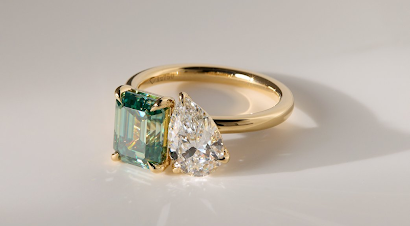
Two stones on one band, set side by side so neither one takes the lead. That’s a toi et moi ring, and if you’ve spotted more of them lately at autumn weddings and Saturday farmers’ markets, you’re not imagining it.
What a Toi et Moi Ring Actually Is
The name is French for “you and me.” Instead of a single centre diamond, the ring holds two stones of similar presence, often in different shapes, sometimes nearly touching and sometimes curving past each other on a bypass band. Browse the toi et moi engagement rings from Cullen Jewellery and you’ll see how far the idea stretches now, from a pear tucked against an oval to a white lab-grown diamond paired with a teal sapphire.
Because both stones carry equal weight, the ring reads less like a statement about one person. It’s closer to a portrait of two.
A Short History of the Two-Stone Engagement Ring
Most people trace it back to 1796, when Napoleon Bonaparte gave Josephine a slim gold band set with a pear-shaped diamond and a pear-shaped sapphire. By imperial standards it was modest. When it came up at auction in France in 2013, though, it sold for close to a million US dollars, far beyond its estimate.
The Victorians loved the format. Two-stone crossover rings, often with garnets or old mine-cut diamonds, still turn up in estate jewellery cases, which is worth remembering if you’re the type who lingers in the antique shops along Warren Street in Hudson. Art Deco jewellers revived the style in the 1920s with sharper, more geometric lines. Then Megan Fox’s emerald-and-diamond ring went viral in 2020, and interest hasn’t really cooled since.
Choosing Your Toi et Moi Ring Style
Mix shapes, but mind the scale
Pairing two different cuts is half the fun. Keep the stones fairly close in size, though, or the ring starts to look like a solitaire with a sidekick. Pears and ovals sit together comfortably because their curves echo each other. An emerald cut beside a round is bolder and more architectural, and it suits someone who likes clean lines in their house as much as on their hand.
Think about real life
Country living is hard on rings. Stacking firewood or pulling garlic in October will test a tall, pronged setting fast, and a snagged claw is a miserable thing to discover halfway through the woodpile. Look for a lower profile, or ask for a bezel around the more delicate stone. Platinum and 18k gold both handle daily wear well.
Start with sustainable stones
Lab-grown diamonds share the same carbon structure and hardness as mined ones, but they skip the excavation entirely and usually cost a good deal less. Moissanite is another sustainable choice, with plenty of fire for the price. You could also reset an heirloom. A grandmother’s sapphire next to a new lab diamond is about the most literal way there is to join two families on one band.
Before You Buy
Try this at the counter. Look at each stone on your finger by itself, then together. If your eye keeps drifting to the small gap where the two shapes meet, rather than to either stone alone, you’ve found the right pair.