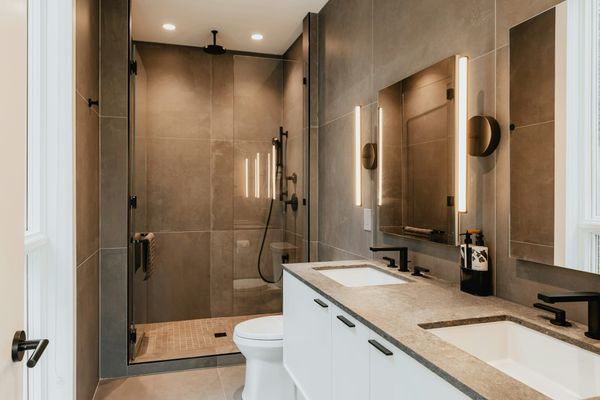
Many modern bathrooms feel cold because their hardest features are allowed to dominate. Large mirrors, pale tile, frameless glass, and smooth cabinetry may look clean in photographs, yet they can create a room with little depth or personality. Lighting often makes the problem worse by flattening color and casting sharp shadows.
A warmer bathroom doesn’t require a full renovation. Thoughtful lighting, tactile finishes, and a measured mix of old and new details can soften the room while preserving its practical, uncluttered character.
The Pitfalls of Pure Overhead Downlights
Recessed downlights are useful for general illumination, but relying on them alone creates deep shadows beneath the eyes, nose, and chin. That’s hardly ideal when you’re shaving, applying makeup, or getting ready on a dark morning. Cool bulbs can also make white tile appear blue-gray and leave natural wood looking washed out.
Use overhead fixtures as one layer. Add lighting near the mirror and, if space permits, a low-level source beneath a vanity or inside a recessed shelf. Bulbs rated around 2700K to 3000K usually produce a comfortable warm-white light. Put each layer on a separate switch or dimmer so the room can shift from bright and practical to calm in the evening.
Warm Metal Finishes Soften Hard Surfaces
Metal finishes act like punctuation in a bathroom. Chrome and polished nickel bring crispness, while aged brass and bronze introduce deeper tones that sit comfortably beside stone, wood, and painted cabinetry. This warmth is especially helpful in rooms dominated by glossy white surfaces.
You don’t need to match every fitting. Choose one main finish for repeated elements, then allow a second finish on a mirror frame or cabinet pulls. If you’re replacing fixtures near the vanity, bathroom wall lights in antique brass can add warmth at both eye level and surface level. Natural materials, artwork, and layered textures can further make a bathroom feel less sterile without sacrificing a clean, modern look.
Position Sconces at True Eye Level
Even a beautiful sconce performs poorly when installed too high. For balanced facial lighting, place a fixture on each side of the mirror with the center of the light source close to the user’s eye level. In many homes, that falls roughly 60 to 66 inches from the floor, though your household’s height and the fixture’s proportions should guide the final position.
Before an electrician moves wiring, tape paper templates to the wall and stand at the sink. Check that the fittings won’t collide with a medicine cabinet door or crowd the mirror. When side mounting isn’t possible, use a horizontal fixture above the mirror that spreads light across its full width. A shade or frosted diffuser will reduce glare from exposed bulbs.
Blend Architectural Eras Gracefully
A period house doesn’t need a themed bathroom, and a newer home can still carry details with a sense of age. The most convincing rooms borrow a few architectural cues instead of copying an entire era. A simple Shaker-style vanity, tongue-and-groove paneling, or a framed mirror can give a streamlined bathroom welcome texture.
Projects that focus on preserving historic character while adding a modern extension show how old and new elements can sit comfortably together without making the original house feel erased. That same approach works in a bathroom, where traditional proportions or materials can be paired with cleaner modern fittings.
Keep the permanent elements restrained, then introduce character through items that can change over time. Linen towels, a small timber stool and framed art are easier to update than patterned tile. Avoid squeezing too many statement features into one room. Paying attention to common bathroom renovation mistakes can also help you avoid poor layouts, awkward proportions and choices that look better in theory than they work in practice.
Look at adjoining rooms before selecting the final details. Repeating a door-hardware finish, paint undertone, or wood species creates a natural connection to the rest of the house. The bathroom will feel considered without appearing preserved in a single period.
The best test happens after sunset. Turn off the overhead lights, switch on the mirror sconces, and look at how the surfaces respond. If the stone gains depth, the metal gives off a gentle glow, and your reflection remains evenly lit, the room has moved well beyond sterile.