Early Life and Family Background
Kylie Jenner is an American media personality, businesswoman, and reality television star widely recognized for starring in Keeping Up with the Kardashians and founding the cosmetics company Kylie Cosmetics. As a prominent digital creator and entrepreneur, she built a global consumer empire by leveraging social media engagement and direct-to-consumer brand marketing.
Born on August 10, 1997, in Los Angeles, California, Kylie Kristen Jenner grew up entirely within the public eye. She is the youngest daughter of Kris Jenner and 1976 Olympic decathlon champion Caitlyn Jenner (formerly Bruce Jenner). Through her parents, Jenner’s extended family encompasses a sprawling media ecosystem: an older sister, Kendall Jenner, alongside half-siblings Kourtney, Kim, Khloé, and Rob Kardashian from her mother’s first marriage, and Burt, Brandon, Brody and Cassandra Jenner from her father’s previous relationships.
Jenner attended Sierra Canyon School in Chatsworth, California, where she participated in cheerleading and school plays. As television production schedules and commercial commitments accelerated during her teenage years, traditional schooling became impractical. Jenner transitioned into an at-home homeschooling program, earning her high school diploma through Laurel Springs School in July 2015.
Living through adolescence in front of production cameras provided an unprecedented education in public relations, visual branding, and audience engagement. We can see how this immersive media upbringing laid the structural foundation for her later entrepreneurial endeavors.
The Rise of Kylie Jenner in Reality Entertainment
Jenner’s public presence began in October 2007 when the E! network debuted Keeping Up with the Kardashians. Premiering when Jenner was just ten years old, the unscripted series documented the day-to-day lives, interpersonal conflicts, and emerging commercial ventures of the blended Kardashian-Jenner household. The program quickly became a foundational pillar of modern reality television, running for 20 seasons and concluding on E! in 2021 before shifting to Hulu under the streamlined banner The Kardashians.
As the original show progressed, Jenner evolved from a supporting ensemble member into a central figure. Her distinctive aesthetic changes—most notably her evolving hairstyles, fashion selections, and makeup techniques—drove immense internet curiosity. Recognizing her individual draw, E! greenlit the 2017 spinoff docuseries Life of Kylie. The eight-episode series explored her professional obligations as a cosmetics founder alongside the personal tensions of navigating young adulthood under non-stop digital scrutiny. Today, her appearances on Hulu’s The Kardashians continue to highlight her balancing act between global brand direction and family life.
Early Ventures and Brand Collaborations
Long before launching standalone corporate entities, Jenner tested commercial waters through collaborative retail partnerships:
- PacSun Apparel (2012): Partnering with her sister Kendall, she created the "Kendall & Kylie" junior lifestyle clothing line, distributing trend-focused apparel across major shopping malls.
- OPI Nail Lacquers (2013): The sisters teamed up with Nicole by OPI to release signature nail polish collections ("Kardashian Kolors"), earning combined six-figure endorsement checks.
- Madden Girl Footwear (2014): A targeted footwear and handbag capsule collection developed in partnership with Steve Madden.
- Science Fiction Publishing (2014): In an unexpected creative venture, the sisters co-authored a dystopian young-adult novel titled Rebels: City of Indra: The Story of Lex and Livia. Written with ghostwriter Maya Sloan, the book sold approximately 13,000 copies in its initial months.
These early licensing agreements served as testing grounds. Rather than simply collecting endorsement fees forever, Jenner realized that long-term enterprise value required direct ownership over her product pipelines.
The Business Empire of Kylie Jenner
The transition from sponsored social media talent to corporate equity holder defines Jenner’s commercial trajectory. By utilizing direct-to-consumer (DTC) digital commerce, she bypassed traditional wholesale barriers, communicating product drops directly to hundreds of millions of followers.
| Brand Name | Launch Year | Core Product Category | Corporate Structure / Key Partners |
|---|---|---|---|
| Kylie Cosmetics | 2015 | Color cosmetics, lip kits, eye palettes | 51% owned by Coty Inc.; 49% retained by Jenner |
| Kylie Skin | 2019 | Skincare, cleansers, moisturizers | Formulated under Coty beauty portfolio |
| Kylie Baby | 2021 | Gentle baby wash, lotions, detanglers | Direct-to-consumer brand incubation |
| Khy | 2023–2024 | Faux leather apparel, base layers, denim | Independent fashion label with guest designers |
| Sprinter | 2024 | Premium canned vodka seltzers | Ready-to-drink beverage market venture |
Kylie Cosmetics and the Coty Acquisition
In August 2015, Jenner funded an initial production run of 15,000 lip kits using $250,000 of her personal earnings from modeling and television. Formulated in collaboration with private-label manufacturer Seed Beauty (founded by John and Laura Nelson), the $29 kits paired a liquid matte lipstick with a matching lip pencil to achieve her signature over-lined aesthetic.
When the website went live, the entire inventory sold out in under two minutes, causing server crashes and immediate secondary market markups.
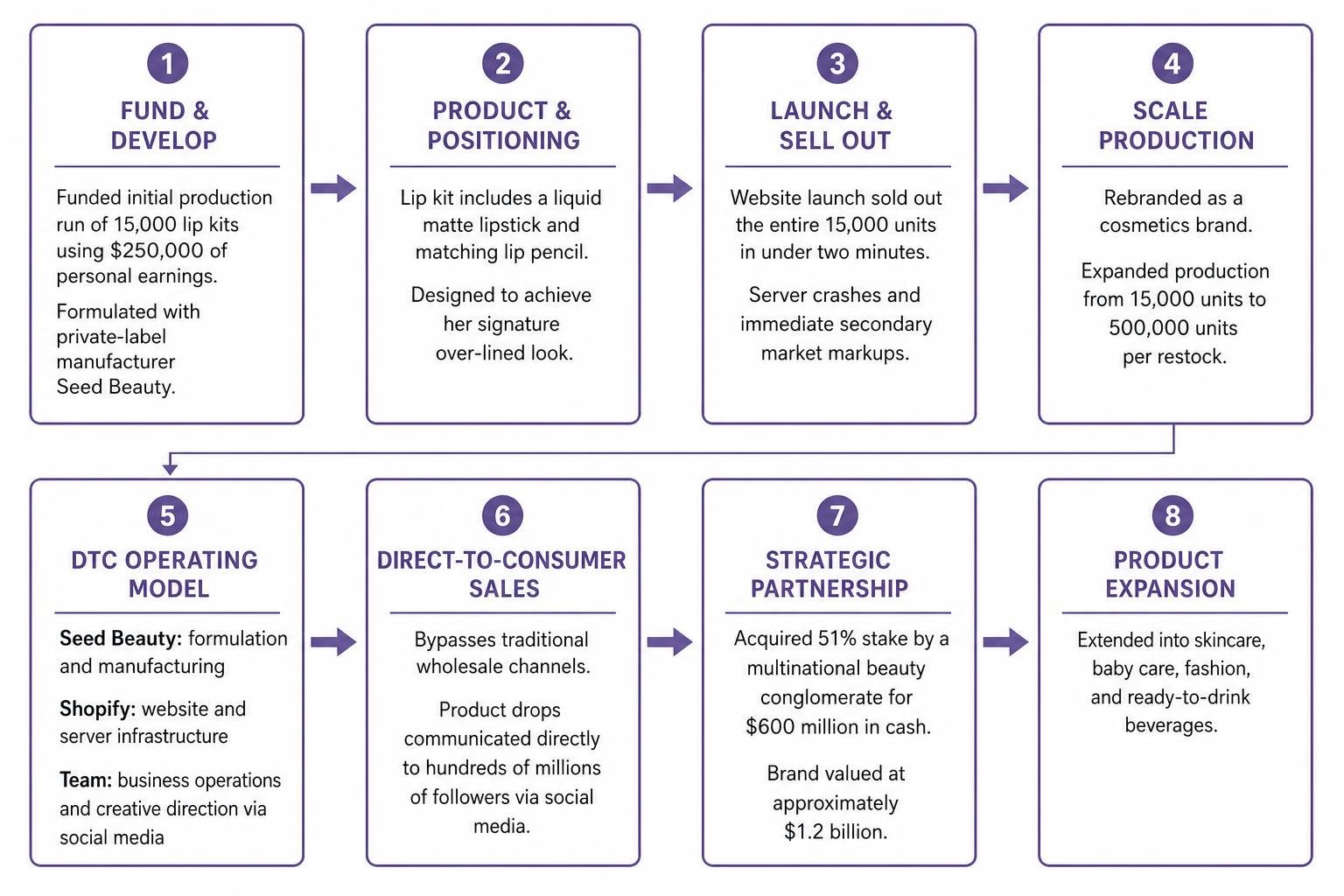
Capitalizing on intense demand, Jenner rebranded the company as Kylie Cosmetics in February 2016, expanding production runs from 15,000 units to 500,000 units per restock. The operational model relied on extreme overhead efficiency: Seed Beauty handled formulation and manufacturing, Shopify managed server infrastructure, and Kris Jenner managed business operations for a standard management fee, while Kylie handled creative direction and marketing via Instagram and Snapchat.
The peak of this direct-to-consumer phenomenon occurred in November 2019, when multinational beauty conglomerate Coty Inc. announced a definitive agreement to acquire a 51% majority stake in Kylie Jenner's commercial empire for $600 million in cash. The transaction valued the standalone beauty brand at approximately $1.2 billion, aiming to leverage Coty’s international retail distribution network while leaving creative communication under Jenner's direction.
Expansion into Skincare, Fashion, and Ready-to-Drink Cocktails
Following the partial sale of her cosmetics company, Jenner diversified her intellectual property across everyday consumer lifestyle categories:
- Kylie Skin (May 2019): Launched with cleansers, toners, and moisturizers promoted as cruelty-free, vegan, and sulfate-free. While the debut Walnut Face Scrub drew minor public criticism regarding physical exfoliation abrasiveness, the brand quickly secured broad placement at retail chains like Ulta Beauty.
- Kylie Baby (September 2021): Developed as pediatric-tested, hypoallergenic personal care products designed for infants and young children, tapping into her audience’s transition into parenthood.
- Khy (Late 2023): A direct-to-consumer fashion line focusing on faux leather trench coats, stretch base layers, and studded denim capsules. Khy utilizes an accessible luxury model, partnering with independent global designers (such as Namilia and Entire Studios) for limited release drops.
- Sprinter (March 2024): A commercial expansion into the ready-to-drink (RTD) alcohol space, featuring 100-calorie, fruit-flavored canned vodka sodas formulated with real fruit juice to compete in the expanding beverage category.
Wealth Valuations, Legal Disputes, and Public Controversies
Operating at this scale of fame and financial velocity brings consistent legal and media scrutiny. Jenner’s commercial career has been marked by debates over financial reporting, intellectual property ownership, and supply chain accountability.
Analyzing the Forbes Net Worth Debacle of Kylie Jenner
In March 2019, Forbes featured Jenner on its cover, naming her at age 21 the "Youngest Self-Made Billionaire of All Time"—eclipsing the milestone previously held by Facebook founder Mark Zuckerberg at age 23. The label ignited intense public debate regarding the term "self-made," with critics arguing that growing up in extreme wealth, elite social connections, and constant television publicity disqualified her from the designation.
The situation escalated dramatically in May 2020 when Forbes published an investigative report retracting the billionaire title. The publication alleged that Jenner’s accounting team had presented inflated revenue metrics, forged tax filings, and misleading draft tax returns between 2016 and 2018 to exaggerate the business's scale prior to the Coty buyout. Filings from publicly traded Coty revealed that Kylie Cosmetics' actual revenues were noticeably smaller than previously claimed to journalists.
As noted in the comprehensive Kylie Jenner biographical record, Forbes subsequently recalculated her net worth down to approximately $700 million in late 2020, removing her from official billionaire tracking lists while noting her position among the wealthiest self-made women in entertainment.
Intellectual Property Lawsuits and Brand Challenges
Jenner’s commercial branding has encountered several high-profile legal hurdles:
- The Kylie Minogue Trademark Dispute (2015–2017): Jenner filed a US patent and trademark application for the standalone name "KYLIE" covering advertising and beauty services. Australian pop icon Kylie Minogue filed formal legal opposition, arguing that granting the trademark would dilute Minogue's existing global brand identity. The dispute was settled privately in 2017 after the trademark office denied Jenner’s broad application.
- Copyright and Visual Art Claims: Los Angeles-based makeup artist Vlada Haggerty threatened legal action in 2016 over striking visual similarities between Haggerty’s copyrighted dripping metallic lip photography and Kylie Cosmetics' promotional assets; the matter was settled without financial disclosures. In 2017, British artist Sara Pope sued Jenner and E! over the neon-lit lip design featured in promotional material for Life of Kylie, which Pope alleged copied her 2015 art piece Temptation.
- Garment Manufacturing Criticisms: In 2020, amid worldwide factory disruptions, human rights monitors claimed that Global Brands Group—a licensing company affiliated with Kendall & Kylie apparel—had withheld payments to garment factory workers in Bangladesh. Representatives for the sisters clarified that their apparel line was owned by a separate licensing partner, Canada's 3072541 Canada Inc., and had no operational ties to the disputed Global Brands Group facilities.
- Kylie Swim Quality Concerns (2021): Consumer reception surrounding her swimwear drop suffered after customers shared viral social media reviews criticizing poor stitching, unlined fabric, and impractical cuts, highlighting the challenges of maintaining quality control across varied brand extensions.
Philanthropic Endeavors and Social Media Impact
Jenner’s cultural footprint is inseparable from her dominance on social platforms. As the fifth-most-followed account on Instagram, she became the first woman to cross the 300-million-follower milestone in January 2022. During peak monetization windows between 2018 and 2019, analytics firms tracked her earning power at between $1.0 million and $1.2 million per individual sponsored post.
Her cultural reach regularly sparks major social trends:
- The "Rise and Shine" Phenomenon (2019): A brief, off-the-cuff video clip of Jenner singing "rise and shine" to wake up her daughter Stormi generated over one billion views on TikTok, becoming the platform's fastest-growing hashtag trend at the time and quickly appearing on trademark applications and specialty merchandise.
- Youth Pop Culture Moments: In 2017, after learning that high school student Albert Ochoa had been turned down by his date, Jenner made a surprise appearance as his date at the Rio Americano High School prom in Sacramento, arriving alongside her friend Jordyn Woods.
Alongside viral internet moments, Jenner has leveraged her platform and personal wealth to fund various charitable causes:
Frequently Asked Questions
How did Kylie Cosmetics achieve widespread global success?
Kylie Cosmetics succeeded through direct-to-consumer digital marketing, manufactured scarcity, and direct social media engagement. By leveraging her massive Instagram audience, Jenner built immense anticipation for limited "drops." Keeping operational overhead low via manufacturing partnerships with Seed Beauty and backend processing on Shopify, the brand turned product releases into major internet events before expanding into physical retail through Ulta and selling a majority stake to Coty.
What was the outcome of the Forbes billionaire controversy?
Forbes initially named Jenner the youngest self-made billionaire in March 2019 at age 21. Following an investigation in May 2020 that analyzed corporate Coty disclosures and disputed previously submitted revenue filings, the publication retracted the billionaire label. The publication adjusted her net worth to roughly $700 million later that year, sparking widespread discussion about transparency in celebrity brand valuations.
What consumer brands are currently owned by Kylie Jenner?
Her active business portfolio includes:
- Kylie Cosmetics (Color cosmetics and lip products, co-owned with Coty)
- Kylie Skin (Skincare and body care line, co-owned with Coty)
- Kylie Baby (Pediatrician-tested personal care products for young children)
- Khy (Direct-to-consumer faux leather, basics, and denim apparel)
- Sprinter (Ready-to-drink canned vodka sodas made with real fruit juice)
Conclusion
Kylie Jenner’s transformation from reality television child star to global beauty mogul illustrates the modern power of digital influence. By translating social media attention directly into consumer products, she helped pioneer the direct-to-consumer influencer playbook that defined 2010s commerce.
While her journey has generated debates over wealth authenticity, creative trademarks, and commercial disclosures, her impact across modern beauty standards and digital marketing remains undeniable.
Understanding this era of pop celebrity requires looking closely at how digital personalities build long-lasting commercial brands. For those interested in exploring modern creative aesthetics, contemporary design, and culture across our region, explore our ongoing coverage of visual art throughout the Hudson Valley and Berkshires.