Leon Botstein Out as Bard President After Internal Epstein Review, But Will Still Teach, Conduct, and Live at College
Independent review finds he misled the Bard community about his relationship with the convicted sex trafficker.

Independent review finds he misled the Bard community about his relationship with the convicted sex trafficker.
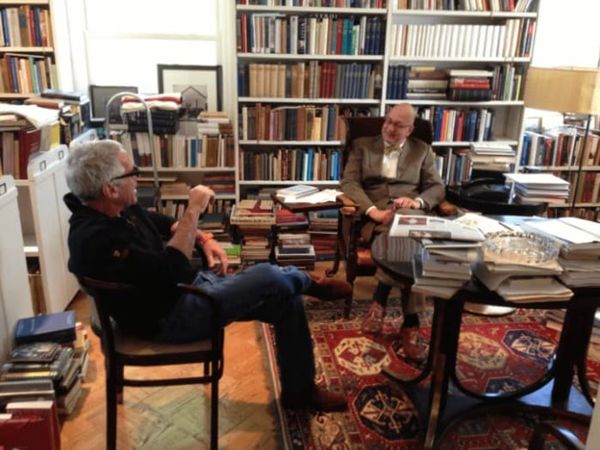
Leon Botstein announced Friday that he is stepping down as president of Bard College after 51 years, but he is not leaving.
The 79-year-old will retire from the presidency at the end of June, he wrote in a lengthy letter to the campus community. He said he would remain on Bard's faculty as a teacher and musician. He says he intends to "continue with the Bard Music Festival, SummerScape, and the Bard Conservatory," and will move to Bard-owned Finberg House, just off the contiguous campus.
The announcement came one day after the Board of Trustees received the findings of an independent review by the law firm WilmerHale into Botstein's years-long relationship with Jeffrey Epstein, the convicted sex offender and financier who died in federal custody in 2019 while awaiting trial on child sex trafficking charges. While WilmerHale says it found no evidence of criminality on the part of Botstein, the review did note moments and statements that belayed a lack in judgment.
The final line of the WilmerHale summary memo, delivered to the board on April 30, reads: "In his public statements and his statements to the Bard community, President Botstein minimized and was not fully accurate in describing his relationship with Epstein."
Botstein had contacts with Epstein from 2012 through 2019, the year of Epstein's sex trafficking arrest and death. Those contacts included 25 visits to Epstein's Manhattan townhouse and a two-day visit to Epstein's private island in the US Virgin Islands.
In previous accounts of Botstein’s trip to the Caribbean, the outgoing president has said he got so ill on the trip he didn’t know where he spent the night. It was not explained how WilmerHale was able to verify Botstein’s itinerary. This is the first time it has been revealed publicly that Botstein spent two days on Epstein’s Little St. James island.
In addition, Botstein reached out to Epstein weeks after the Miami Herald reported new details on Epstein's criminal prosecution in 2018, writing that he hoped Epstein was "holding up as well as can be expected.”
The report also revealed that Epstein made multiple visits to Bard and accompanied Botstein to concerts and recitals, and that Botstein had extended numerous additional invitations to Epstein (including to stay at a campus guest cottage and attend student performances).
WilmerHale found that when Botstein first pursued Epstein as a donor in 2012, he had already been presented with information about Epstein's 2008 guilty plea on charges of soliciting prostitution from a minor, and that Epstein had been designated by a New York court in 2011 as a Level 3 Sex Offender, the classification reserved for those deemed at the highest risk of reoffending. A senior faculty member whom Botstein had enlisted to help draft a fundraising proposal warned him that Bard should not engage with Epstein at all. Botstein dismissed the concern.
His justification, as captured in the WilmerHale memo, was blunt: his view was that Bard's need for funds was paramount "I would take money from Satan if it permitted me to do God's work," Botstein reportedly said.
The report also found that Botstein failed to disclose to the Board his consulting arrangement with an Epstein-linked entity in 2016, under which he received fees he says he ultimately donated back to Bard—though the review noted that documents cannot confirm those funds were ever separately identified or transferred as he claimed.
There is reason to believe Botstein had already planned to retire this year before the Epstein scandal consumed his final months in office. In his announcement, he pointed to the completion of Bard's $1 billion endowment campaign in January 2026, a milestone he had cited privately to trustees as the precondition for his departure, and his upcoming 80th birthday as the drivers of his decision.
The college had even planned a gala in his honor. The celebration at Cipriani in Manhattan, scheduled for March 26, had been billed as a tribute to Botstein's 50 years as college president, with a 10-person table priced at $250,000 and a chance to dine with Botstein available for $50,000. Bard indefinitely postponed the gala in response to the increased public scrutiny of the Epstein relationship.
What makes Friday's announcement notable, and what much of Friday’s news coverage has glossed over, is the distinction between Botstein leaving the presidency and Botstein leaving Bard. He makes it clear in his statement that he is not going anywhere.
He will continue to lead the Bard Music Festival and SummerScape, serve in the Bard Conservatory, conduct the American Symphony Orchestra, and reside in his campus home. For a campus community that has spent months calling for accountability, the question now is whether a change in title constitutes the reckoning they were seeking.
The Bard College Board of Trustees Executive Committee said the "concerns raised in recent months have been serious and deeply felt" and pledged that funds associated with Epstein would be directed to organizations supporting survivors of sexual harm. The board said it would soon announce an interim leader and details of a national search for a permanent president.