Why Michael Landon Still Matters
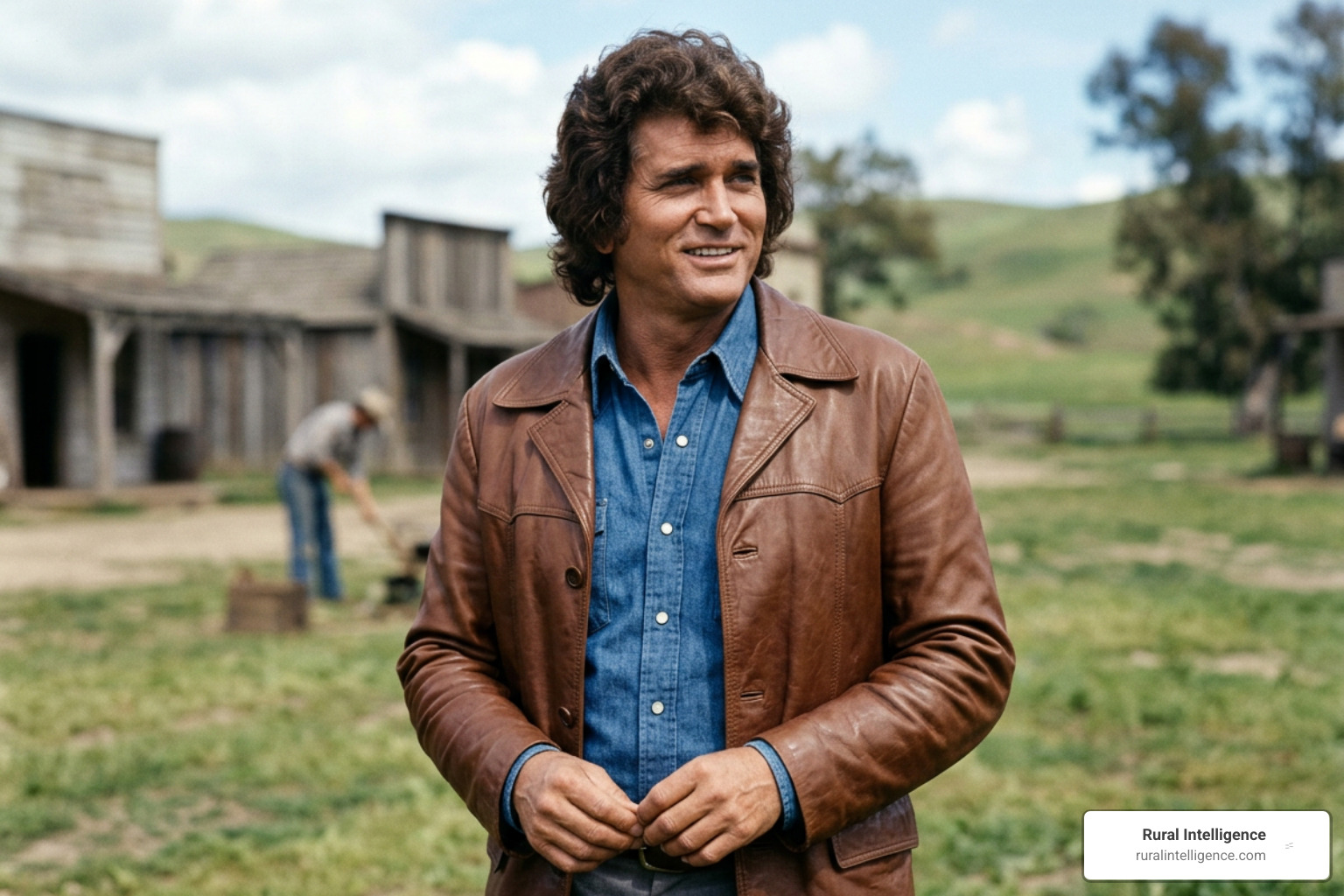
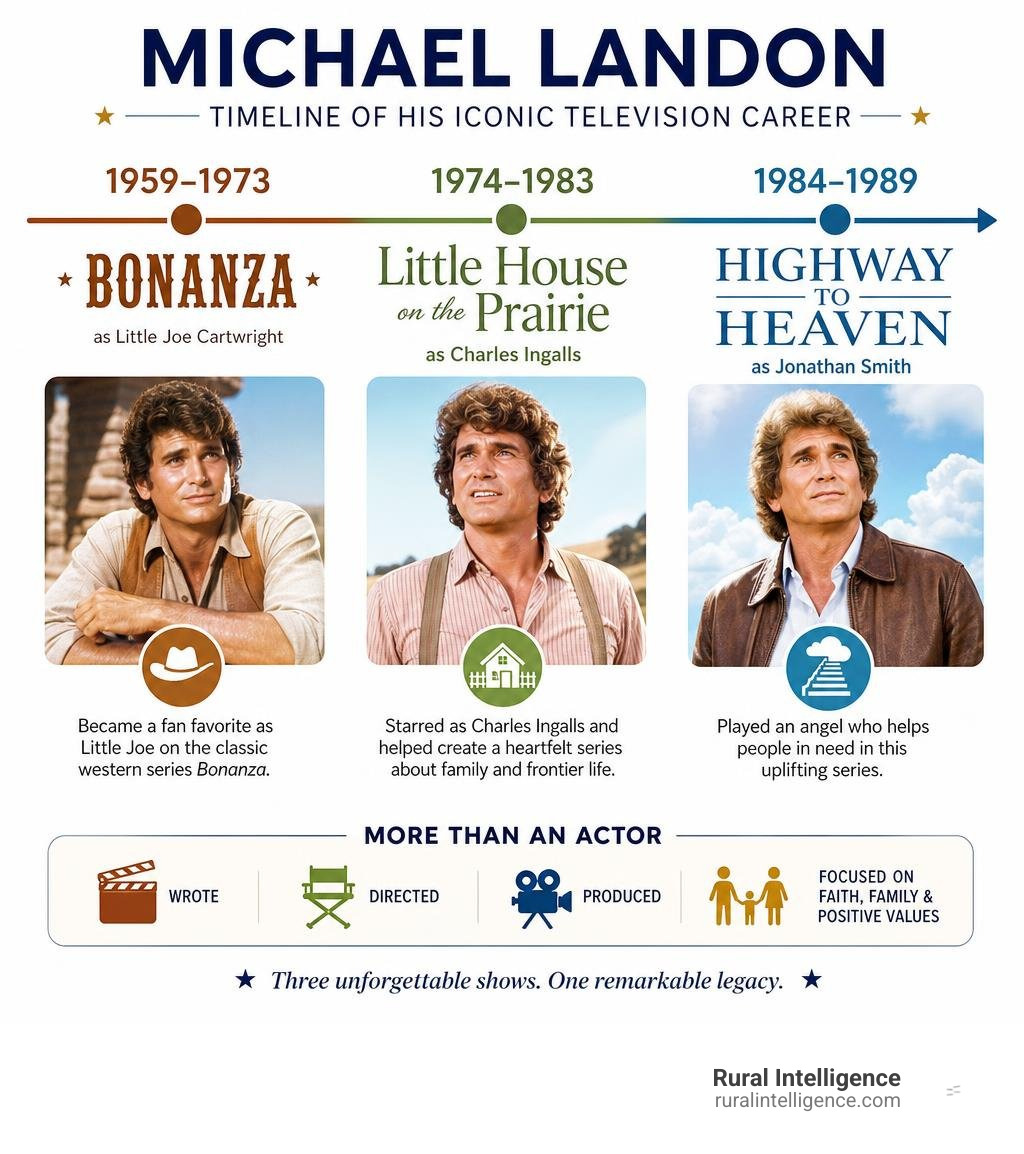
Michael Landon was one of American television's most influential actor-creators. Born Eugene Maurice Orowitz, he became famous as Little Joe Cartwright in Bonanza, Charles Ingalls in Little House on the Prairie, and Jonathan Smith in Highway to Heaven. Across those shows, he did far more than star: he wrote, directed, produced and helped shape a warm, family-centered style of network TV that still thrives in reruns.
His career was also a remarkable reinvention story. A top high-school javelin thrower whose scholarship path ended after a shoulder injury, Landon turned to acting and built a three-decade presence in American homes. He appeared on the cover of TV Guide 22 times, second only to Lucille Ball.
This guide looks beyond the familiar TV father image. It covers his difficult childhood, ambitious creative life, complicated family relationships, faith-driven work, and public battle with pancreatic cancer before his death in 1991 at age 54.
The Early Life and Athletic Beginnings of Michael Landon
Before becoming a fixture of primetime television, Eugene Maurice Orowitz was born on October 31, 1936, in Forest Hills, Queens, New York. When he was four years old, his family relocated to Collingswood, New Jersey, a quiet suburban borough that provided the backdrop for an difficult childhood.
Landon grew up in a home divided by religious tension and emotional volatility. His father, Eli Maurice Orowitz, was Jewish and worked as a theater manager; his mother, Peggy O'Neill, was an Irish-Catholic former dancer and comedian. As one of the few Jewish families in their neighborhood, the Orowitzes faced persistent anti-Semitism. Eugene frequently dealt with neighborhood prejudice, riding his bicycle daily to a nearby town to attend Hebrew school in preparation for his bar mitzvah.
Home life offered little peace. His mother suffered from severe, erratic mental health struggles and made repeated suicide attempts throughout his youth. During one family beach trip, Eugene had to physically rescue her from drowning in the ocean despite not knowing how to swim himself. The constant domestic stress manifested in chronic childhood bedwetting—a condition his mother punished by hanging his soiled bedsheets out his bedroom window for classmates and neighbors to see. Every afternoon, the young boy would sprint home from school to pull the sheets down before anyone noticed.
Decades later, Landon channeled this intense early humiliation and emotional pain directly into art when he wrote, produced, and directed the acclaimed 1976 autobiographical teleplay The Loneliest Runner. For a detailed account of these formative years, readers can explore the comprehensive life entry at Encyclopedia.com.
From Eugene Orowitz to Hollywood Prospect
Eugene was determined to forge an entirely new path for himself. When he set his sights on the entertainment industry in the mid-1950s, he sought a fresh start that began with changing his name.
After an agent suggested that Eugene Maurice Orowitz was unlikely to turn heads on a casting roster, the young hopeful pulled open a local telephone directory. Scanning names alphabetically, he initially considered "Michael Lane," but upon discovering it was already registered with the Screen Actors Guild, he kept flipping pages until settling on Michael Landon.
His entry into acting happened almost by accident. While working as a gas station attendant across from Warner Bros. studios, Landon met an aspiring performer and offered to help him run lines for an upcoming audition. The scene required a young soldier to break down and cry. When Landon stepped up to assist, he tapped into the deep reservoir of his painful childhood memories, bursting into real, unrestrained tears.
Talent agent Bob Raison noticed Landon's raw screen presence and signed him. Following rigorous acting classes, Landon began landing television guest spots on anthology programs and Westerns before securing his breakout film lead as the troubled high schooler Tony Rivers in the 1957 cult classic I Was a Teenage Werewolf.
High School Javelin Record and USC Athletics
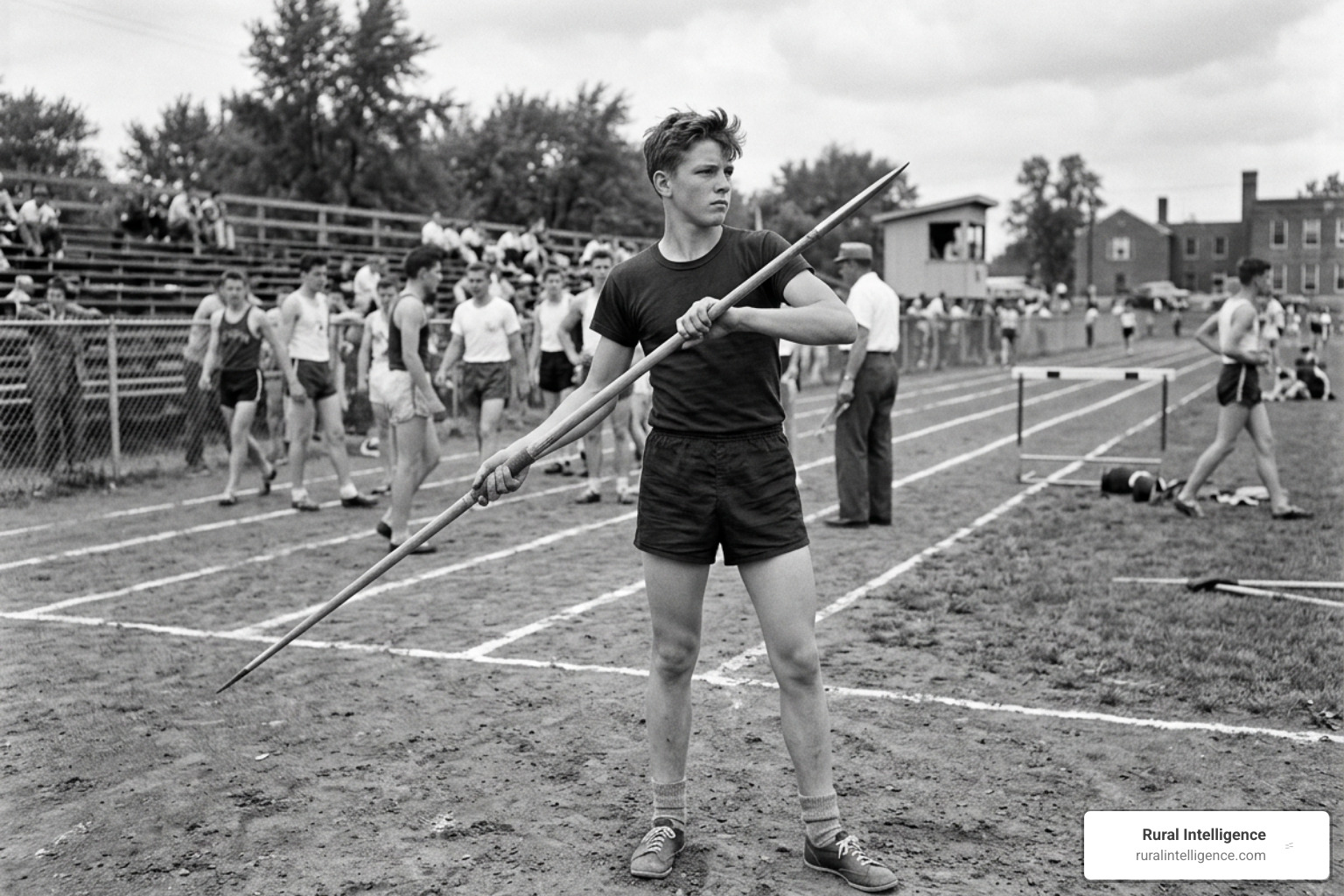
Acting was not Landon's original ticket out of New Jersey. In high school, he discovered an extraordinary natural talent for track and field, specifically the javelin throw.
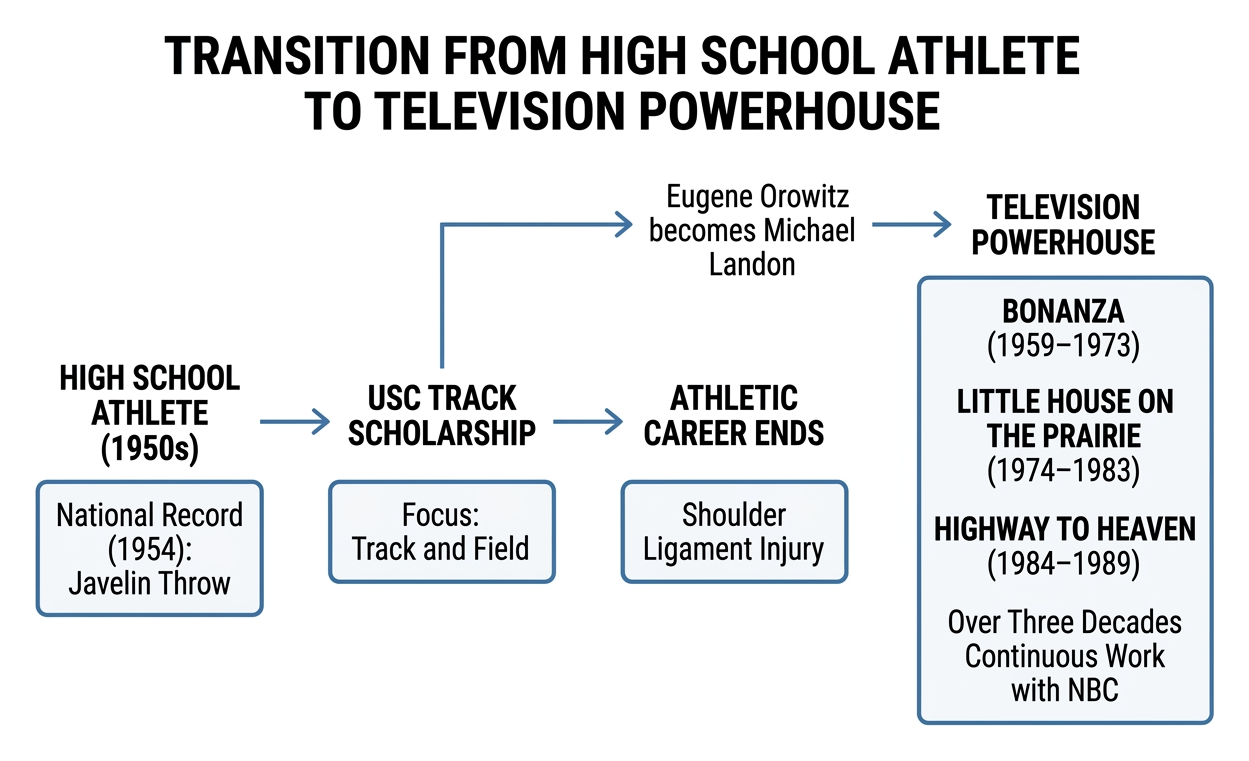
Possessing remarkable arm whip and upper-body power, Landon set a national record in 1954 with a high-school toss of 193 feet 4 inches (58.93 meters)—the longest recorded throw by any American prep athlete that year. He harbored a curious superstition about his athletic prowess, convinced that keeping his hair long, like the biblical figure Samson, gave him strength.
His athletic achievements earned him a full track-and-field scholarship to the University of Southern California (USC). However, collegiate athletics proved contentious. After hazing incidents in which fellow teammates forcibly pinned him down and cut his long hair, Landon experienced a sudden loss of confidence. Shortly thereafter, while pushing for extra distance in practice, he severely tore the ligaments in his throwing shoulder.
With his shoulder permanently damaged, his track career vanished overnight. Landon left USC, worked a series of odd jobs unloading freight trains and pumping gas, and redirected his ferocious competitive drive toward acting.
The Golden Era of Television: Bonanza, Little House, and Beyond
Over three consecutive decades, Michael Landon established an unmatched presence on American network television. From 1959 until 1989, he worked almost continuously under contract with NBC, becoming one of the most bankable stars in television history. Complete records of his screen appearances, directorial efforts, and production credits are preserved in Michael Landon's filmography on TMDB.
| Series | Network Run | Episode Count | Primary Roles Held by Landon |
|---|---|---|---|
| Bonanza | 1959–1973 (14 seasons) | 430 episodes | Lead Actor, Episodic Writer, Episodic Director |
| Little House on the Prairie | 1974–1983 (9 seasons) | 187 episodes | Lead Actor, Executive Producer, Director (85 eps), Writer (45 eps) |
| Highway to Heaven | 1984–1989 (5 seasons) | 111 episodes | Show Creator, Lead Actor, Executive Producer, Director (94 eps), Writer (21 eps) |
Little Joe Cartwright and the Triumph of Bonanza
In 1959, at age 22, Landon was cast as Joseph "Little Joe" Cartwright, the youngest and most impetuous son of Ben Cartwright (played by Lorne Greene), in NBC's frontier Western Bonanza.
Bonanza was historic in multiple ways: it was one of the earliest primetime network series filmed and broadcast in full RCA color, serving as a flagship showcase for color television sets across the country. Landon's good looks, charismatic swagger, and emotional vulnerability turned him into an overnight teen idol and fan favorite.
Not content to simply deliver lines, Landon studied every facet of the production machine on the Paramount lot. He shadowed directors, asked technical questions of the lighting crew, and began pitching story ideas.
By the fourth season, he wrote his first episode, and in 1968, he made his television directorial debut. Over its 14-season run spanning 430 episodes, Bonanza dominated the Nielsen ratings, finishing as the number-one show in the United States for three consecutive seasons (1964–1967).
How Michael Landon Shaped Little House on the Prairie
When Bonanza ended in 1973, Landon moved swiftly into his next signature project. In 1974, NBC launched Little House on the Prairie, a dramatic adaptation of Laura Ingalls Wilder's frontier book series. Landon not only starred as patriarch Charles "Pa" Ingalls but took charge as executive producer, frequent writer, and primary director. Further details about his leadership on this series can be found in the biographical profile on Michael Landon.
Under Landon's creative vision, Little House was transformed into an emotional, values-driven family drama set in 19th-century Walnut Grove, Minnesota. Landon possessed a rare, instinctual grasp of emotional pacing. He had the ability to balance broad slapstick humor with genuine, tear-inducing drama.
Behind the camera, he directed 85 episodes and wrote 45, maintaining a disciplined, fast-moving set where production regularly finished ahead of schedule so cast and crew could go home to their families.
Highway to Heaven and Landon’s Auteur Legacy
In 1984, Landon took a bold gamble by pitching Highway to Heaven. Network executives were skeptical of a series centered on an angel stripped of his wings, sent to Earth by "The Boss" to help people through everyday struggles. Landon stood his ground, maintaining absolute creative independence. Highway to Heaven became the only series in his career that he owned outright under Michael Landon Productions.
Re-teaming with his longtime close friend and Little House co-star Victor French (who played the gruff, redeemed Mark Gordon), Landon used the show to tackle contemporary social issues, including terminal illness, elderly care, racism, and teenage suicide.
Landon made a conscious effort to open the industry to marginalized groups, regularly casting disabled actors, using real-life cancer patients in guest roles, and hiring disabled writers to draft authentic scripts. The series ran for five successful seasons and 111 episodes.
Personal Life, Faith, and Complex Relationships
Behind the wholesome image of "America's favorite father," Landon was an intense, multifaceted individual with a sharp sense of humor, immense generosity, and a private life marked by domestic turbulence.
Landon was an inveterate practical joker. On set and in private, his offbeat antics were legendary—from hiding live toads in his mouth and opening it mid-conversation to walking into local pizza parlors dressed in superhero outfits. When appearing on The Tonight Show Starring Johnny Carson, he frequently engineered elaborate gags, once creating a faux restaurant menu full of feline puns after playfully convincing Carson he had accidentally run over the restaurateur's pet cat.
Yet his professional relationships were not without friction. Actress Karen Grassle, who played his onscreen wife Caroline "Ma" Ingalls for eight seasons, detailed in her later memoir that Landon could be domineering, moody, and resistant to paying female co-stars equitable salaries during contract negotiations. However, the two reconciled in 1991, sharing a warm, emotional phone conversation shortly before Landon's death.
Conversely, his child co-stars, particularly Melissa Gilbert (who played Laura Ingalls), viewed him as a dedicated surrogate father and mentor. Landon integrated Gilbert into his own household, taking her on family spring break vacations and treating her like his own daughter.
Marriages, Family Life, and Michael Landon Jr.
Landon was married three times and raised a blended family of nine children:
- Dodie Levy-Fraser (m. 1956–1962): Landon adopted Dodie's son Mark and together they adopted an infant son, Josh.
- Marjorie Lynn Noe (m. 1963–1982): Landon adopted Lynn's daughter, Cheryl, and the couple had four children together: Leslie, Michael Jr., Shawna, and Christopher.
- Cindy Clerico (m. 1983–1991): Landon married Clerico, a makeup artist on Little House on the Prairie, and they had two children: Jennifer and Sean.
In 1973, his stepdaughter Cheryl was involved in a horrific car accident that killed several passengers and left her in a deep, critical coma. Distraught at her hospital bedside, Landon made a solemn vow to God: if she survived, he would dedicate his life and creative talents to producing uplifting television that genuinely helped humanity. Cheryl made a full recovery, and Landon spent the remainder of his career fulfilling that promise through Little House and Highway to Heaven.
His children would carry on his creative torch. His son, whose work is chronicled in the overview of the career of Michael Landon Jr., became a successful television director, writer, and producer who produced commemorative projects honoring his father's storytelling style, such as Michael Landon, the Father I Knew.
Directorial Method and Behind-the-Scenes Generosity
Landon's efficiency as a director became legendary in Hollywood. He famously wrote scripts directly from his director's chair while set technicians and camera crews adjusted lighting around him. Because he kept the same core technical crew across Bonanza, Little House, and Highway to Heaven, his sets operated with seamless loyalty and speed.
Off the set, Landon donated heavily to charitable causes. He was a dedicated patron of Free Arts for Abused Children and an active supporter of the Down's Syndrome Parents of Los Angeles, frequently hosting benefit screenings and funding educational programs for children with developmental challenges.
Pancreatic Cancer Diagnosis, Passing, and Cultural Legacy
In early 1991, Landon began experiencing severe abdominal pain and unexpected weight loss. Having long avoided routine doctor visits due to a self-admitted stubbornness regarding medical exams, he initially delayed seeking evaluation.
In early April 1991, tests revealed a devastating diagnosis: advanced, inoperable pancreatic cancer that had already metastasized to his liver.
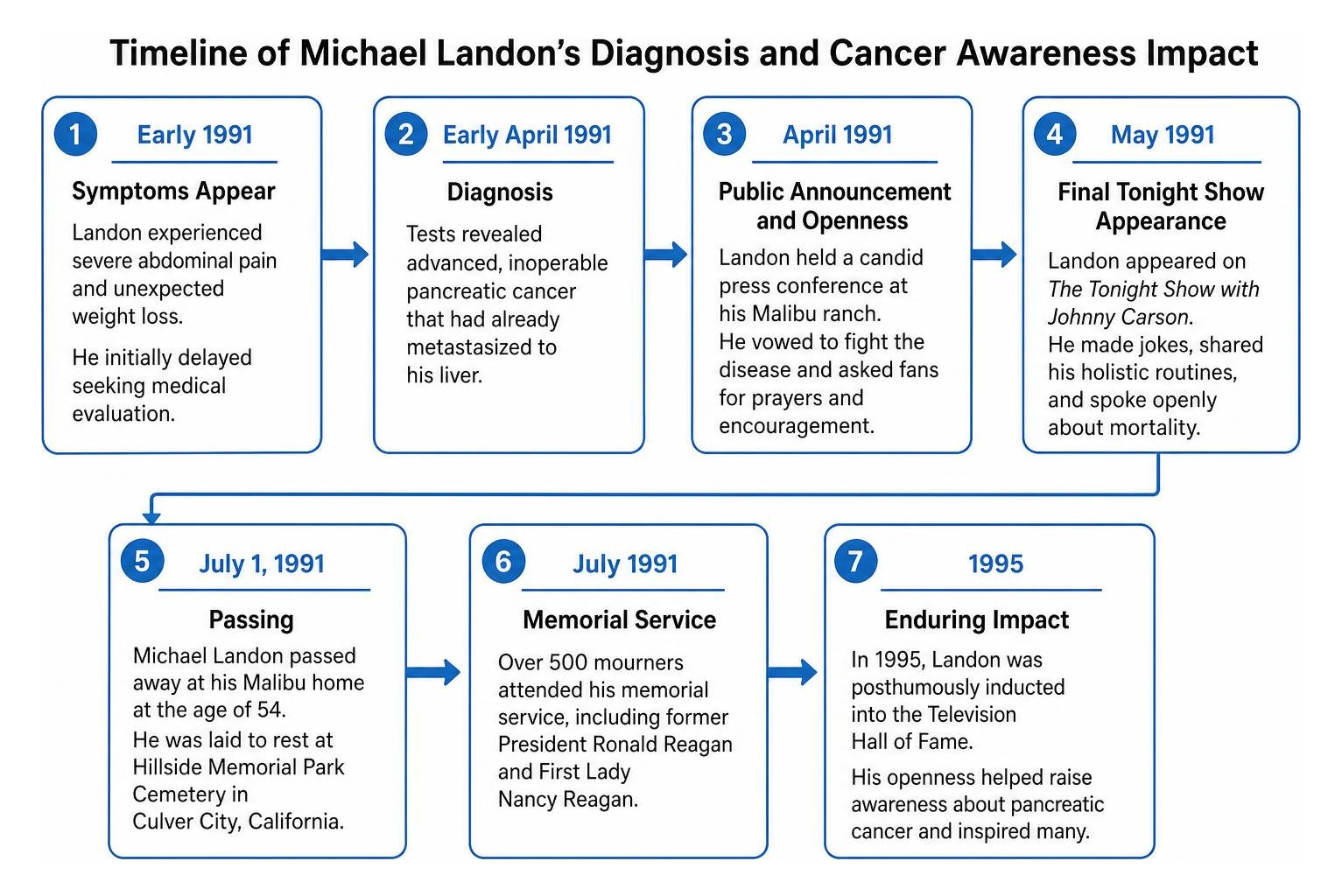
Rather than keeping his condition secret, Landon called a candid press conference at his 10-acre ranch in Malibu, California. With characteristic wit, he told reporters he intended to fight the disease with everything he had, asking fans to send prayers and encouragement rather than despair.
He pursued both conventional chemotherapy and alternative therapies, including nutritional regimens and coffee enemas. In May 1991, he made a final, courageous appearance on The Tonight Show Starring Johnny Carson, making lighthearted jokes about his gray hair roots and explaining his holistic routines while speaking openly about mortality.
Michael Landon passed away at his Malibu home on July 1, 1991, at the age of 54. He was laid to rest at Hillside Memorial Park Cemetery in Culver City, California. Over 500 mourners attended his memorial service, including former President Ronald Reagan and First Lady Nancy Reagan. In 1995, Landon was posthumously inducted into the Television Hall of Fame.
The 1991 Health Crisis and Public Stance
Landon's decision to face his diagnosis in the public eye broke historical barriers regarding cancer stigma. In the early 1990s, public figures rarely spoke openly about terminal cancer. By explaining the mechanics of his stage 4 diagnosis with honesty, Landon demystified the disease for millions of viewers, fostering national discussions around palliative care and patient agency.
How Michael Landon’s Battle Raised Cancer Awareness
Landon's passing sparked an unprecedented surge in public awareness concerning pancreatic cancer—a malignancy historically starved of research funding.
His public battle inspired grassroots support that helped drive the formation and expansion of major advocacy groups, such as the Pancreatic Cancer Action Network (PanCAN). Over the past three decades, these organizations have channeled millions into early detection research, genetic tumor sequencing, and multi-agent chemotherapy regimens like FOLFIRINOX and gemcitabine combinations, extending survival windows that were virtually non-existent during Landon's lifetime.
Frequently Asked Questions About Michael Landon
What was Michael Landon's birth name and how did he choose his stage name?
Michael Landon was born Eugene Maurice Orowitz on October 31, 1936, in Queens, New York. After an agent advised changing his birth name, he chose his professional pseudonym by searching alphabetically through a phone directory until finding "Michael Landon."
How many television series did Michael Landon write, direct, and star in?
Landon starred in, wrote, and directed episodes across three consecutive multi-year network hit shows: Bonanza (14 seasons), Little House on the Prairie (9 seasons), and Highway to Heaven (5 seasons), totaling more than 700 combined television episodes.
What caused Michael Landon's death and how old was he?
Landon died from inoperable pancreatic cancer that had spread to his liver on July 1, 1991, at his home in Malibu, California. He was 54 years old.
Conclusion
Decades after his death, Michael Landon remains a towering architect of American television. From his breakout days on the Ponderosa to the heartwarming frontier life of Walnut Grove and the uplifting missions of Highway to Heaven, his work was anchored by a simple, unwavering philosophy: that love, family, and basic human kindness matter far more than material success.
At Rural Intelligence, we celebrate storytelling that captures genuine human connection, community resilience, and timeless artistic vision. To discover more profiles and features exploring creative voices across our region, explore our ongoing coverage of regional storytelling and visual art. Landon's enduring catalog continues to show us that heartfelt stories, crafted with conviction, never go out of style.