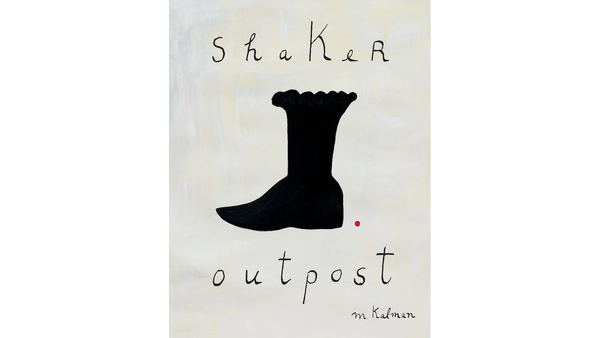
For the Shaker Museum’s new pop-up exhibition, “Shaker Outpost: Design, Commerce, and Culture,” artist Maira Kalman will curate an exhibition of her favorite pieces from the vast Shaker Museum collections and create new paintings that will engage in a vibrant conversation with the Shaker objects. The show marks the return of Shaker Museum exhibitions to Chatham after two-and-a- half years at the Kinderhook Knitting Mill, and will open to the public on Saturday, May 2, at 4 Depot Square in downtown Chatham, running through Sunday, July 5.

Maira Kalman is an unusual but inspired choice to inaugurate the Shaker Museum’s new pop-up space The storefront in Depot Square sits in the shadow of the museum’s future permanent home—now an active construction site—two blocks away in the center of Chatham’s conspicuously charming village.

Kalman occupies a singular place in contemporary visual culture. She is widely recognizable for her covers for The New Yorker and for beloved books such as The Principles of Uncertainty (2007), where small, intimate observations expand into philosophical musings that accumulate emotional force over time. Her work has moved fluidly across disciplines, from collaborations with choreographer Mark Morris to textiles for Isaac Mizrahi and theater projects, including work with David Byrne on “American Utopia” (2021).

Maira Kalman. Photo: Kimisa H.

Though often placed in the categories of illustrator or cartoonist, Kalman’s painting practice carries a distinct visual and emotional richness. In her brushwork, one can feel the ghosts of James Thurber and Charles Addams mingling with the intimacies of Pierre Bonnard. The result is work that is both wry and tender, visually disarming yet profound.

Kalman is also, unmistakably, a New Yorker—part of a sophisticated cultural milieu that can feel like a lost golden age, when one might chat with friends in the Museum of Modern Art Sculpture Garden before heading uptown for cocktails while listening to Bobby Short at the Cafe Carlyle. That sensibility might seem, at first glance, far removed from the spare, devotional world of the Shakers. Yet it is precisely this tension that makes her presence here so compelling.

One of Kalman’s central themes is the capacious category of “things.” In her work, objects carry meanings far beyond their utility. A sponge, a glove, a chair—these become repositories of memory, emotion, and narrative. This sensitivity to the poetic afterlife of objects creates a natural bridge to Shaker material culture, where function and meaning were inseparable.

Kalman chose a number of objects from the Shaker Museum’s collection to accompany her paintings. Shaker Museum, Chatham.

For this exhibition, Kalman immersed herself in the museum’s collection of more than 18,000 objects housed in Old Chatham, selecting items that drew her in—bear-fur mittens, glove forms, garments of daily life. There is a long tradition of inviting contemporary artists into dialogue with Shaker aesthetics, often with transformative results. A key precedent is “Shaker: Furniture and Objects,” curated by France Morin for the New Museum in 1973, for which artists spent time in the last active Shaker community in Maine in preparation for the exhibition. Participants such as Wolfgang Tillmans, Janine Antoni, and Adam Fuss found their work deeply affected by the encounter.

Crucially, Shaker communities did not exist in isolation. They maintained carefully designed points of contact with the outside world through their stores—spaces that functioned as their primary interface with nonbelievers. In these shops, visitors encountered Shaker-made furniture, clothing, and herbal remedies: objects that were both practical goods and emissaries of a radically egalitarian theology. Commerce, in this sense, was not separate from belief but a means of extending it.

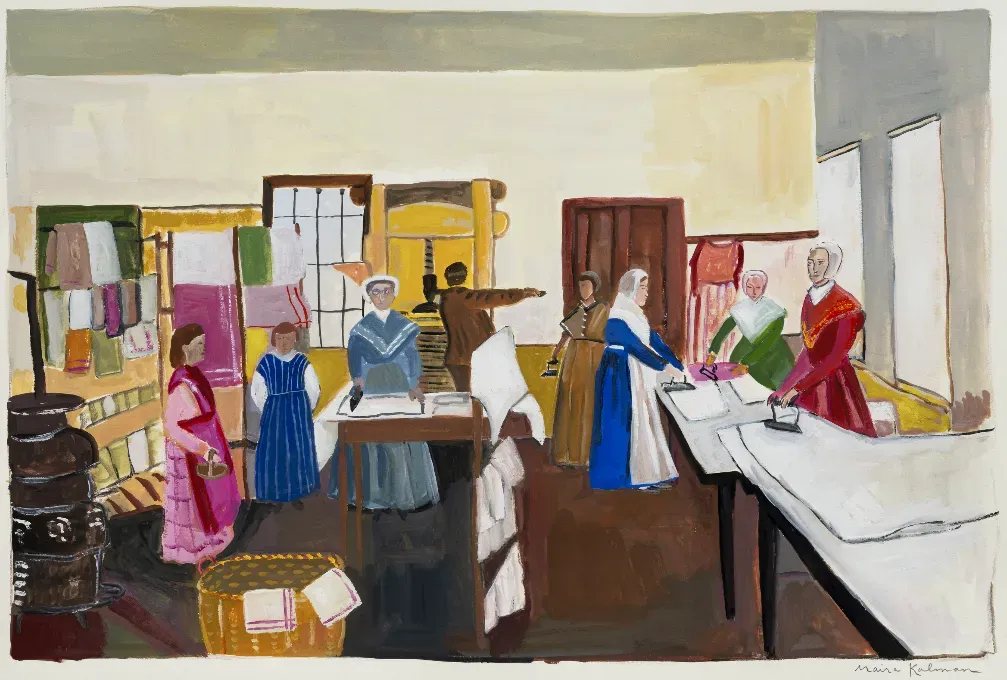
"The Laundry Room," a painting by Maira Kalman from the exhibition “Shaker Outpost: Design, Commerce, and Culture" at the Shaker Museum's pop-up space in Chatham. Credit: © Maira Kalman; Courtesy of the artist and Mary Ryan Gallery, New York

Kalman’s installation resonates strongly with that history. It builds on a key element of her earlier survey “Various Illuminations (of a Crazy World),” organized by The Jewish Museum and traveling to multiple venues, where she created a kind of “general store”—filling the gallery with chairs, ladders, and tables of accumulated objects. At times, she inhabited the space herself, signing books, discussing James Joyce, even offering visitors onion rings. That same spirit animates the Chatham installation, where display and lived experience merge.

Kalman describes her encounter with Shaker design in terms that feel both personal and precise: “After seeing their work, you want to run home and throw out everything you have,” she says. “You want to edit your life. You only want what is essential.” Her selection of clothing—hats, shoes, socks, gloves—reflects that ethos. “They have wit and wisdom,” she notes. “Clarity and kindness. They are practical and they sing.”

The Long Table with Fruit and Flowers, Maira Kalman. © Maira Kalman; Courtesy of the artist and Mary Ryan Gallery, New York

The exhibition also includes new paintings based on archival photographs: figures at work, domestic interiors, moments of quiet labor—a woman with a dog, a man holding tools, a table set for dinner. These scenes of home and hearth extend the conversation between past and present, grounding Kalman’s sensibility in the rhythms of Shaker life.

Importantly, Kalman’s “general store” will remain in the space as future exhibitions rotate, creating an evolving dialogue with subsequent artists, including Hudson-based ceramicist Paula Greif. The project thus becomes less a single exhibition than an ongoing framework for thinking about objects, use, and meaning.

For the Hudson Valley, this arrives at a moment of renewed attention to Shaker culture. The Testament of Ann Lee was recently released to great acclaim, while “A World in the Making: The Shakers,” has begun its American tour at the Institute of Contemporary Art Philadelphia through August 9. Within this broader resurgence, Kalman’s project stands out for its intimacy and clarity—less a historical survey than a lived, felt encounter with what the Shakers made, and what they continue to offer us.

Share this post

Written by

Slow Food Hudson Valley Celebrates Spring Foraging at Liberty  in Ghent Farms Benefit
Guests gather around a long communal table at a past Slow Food Hudson Valley event, where seasonal ingredients and local craftsmanship set the tone—an approach that returns at “Wild Hudson Valley” on April 26 with a menu built around the region’s fleeting spring forage. Credit: Ralph Gartner

Slow Food Hudson Valley Celebrates Spring Foraging at Liberty in Ghent Farms Benefit

Slow Food Hudson Valley Celebrates Spring Foraging at Liberty  in Ghent Farms Benefit
Guests gather around a long communal table at a past Slow Food Hudson Valley event, where seasonal ingredients and local craftsmanship set the tone—an approach that returns at “Wild Hudson Valley” on April 26 with a menu built around the region’s fleeting spring forage. Credit: Ralph Gartner

Slow Food Hudson Valley Celebrates Spring Foraging at Liberty in Ghent Farms Benefit