Val Kilmer's Life, Career and Lasting Screen Legacy
Val Kilmer was an American actor known for playing Iceman in Top Gun, Jim Morrison in The Doors, Doc Holliday in Tombstone, and Bruce Wayne in Batman Forever. A Juilliard-trained performer with sharp comic timing and intense dramatic range, he built a career that crossed blockbusters, westerns, crime films, theater, music, and visual art.
Kilmer died of pneumonia on April 1, 2025, at age 65, following years of health challenges related to throat cancer. His films collectively earned more than $3.85 billion worldwide, but his legacy is larger than box office: he was a bold, often surprising actor who brought unusual commitment to every role.
From his early stage work to his moving final appearance alongside Tom Cruise in Top Gun: Maverick, Kilmer's story includes major Hollywood success, creative risk-taking, personal loss, a changed voice, and a determined return to the screen.
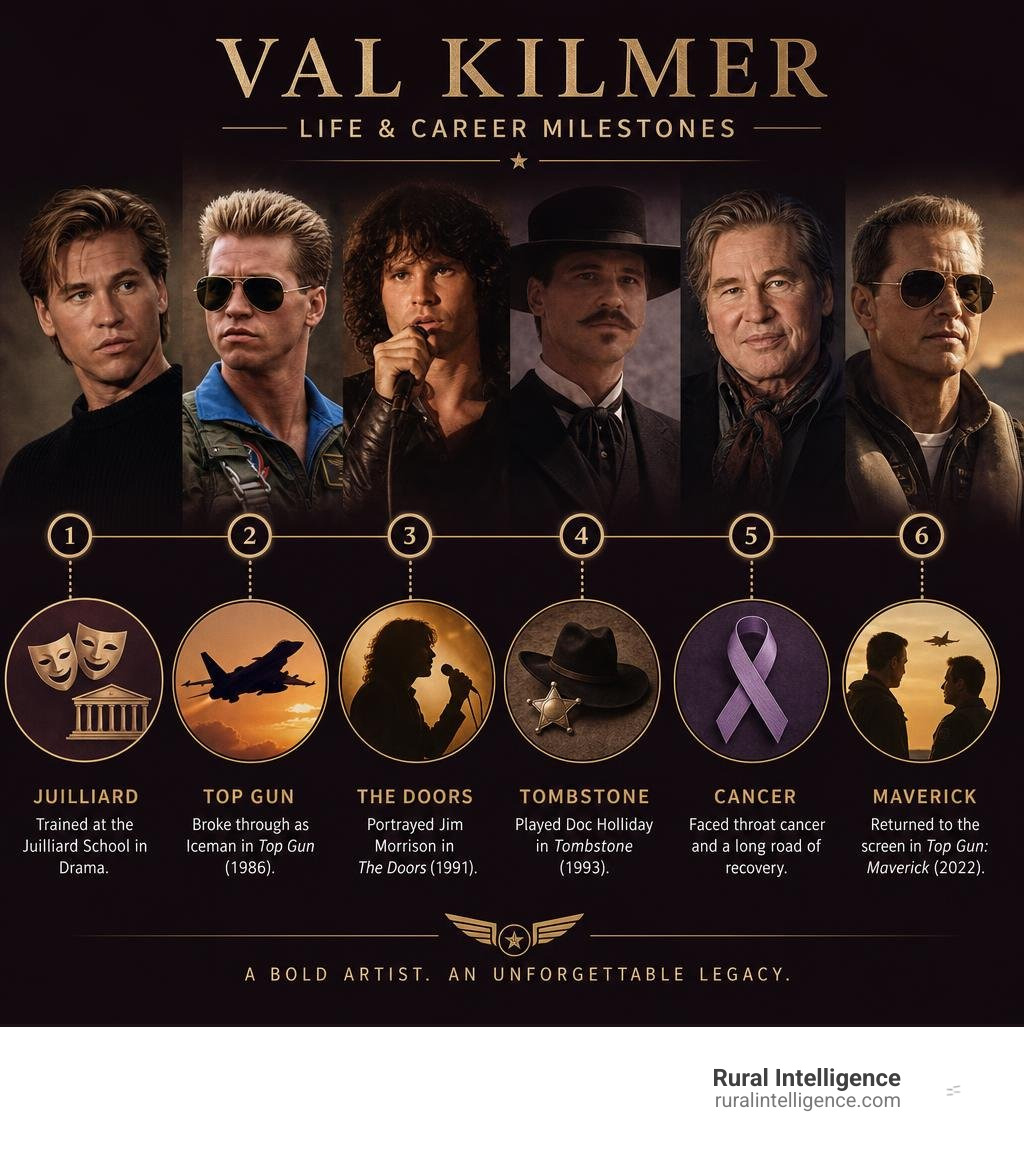
Handy val kilmer terms:
Early Life, Juilliard Training, and the Making of Val Kilmer
Val Edward Kilmer was born on December 31, 1959, in Los Angeles, California. He grew up in the San Fernando Valley in a family shaped by creativity, religion, and loss. His parents divorced when he was young, and he was raised in the Christian Science faith, a belief system that later influenced how he spoke about illness, healing, and art.
Kilmer attended Chatsworth High School, where his classmates included future actors Kevin Spacey and Mare Winningham. Even then, he stood out as a serious student of performance. The joking, charming side that would later power his early comedies was already there, but so was a deep seriousness about craft.
At 17, Kilmer became, at the time, the youngest person accepted into the Juilliard School's Drama Division. That detail matters because Juilliard was not a celebrity finishing school; it was a demanding classical training ground. Kilmer studied voice, movement, Shakespeare, and stage discipline. He was part of Drama Division Group 10, a cohort that helped sharpen his competitive instincts and theatrical technique.
For readers who want a concise factual timeline, the Val Kilmer biographical background is a useful starting point, though Kilmer's life is best understood as more than a list of credits.
A defining tragedy came in 1977 when his younger brother Wesley died at age 15 after an epileptic seizure in a swimming pool. Kilmer later drew on that grief in his work, especially in emotionally bruised performances such as The Salton Sea. His best roles often carried a sense of private sorrow beneath the charisma.
While at Juilliard, Kilmer also began writing. He co-wrote the play How It All Began, which was produced by Joseph Papp at the Public Theater. In 1983, he made his Broadway debut in The Slab Boys alongside Sean Penn and Kevin Bacon. Before movie stardom arrived, Kilmer was already a working stage actor with serious credentials.
Breakthrough Comedies and Hollywood Entry
Kilmer's first major screen splash came with Top Secret! in 1984, a spy-film parody from the creators of Airplane!. He played Nick Rivers, an American rock-and-roll singer who gets tangled in Cold War absurdity. The part required deadpan comedy, singing, dancing, and a willingness to look ridiculous while somehow still looking like a movie star. Not a bad skill set.
Kilmer sang his own songs in the film and even released music under the fictional Nick Rivers name. That early musical confidence would later become crucial when he played Jim Morrison.
In 1985, he starred in Real Genius, another comedy, this time as Chris Knight, a brilliant, mischievous science student. The role showed Kilmer's gift for relaxed comic intelligence. He could play the smartest guy in the room without making the audience hate him, which is harder than it sounds.
He also made selective choices early. Kilmer turned down a role in Francis Ford Coppola's The Outsiders because of theater commitments, a decision that says a lot about his priorities at the time. He was not simply chasing visibility; he was trying to build a career on performance.
Then came director Tony Scott and Top Gun. Kilmer initially had little interest in the film, but the role of Tom "Iceman" Kazansky expanded and became one of the great rival performances of 1980s cinema. With one cool stare and a bite at the air, Kilmer entered pop-culture immortality.
Iconic Roles, Hollywood Stardom, and Box Office Triumphs

Kilmer's career-defining roles stretched across genres. He was not just a blockbuster actor, not just a character actor, and not just a stage-trained prestige performer. He was all of those things, sometimes in the same year.
| Film | Year | Role | Why it mattered | Box office note |
|---|---|---|---|---|
| Top Gun | 1986 | Tom "Iceman" Kazansky | Made him a global star and a defining 1980s screen rival | More than $344 million worldwide |
| The Doors | 1991 | Jim Morrison | Proved his dramatic and musical transformation skills | Major critical career milestone |
| Tombstone | 1993 | Doc Holliday | Became one of his most quoted and beloved performances | Cult western classic |
| Batman Forever | 1995 | Bruce Wayne/Batman | Put him at the center of a major superhero franchise | Major summer blockbuster |
| Heat | 1995 | Chris Shiherlis | Paired him with Michael Mann, Robert De Niro, and Al Pacino | Crime-film landmark |
| The Saint | 1997 | Simon Templar | Showed his studio-leading-man status | $169.4 million worldwide; $6 million salary |
| Top Gun: Maverick | 2022 | Adm. Tom "Iceman" Kazansky | Emotional final film appearance | Nearly $1.5 billion worldwide |
In Top Gun, Kilmer's Iceman was not a villain, exactly. He was the disciplined counterweight to Tom Cruise's impulsive Maverick. The movie became the top-grossing film of 1986, earning more than $344 million worldwide over its lifetime, and Iceman became shorthand for controlled confidence.
His turn as Jim Morrison in Oliver Stone's The Doors was a different kind of breakthrough. Kilmer reportedly memorized the Doors' catalog, studied Morrison's mannerisms, wore similar clothes, and immersed himself in the singer's world. He performed his own vocals, and members of the Doors were said to have found his singing uncannily close to Morrison's.
Then came Tombstone. As Doc Holliday, Kilmer stole scenes with elegance, illness, menace, and wit. He practiced Chopin's Nocturne in E minor for months for a piano scene despite not being a pianist. The result was a performance so lived-in that "I'm your huckleberry" became a permanent part of movie-quote culture.
In Batman Forever, Kilmer stepped into one of the most visible roles in Hollywood. Batman co-creator Bob Kane praised his interpretation, and Kilmer brought a brooding quality to Bruce Wayne. Yet the role also frustrated him. He later suggested that the heavy suit limited performance so much that he felt he mostly had to stand where he was told. Every actor wants a challenge; fewer want to be out-acted by rubber armor.
The same year, Heat gave him one of his finest ensemble roles. As Chris Shiherlis, Kilmer played a professional thief whose personal life was unraveling. Michael Mann's crime epic remains one of the most admired films of the 1990s, and Kilmer's work fits seamlessly beside Robert De Niro and Al Pacino.
By the late 1990s, Kilmer was earning major studio salaries, including a reported $6 million for The Saint, which grossed $169.4 million worldwide. Across his career, films featuring Kilmer grossed more than $3.85 billion worldwide.

The Method and Range of Val Kilmer on Screen
Kilmer had a reputation for intensity because he pursued roles with unusual commitment. He leaned toward immersive preparation, though he was not always easily categorized as a strict Method actor. What mattered was transformation.
For The Doors, he became Morrison vocally and physically. For Tombstone, he shaped Doc Holliday around frailty, intelligence, and deadly charm. For The Salton Sea, he drew on grief and emotional damage. In Spartan, directed by David Mamet, he stripped his style down into clipped, tactical minimalism. In Kiss Kiss Bang Bang, he showed late-career comic sharpness as "Gay Perry," playing opposite Robert Downey Jr. in a film that helped revive interest in both actors.
Critic Roger Ebert wrote in 1992 that if there were an award for the most unsung leading man of his generation, Kilmer deserved it. That judgment has aged well. Kilmer was famous, yes, but he was also oddly underrated because his range made him hard to brand. He could sing, brood, joke, fight, seduce, and disappear into a historical figure. Hollywood often prefers a simpler label.
Industry Reputation, Creative Passions, and Personal Life

Kilmer's public image was complicated. He was admired as a performer and sometimes feared as a collaborator. Some directors described him as difficult, while other co-stars defended him as dedicated, protective, and deeply professional.
Director Joel Schumacher, who worked with him on Batman Forever, later described him as challenging on set. John Frankenheimer, who directed The Island of Dr. Moreau, was openly critical of Kilmer's work habits and said he would not work with him again. The troubled production of that film became Hollywood legend, with Kilmer's reputation taking a lasting hit.
But the story was not one-sided. Kurt Russell, his Tombstone co-star, pushed back against the idea that Kilmer was simply difficult. Other performers, including Mira Sorvino and Hilarie Burton, spoke positively about him. Burton described Kilmer as protective during Bloodworth, where he helped change an unnecessary intimate scene into a barbecue meal scene that better served the characters and made the set more comfortable.
A balanced view is probably the fairest one: Kilmer could be demanding, sometimes combative, and not always diplomatic. He also cared deeply about the work and often elevated it. The BBC's obituary of Val Kilmer captured that tension well, presenting him as both brilliant and unpredictable.
His personal life also shaped his image. Kilmer married British actress Joanne Whalley in 1988 after they worked together on Willow. They had two children, Mercedes and Jack, before divorcing in 1996. Both children became part of his later creative life, especially in the documentary Val, where Jack helped narrate his father's words because Kilmer's own voice had been severely damaged.
Kilmer also had high-profile relationships with women including Cher, Cindy Crawford, and Daryl Hannah. But despite the celebrity aura, he often preferred distance from Hollywood. He owned a 6,000-acre ranch in New Mexico, a place that reflected his love of open space, solitude, and the American West.
Multidisciplinary Arts, Poetry, and Philanthropy
Kilmer was never only an actor. He wrote poetry, made visual art, pursued photography, created music, and developed stage projects.
In 1983, he self-published a poetry collection titled My Edens After Burns. The book later became a collector's item, with second-hand copies reportedly selling for $300 and up. Some of the poems were associated with his early romantic fascination with Michelle Pfeiffer, which gives the whole thing a very 1980s Hollywood-poet energy.
His long fascination with Mark Twain became the one-man stage show Citizen Twain, later filmed as Cinema Twain. Kilmer wrote and performed the piece, using Twain as a way to explore humor, morality, American identity, and spiritual searching. It connected his theatrical roots with his personal beliefs.
He also worked in visual art, including enamel painting on metal, photography, and later digital art projects. Through Kamp Kilmer, he explored creative community-building and Web3-related art. We follow many kinds of creative lives at Rural Intelligence, and Kilmer's restless movement between screen, stage, writing, and regional visual art and cultural exhibitions feels especially relevant to anyone interested in artists who refuse to stay in one lane.
Kilmer's philanthropic efforts included humanitarian work. In 1998, he traveled to Iraq with AmeriCares to help deliver aid. He also participated in relief efforts after Hurricane Katrina in New Orleans. His public life could be eccentric, but it was also marked by service and a sincere interest in healing.
For a more official overview of his creative work beyond film, his estate's Val Kilmer profile offers additional context.
Throat Cancer Battle, Final Film Appearances, and Passing
Kilmer's later years were defined by resilience after a devastating throat cancer diagnosis. Reports vary on whether symptoms began in 2014 or the diagnosis was confirmed in 2015, but the outcome is clear: treatment changed his life.
He underwent chemotherapy and two tracheotomies. The procedures helped save his life, but they severely damaged his voice. His once-rich speaking voice was reduced to a strained rasp, and he often used an electric voice box or other assistance to communicate.
For an actor known for vocal precision, this was a profound loss. Kilmer had built performances around sound: Morrison's singing, Doc Holliday's silky menace, Iceman's clipped confidence, Batman's controlled gravity. Losing his natural voice meant losing one of his central instruments.
The 2021 documentary Val, released by Amazon Studios, gave audiences an unusually intimate look at his life. Built from decades of personal video footage, the film showed Kilmer as actor, father, patient, artist, and archivist of his own experience. Because speaking was difficult, his son Jack narrated much of the documentary using Kilmer's written words.
Then came Top Gun: Maverick in 2022. Kilmer's return as Iceman opposite Tom Cruise became one of the film's emotional high points. The scene did not hide his illness; it incorporated it. Iceman, now an admiral, communicates partly through typed words before speaking briefly to Maverick. The moment worked because it was not just nostalgia. It was two actors, two characters, and decades of movie history meeting in one quiet room.
Top Gun: Maverick became a global phenomenon, earning nearly $1.5 billion in ticket sales worldwide. For Kilmer, it served as a graceful final film appearance. The Britannica profile of Val Kilmer identifies Top Gun: Maverick as his last film, and it is difficult to imagine a more fitting farewell.
Kilmer died on April 1, 2025, at Ronald Reagan UCLA Medical Center in Los Angeles. He was 65. His daughter Mercedes confirmed that the cause was pneumonia. His death prompted tributes from across the film industry, with colleagues and fans remembering his beauty, wit, intensity, and originality.
Many tributes focused on the contradictions that made him fascinating: he was a movie star who resisted simple stardom, a comic actor with tragic depth, a difficult collaborator to some and a generous one to others, a man whose voice was damaged but whose presence remained unmistakable.
How Val Kilmer Rebuilt His Voice with Artificial Intelligence
One of the most forward-looking chapters of Kilmer's life involved artificial intelligence and voice restoration. After his cancer treatments, he collaborated with the AI speech company Sonantic to recreate a version of his speaking voice using archived audio.
The company reportedly developed more than 40 vocal models to capture different aspects of his sound. This was not simply a novelty. For Kilmer, whose identity as a performer was deeply tied to voice, it offered a way to communicate with more of his old expressiveness.

It is important to clarify a common point: while Kilmer worked with Sonantic on AI voice modeling, Top Gun: Maverick reportedly used his actual recorded voice digitally altered for clarity, rather than an entirely AI-generated performance. Still, his broader AI collaboration became an important example of how technology can preserve or restore part of a performer's artistic identity.
After his death, questions about digital likeness and AI performance became even more relevant. Reports noted that his likeness and voice were generated for the film As Deep as the Grave with family approval, without Kilmer filming new scenes. That raises big ethical and artistic questions for the film industry: Who controls a performer's image? How should consent work after death? When does preservation become imitation?
Kilmer's case will likely remain a touchstone in those debates because his use of AI grew out of real medical need, not gimmickry. It was a tool for dignity, communication, and artistic continuity.
For another general reference point on his life and career, see this alternate Val Kilmer overview.
Frequently Asked Questions
What caused Val Kilmer's voice loss and how did he communicate?
Kilmer's voice loss was caused by treatment for throat cancer. He underwent chemotherapy and two tracheotomies, which damaged his vocal cords and left him with a severely weakened speaking voice.
After treatment, he communicated in several ways. He used an electric voice box, typed messages, written text, and help from family members. In public appearances, he sometimes spoke briefly but with difficulty. In the documentary Val, his son Jack narrated much of the film using Kilmer's own written words.
He later worked with Sonantic to build AI models of his voice from archival recordings. Those models helped recreate the tone and rhythm of his earlier speech, giving him a new way to express himself.
What were Val Kilmer's most critically acclaimed roles?
Kilmer's most acclaimed roles include:
- Doc Holliday in Tombstone: Often considered his most beloved performance, full of humor, danger, elegance, and sadness.
- Jim Morrison in The Doors: A major transformation that showed his singing ability and commitment to biographical detail.
- Tom "Iceman" Kazansky in Top Gun and Top Gun: Maverick: The role that made him globally famous and later gave him a moving final screen appearance.
- Chris Shiherlis in Heat: A precise, emotionally tense performance in one of the great crime films.
- Bruce Wayne/Batman in Batman Forever: A major pop-culture role, even if Kilmer himself felt restricted by the suit and the production.
We would also add Kiss Kiss Bang Bang, Spartan, The Salton Sea, and Real Genius for anyone trying to understand his full range.
When did Val Kilmer pass away and what was the cause?
Kilmer died on April 1, 2025, at Ronald Reagan UCLA Medical Center in Los Angeles. He was 65 years old. His daughter Mercedes confirmed that the cause was pneumonia.
His death followed years of health challenges after throat cancer and its treatment. While cancer had dramatically affected his voice and overall health, pneumonia was reported as the immediate cause of death.
Conclusion
Val Kilmer's career was never tidy, and that is part of why it remains so compelling. He began as a Juilliard prodigy, broke through as a comic leading man, became a blockbuster star, transformed himself into Jim Morrison, stole a western as Doc Holliday, wore the Batman cowl, and returned decades later for one of modern cinema's most moving franchise farewells.
He could be funny, difficult, generous, intense, strange, and brilliant. Sometimes he was all of those before lunch. But the through-line was commitment. Kilmer cared about performance as an art, not only as a profession.
His later life added another layer to his legacy. After cancer changed his voice, he kept creating through film, memoir, documentary, visual art, stage work, and AI-assisted speech. He became not just a symbol of 1980s and 1990s movie stardom, but also a figure in the evolving conversation about illness, identity, technology, and artistic survival.
For us at Rural Intelligence, his story resonates because it is ultimately about the many lives an artist can live: public and private, glamorous and painful, local and mythic, disciplined and wildly unpredictable. Val Kilmer's screen presence endures, but so does the larger lesson of his life: an artist's voice can change and still be heard.